AI literacy, technical awareness, strategic thinking, and strong business judgment are among the valued skills that employers seek. But the issue is a lack of such skills among the most eligible candidates for the role. This highlights the growing need to opt for exclusively designed courses for working professionals to stay relevant and competitive.
As per ISC2, 95% of organizations said they need at least one important cybersecurity skill, and 59% said their skills gaps are critical or significant.
So, we explore some of the key learning options available and how professionals can select the right learning platforms for themselves.
Why Most Online Courses Are Not Built for Working Professionals
Currently, most online courses are curated for broad audiences and thus consist of introductory content with little focus on hands-on experience. They also lack interactive sessions, as they are designed with long hours of basic theory. Thus, there is a lack of advanced and role-specific content along with proper guidance that is actually required for professionals seeking career growth and promotion.
Further, self-paced learning systems seem to fit well into one’s busy schedule. But in practice, during learning, it creates a lack of accountability. This ultimately results in lesser discipline and contributes to major dropouts from online courses.
Difference Between Learning for Curiosity and Learning for Career Growth
One main thing to understand while choosing to learn or skill up is that learning can be for two reasons: curiosity or career growth.
Learning for Curiosity: The will to gain knowledge for curiosity is driven by personal interest, enjoyment, or intellectual exploration. It does not require immediate ROI, and success is measured by enjoyment or personal enrichment. It can happen anytime, be slow, and not be regular.
Learning for Career Growth: Learning for career growth is aimed at increasing income, getting a specific job role, for job security or transitioning into another industry. It is goal-driven and follows a structured path. It is generally preferred to be self-paced, and consistency, time limit and hands-on experience are the key to witnessing results.
Understanding this difference is crucial to choose the course worth investing the time and money. The choice must be such that the upskilling courses for working professionals are tied to market demand and measurable outcomes. It should offer a visible proof of skill and must be valued by employers.
Why Course Volume Is Not the Same as Career Progress
Another key aspect to know when upskilling is that the multiples of even the best online courses are not enough in the career growth journey. Buying multiple courses and earning loads of certifications may feel productive, but they are not proof of real progress.
This is because information does not guarantee implementation or real-life practice. For instance, learning from coding tutorials and earning multiple certificates without practice does not make an individual capable of completing the task.
What the US Professional Learner Actually Needs in 2026
For working professionals spending most of their time and energy during their working hours, the need is for a course structured to directly serve the goal of getting the required ROI. It means the outcome of the course should be the capability to apply the skills and be aligned with industry demand for evolving roles and responsibilities.
Some of the in-demand skills that employees value in 2026 include:
- Data analysis
- Data engineering
- Cybersecurity
- Cloud native engineering
- AI and Machine Learning
- Communication
- Analytical thinking
- Digital marketing
- Project management
- Emotional intelligence
The Professional Cost of Not Upskilling in 2026
The world is proceeding fast. Reliance on AI to pace up the work with efficiency is increasing. Employers value speed and adaptability now. Thus, employer expectations are rising faster than many professionals realize. The professional cost of not upgrading skills includes job replacement due to automation. It also limits career growth in sectors requiring human-specific capabilities (as AI can carry out other tasks).
Additionally, inability due to skill gaps can lead to reduced earnings and hiring potential, missed growth opportunities, and may lead to becoming a victim of layoffs. Also, falling behind younger and digitally fluent professionals and reduced long-term career relevance in a rapidly changing job market are also seen.
How AI Is Changing Role Requirements Across Industries
AI is not completely taking up the jobs of humans. Rather, the expectations are new now. Employees are no longer required to possess traditional skills for the job. They are expected to adapt and be able to leverage AI for productivity. For instance, the AI has set the following new expectations across industries:
- Data interpretation and strategic decision-making skills: Using AI to analyze large amounts of data for customer segmentation
- Customer behavior understanding and personalization strategy skills: Setting up AI-driven recommendation engines to ensure content personalization
- Financial analysis and risk evaluation skills: Utilizing AI for assessing credit risks and market trends to help financial institutions make data-driven decisions
- Fraud investigation and critical thinking skills: Making AI detect and flag fraudulent transactions efficiently and quickly
- Scientific reasoning and research validation skills: Using AI for research to analyze chemical compounds and predict their effectiveness in treating diseases
Hence, employers expect professionals to:
- Use AI and technology to improve productivity and decision-making
- Learn continuously and adapt quickly to change
- Develop skills not possessed by AI, such as high-level judgment, experience-based work delivery, and empathy
- Contribute beyond and better than routine task execution
- Combine technical expertise with strategic thinking and communication skills
- Deliver measurable business impact
High-Value Courses for Working Professionals in 2026
Some of the best online courses for working professionals to choose in 2026 are as follows (most of them are relevant in almost every industry):
Data Analytics
This is one of the courses for working professionals that develops skills useful for predicting maintenance needs, scheduling repairs, scaling, project and risk management, and much more. This is because data is the basis for decision-making. Efficient analysis and quality communication make the data and its analysis worthy of consideration.
Skills to aim for in data analytics include:
- Statistical methods
- Excel and spreadsheets
- Data visualization tools
- SQL
- Data cleaning
Note: TechMaster Certificate Program in Data Analytics offers the above mentioned and multiple other skills.
Digital Marketing
This is another one of the versatile career growth courses that offers opportunities for professionals belonging to any industry. From healthcare and education to finance, retail and tech, organizations depend on digital channels to attract customers, build trust and drive revenue.
Thanks to digital modes of communication and AI, marketing has shifted from simple promotion to managing search, social media, content and paid campaigns. The challenge to solve in this field by upskilling is to develop strategies that can translate into the form of visibility, customer engagement and conversions.
Skills that can help navigate through this are:
- Search Engine Optimization (SEO) and Search Engine Marketing (SEM)
- Content Marketing
- Video Marketing
- Performance Marketing
- Social Media Marketing
- Email Marketing
Product Management
Highly relevant for product managers, new product management skills help overcome challenges such as a lack of product-market fit, high market competition and weak strategic alignment. One of the best online courses for working professionals in product management, it helps deal with operational and execution challenges like prioritizing the roadmap, overcoming slow development, and technical debt, among multiple other issues.
Skills that can be expected to actually offer results are:
- Developing a custom centric mindset
- Developing strategic vision
- Market research
- Adaptibility
- Emotional intelligence and conflict resolution are relevant for both new and old employees
Project Management
New skills in project management can upgrade professionals to overcome scope creep and plan and schedule properly to avoid missing deadlines. Strategic and financial challenges, like budget overruns and resource misalignment and operational hurdles, like poor productivity, flexibility and risk exposure, can also be dealt with effectively.
Skills that should be aimed for are:
- Methodologies and frameworks for project planning and scheduling
- Budget, cost and resource management for risks, uncertainties, and handling multiple projects
- AI and automation literacy
- Advanced stakeholder management through Emotional Intelligence
- Complex problem solving
Business Analysis and Data-Driven Decision Making
Learning this helps professionals with evidence-based decision-making. The high value is best served when professionals are dealing with unclear priorities, inefficient processes, difficulty explaining recommendations to leadership, or poor reporting. Similarly, if individuals are unable to find methods to improve operations or identify business problems, career growth courses in business analysis can help.
Skills that add value are:
- Predictive analytics
- Statistical programming
- Analytical skills
- Data programming and visualization
- Big Data
- Business process modeling
- Requirements analysis
- Requirements elicitation
AI and Machine Learning for Non-Technical Professionals
AI and ML upskilling courses for working professionals help employees improve productivity, decision-making and innovation without the requirement of coding expertise. They serve multiple departments of the company, including marketing, finance, HR and operations, for workflow automation, data analysis, report generation, and many more tasks.
Skills that are must have for professionals are:
- Prompt engineering and management
- No-code AI automation
- Workflow redesign thinking
- AI-powered data analysis
- Ethical AI governance
Cybersecurity Fundamentals
The high value of the cybersecurity course is evident by the 4.8 million unfilled roles in the domain. The rise in threats and attacks, the presence of numerous weak links, and the impact of financial and reputational damage are some of the major reasons that make employers hunt for capable and updated candidates.
Skills that will help step into the field are:
- Technical foundation
- Threat intelligence acumen
- AI and data literacy
- Communication and risk management
Cloud Computing and Technical Literacy for Modern Workplaces
Cloud computing fulfills the need for existing business infrastructure problems via a better alternative, i.e., the cloud. It is driven by AI integration and hybrid cloud adoption. Skilling up with these courses for working professionals is generally aimed at decreasing recovery time, ensuring business continuity, managing cost, and keeping pace with innovations in AI and Machine Learning integrated into cloud platforms.
Skills that hold relevance here are:
- Multi-cloud expertise
- Hybrid cloud infrastructure
- Infrastructure as Code (IaC)
- MLOps and AI-Powered operations
- Zero-trust architecture
- Serverless computing
- Containers and Kubernetes
How to Choose the Right Course for Your Career Stage
A major decision maker in choosing the right courses for working professionals is the career stage. While individuals aiming for a transition focus on building foundational knowledge and entering the job market, the requirements for mid-career professionals are promotion, salary growth, leadership readiness, or long-term career stability.
Hence, it’s important to not make a choice based on trends or popularity. Instead, the right method is to identify the specific career goal or the currently faced problem.
- Do you wish to be a part of a new project that requires a specific set of skills?
- Are you seeking to move into management or any other field?
- Is the goal job security or promotion?
- Do you want to switch to a different industry or field?
The choice of course will differ in each. But the decision will depend on whether the course offers industry relevance, practical application, and measurable outcomes. Also, if the teaching method and guide match the energy and learner style of the individual. Further, prefer the ones that offer networking opportunities and real-world projects.
What Separates a High-Value Course From a Low-Value One
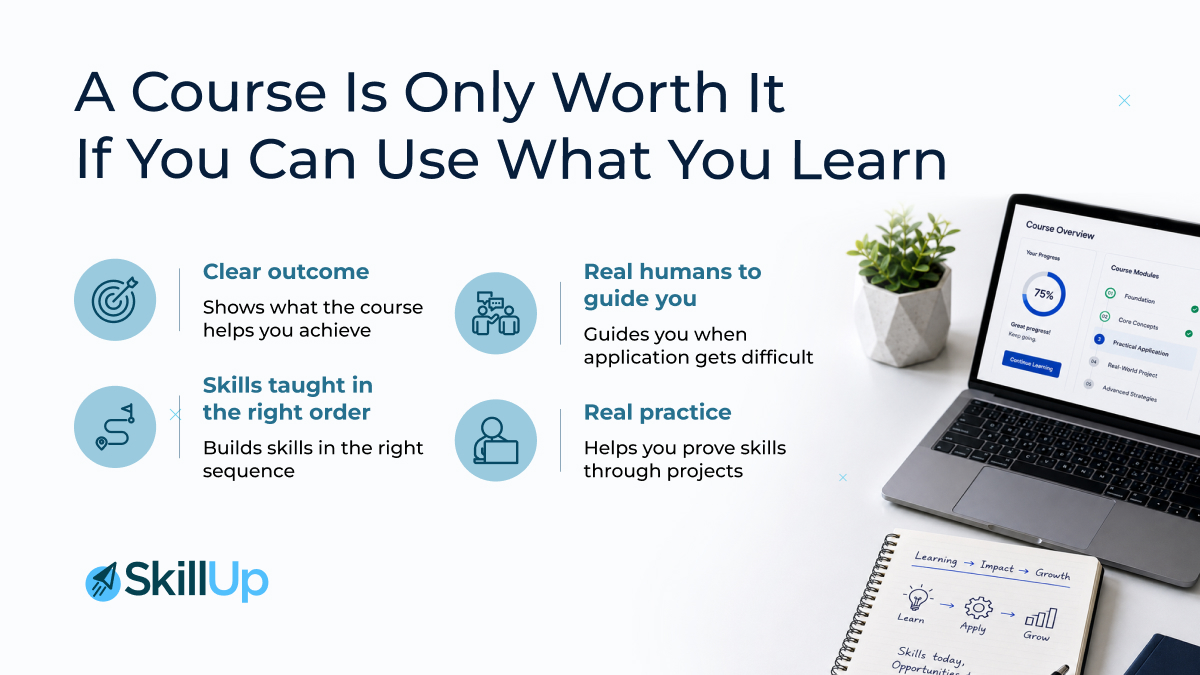
A high-value course will be the one that delivers the results you need. It will be the one that is not just added to your resume, but shows up in your capabilities and personality.
Career Outcome Clarity: The First Filter to Apply
A high-value course will clearly state what it can help achieve, such as promotion readiness, salary growth, leadership development, or role transition. A low-value course will make vague promises without connecting learning to real career outcomes.
Structured Curriculum vs. a Library of Disconnected Modules
Strong programs follow a step-by-step path where each topic gradually proceeds into a deeper, more detailed or advanced version. The overall content brings clarity on what you are learning, and why and how it can help. Low-level platforms will offer large content libraries that feel useful but lack direction and practical progression.
The Role of Mentorship and Human Support in Professional Learning
Programs offering support from mentors, coaches, or expert guidance are another one of the important differentiating factors. They offer proper solutions to the diverse and real-life problems that only human experience and intelligence can answer. They also develop confidence in applying new skills and improve accountability among learners. Low-value programs often lack these.
Trial Access, Refund Policies, and Reducing Enrollment Risk
Reputable and trustworthy providers often offer trial lessons, transparent pricing, and refund windows to help learners assess fit. This reduces the risk of committing your mind, time, and money to the wrong program.
Industry Relevance and Updated Content
High-value courses for working professionals stay aligned with changing market needs, AI trends, and evolving employer expectations. They continuously update tools, case studies, and frameworks to reflect changing needs. Low-value courses will offer generic or old content that does not add real value.
Transparent ROI vs. Hype Marketing
High-value program providers are realistic about outcomes and clear about who the course is for. They avoid exaggerating claims and urgency-based marketing.
Connecting Course Completion to Real Career Movement
Once the course is completed, the question arises of how to use the learnings. Here is how you can incorporate and showcase the newly added skills to your employers:
Applying New Skills Within Your Current Role Immediately
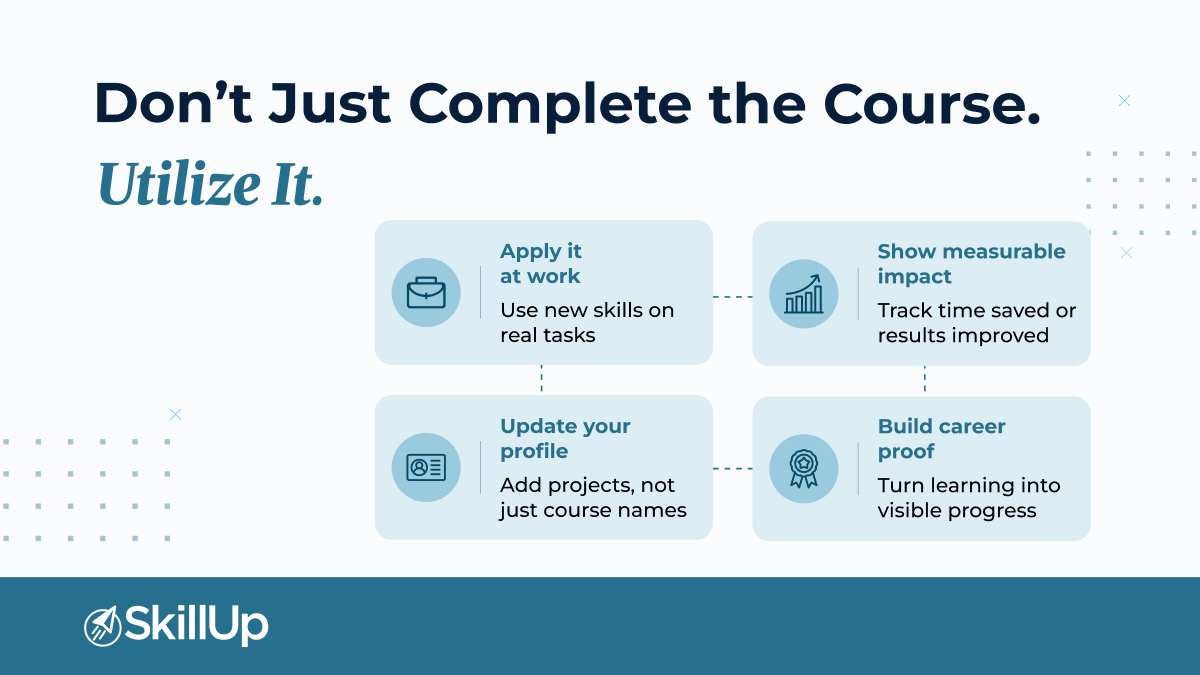
Since you will opt for the new skill as per the gap, you know exactly where the new learnings can be used to show your capabilities. Still, an example is if you complete a course on AI tools or data analytics, you can start using the skills to automate weekly reporting, improve client insights, or reduce manual work in dashboards.
Similarly, a marketing professional might apply new skills by improving campaign targeting using AI-driven insights, while a project manager could use new frameworks to streamline delivery timelines. Small improvements like clear presentations, better forecasting, and faster reporting help demonstrate immediate value to managers and leadership.
Signaling Upskilling Credibly to Employers and Recruiters
Your resume must not be a mere list of earned certificates. Rather, it should demonstrate the impact you created. For example, a financial professional can go with the following approach: Instead of mentioning ‘completed specific AI course’, mention ‘used AI tools to reduce monthly reporting time by 30%’. Similarly, an HR professional might show how they improved hiring turnaround time using new sourcing or analytics techniques.
Also, add project-based achievements to your resume and LinkedIn. Remember that the goal is to position yourself as someone who improves systems and outcomes.
Realistic Timelines for Promotion and Role Transition
Do note that upskilling will follow organizational timelines and not personal expectations. Promotions and role transitions generally depend on performance review cycles, available roles, and demonstrated impact over time. For instance, a team lead who learns advanced project management skills may need to consistently apply them over 6 to 12 months before being considered for a senior management role. Internal recognition is often built gradually.
However, transition to a new industry, company or role may offer results at a different pace. Still, it will depend on job availability, networking, and other factors.

SkillUp Online