There is a feeling a lot of writers know right now. You sit down to write something, the cursor blinks, and instead of writer’s block, you get something worse: the why bother. Why agonize over one subject line when a $20 tool can generate 50 versions in three seconds?
That feeling is real. But the conclusion most people draw from it is wrong.
The argument in this episode is not that writing is dying. It is that writing is becoming the most important technical skill in the economy, and most people have not noticed it yet.
AI does not remove writers. It removes average writing.
Large language models are probabilistic. They predict the next most likely word in a sequence based on the entire dataset of the internet. Which means, by design, they default to the average. The generic. The safe.
If your writing is average, you are competing with a machine that can produce average instantly and for free. That is a fight you will lose.
But if you bring specific insight, a distinct voice, and the ability to articulate exactly what you want, the machine becomes something else entirely. Not a replacement. An exoskeleton. You provide the strategy, the psychology, and the empathy. The AI provides the scale.
The shift from writing to instruction
The practical leap is what our first episode of SkillUp Podcast covers. It is the move from creative writing to structured instruction. It sounds like a small shift. It is not.
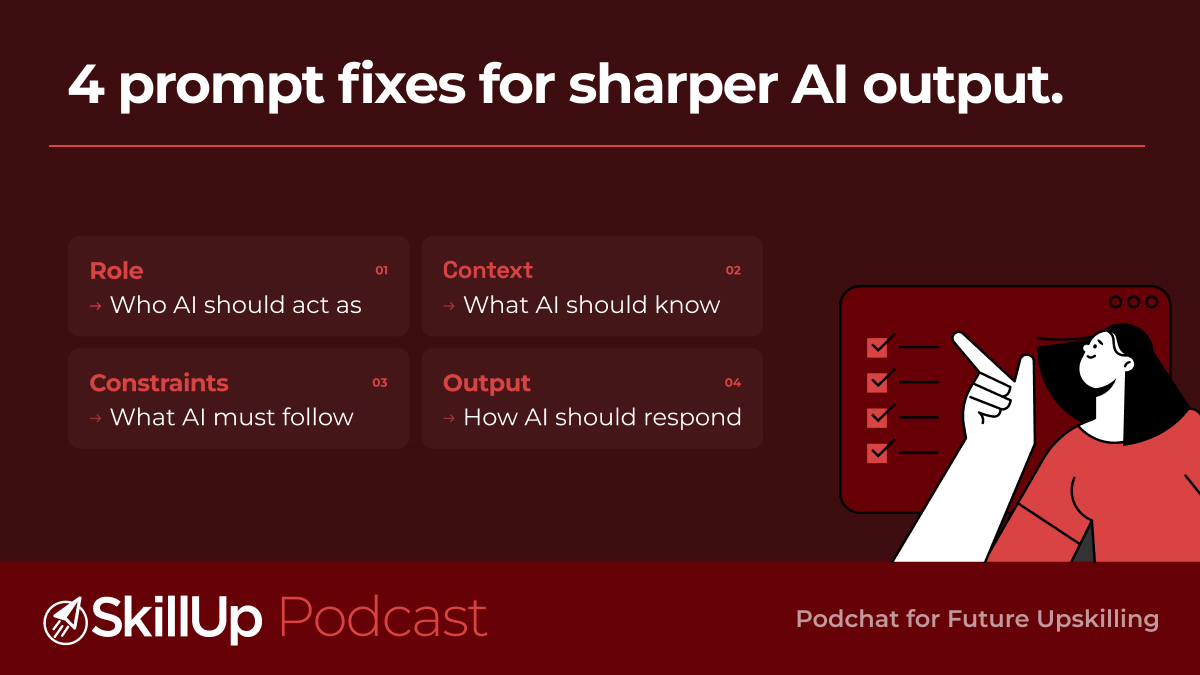
Writing for a machine means giving it a role, context, constraints, and a specific output format. Each element narrows what the AI pulls from. A prompt that says “write an email” gets you the average of the internet. A prompt that says “act as a direct response copywriter selling a SaaS product to skeptical CTOs, using short punchy sentences, no jargon, and no more than 150 words” gets you something usable.
Constraints, specifically, are where the quality comes from. An unconstrained AI defaults to clichés. A tightly constrained AI is forced away from the average, which is exactly where you want it.
This is where it gets interesting. [The full episode takes it further.] – Use call out box
From prompts to systems
The bigger idea in this episode is what happens when you stop writing individual prompts and start chaining them together.
Think about a standard content workflow. You record something, then you manually write show notes, draft a tweet, put together a newsletter intro. Each step done by hand, one at a time, for hours.
An AI product thinker looks at that process and sees a system waiting to be built. Upload the transcript, extract the sharpest points, route them to separate prompts, get finished assets out the other end. You build the factory once. After that, you feed it raw material and it produces finished work.
That is the shift from writer to product thinker. You stop writing the tweet. You design the machine that writes the tweet.
And the thing worth noting: these systems are not just productivity tools. They are sellable products. A well-built, tightly constrained AI workflow that solves a specific problem for a specific audience is a digital product. The barriers to building software have collapsed. If you can articulate the business logic clearly in plain English, you can build the tool.
The part that keeps it human
There is an obvious counterargument: if everyone builds these systems, the internet fills with automated noise. A machine that turns one idea into 50 LinkedIn posts is not adding value, it is adding pollution.
The answer is that the system is a multiplier. Any number times zero is still zero. You have to bring genuine insight, real lived experience, and a distinct voice before automation adds anything. The machine amplifies what is already there. It cannot invent it.
Which is why the human element is not optional. You need the technical precision to direct the machine and the empathy and judgment to edit what it hands back. You are the translator between raw computing power and the person on the other end. That is not a diminished role. It is a more valuable one.
Listen to the full episode
This blog captures the spirit of the argument, but the conversation goes further, including a breakdown of the four-part prompt formula, examples of how content repurposing systems actually work in practice, and a closing thought on what it means that human writers are, right now, actively shaping what AI will be capable of next.

SkillUp Online