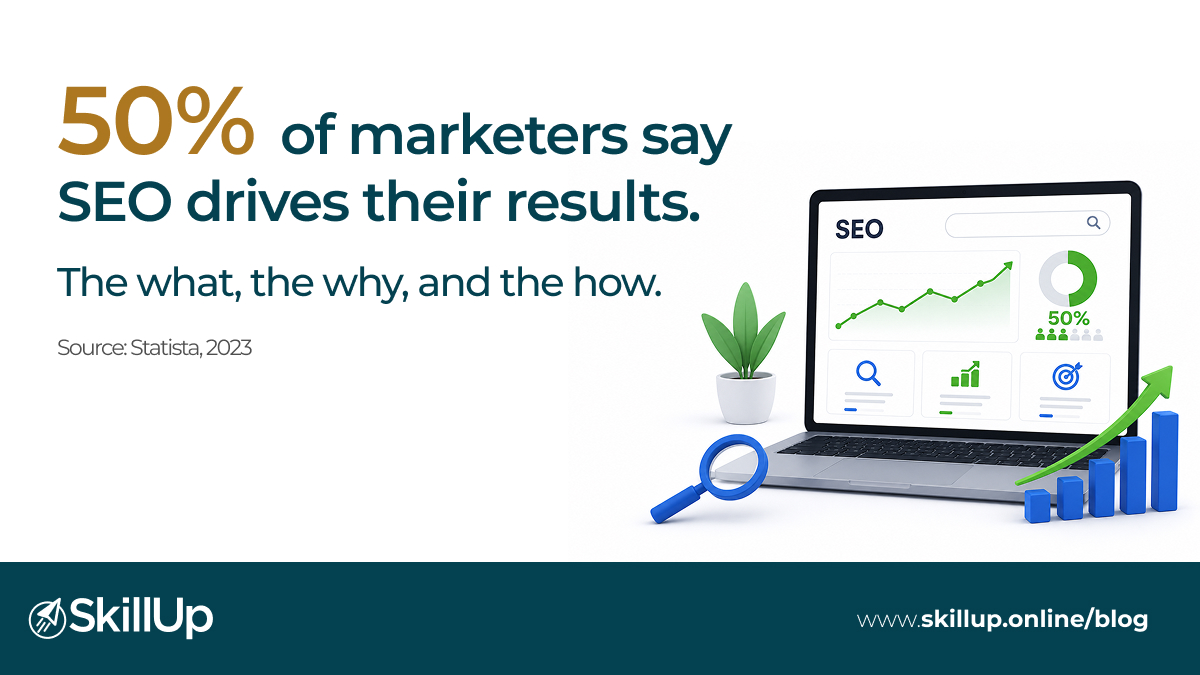
SEO marketing remains one of the most effective ways for businesses to attract customers online. According to a 2023 Statista survey, 50% of global marketing professionals identified SEO as a significant contributor to their company’s marketing goals.
Simply put, SEO marketing is the process of optimizing a website and its content to rank higher in search engine results without relying on paid advertisements.
As consumers have turned to search engines and AI-powered platforms, understanding SEO has become essential for businesses to improve visibility, build credibility, and generate consistent organic traffic. If you are considering a career in the field and looking to learn more about it in detail, this guide covers what SEO marketing is, why it matters, and how to start building the skill.
What Is SEO Marketing?
SEO or Search Engine Optimization marketing is the practice of improving a website so it ranks higher in unpaid search results. The aim is to earn visibility when people search for topics related to your business. It helps turn traffic into sales.
SEO works by aligning with how search engines actually operate:
- Crawling: Crawlers scan the web and follow links to discover new and updated pages.
- Indexing: Search engines store and organize that content so it can be retrieved later.
- Ranking: SEO decides which pages reach the top by running them through hundreds of ranking signals.
Now, SEO is separate from Search Engine Marketing (SEM). SEO earns its rankings organically over time, while SEM pays for ad placement.
Further, SEO is not limited to ranking on search engines. But it encompasses AI tools such as ChatGPT, Gemini, and Google’s AI Overviews, which also draw their answers from the web content. Hence, optimizing LLMs and AI-powered search is now also part of SEO. Optimizing these AI platforms, often called GEO, is even its own discipline. Learn more about these with the course on SEO, GEO & Organic Growth with AI.
Why Is SEO Marketing Important?
The importance of SEO marketing can be attributed to:
Organic visibility drives sustained, cost-effective traffic
A page that ranks on search engines keeps driving traffic continuously, even when the paid ads stop. SEO draws the audience by delivering visits as long as the page holds its position.
First-page rankings significantly influence purchase decisions
Search visibility is usually concentrated on the first page, as users rarely move to the second page. Hence, appearing in that result determines the business’s sales and influences the decision-making of the audience.
Strong SEO builds long-term brand authority
Consistently ranking for relevant topics indicates brand expertise and reliability in the field. This perception builds gradually across many searches and contributes to a level of trust and authority that is difficult to achieve through advertising alone.
Further, searches are also changing. AI-generated summaries, such as Google’s AI Overviews, answer many queries directly and draw from the sources they assess as most credible. This makes the quality, accuracy, and structure of content more important, as only well-built content is likely to be referenced.
Core Components of an SEO Strategy
A complete SEO strategy works across four connected areas. Each addresses a different part of how search engines find, understand, and rank a site, and a weakness in one limits the result of the others.
Technical SEO
It concerns the foundation that lets search engines access a site at all. It covers site speed, mobile-friendliness, and crawlability. Additionally, it includes secure connections and a clean site structure. Even strong content struggles to rank if technical issues stop search engines from crawling or understanding the pages.
On-page SEO
Here, the focus is on optimizing individual pages so their relevance is clear. This includes:
- Keyword placement in the title and opening content
- Logical heading structure
- Well-written meta descriptions that summarize the page and encourage clicks
Internal links and descriptive image alt text support both readers and search engines.
Content SEO
It deals with the quality and depth of the material itself. It ensures that pages must thoroughly answer the user’s question, offer original insight, and stay current to perform best. Content SEO also requires Experience, Expertise, Authoritativeness, and Trustworthiness signals to indicate the credibility of the source.
Off-page SEO
It helps businesses build authority from outside the site. The key factors here are backlinks, i.e., the links other websites point at your pages. They signify trust.
With off-page SEO, the quality and relevance matter more than the volume. A few links from authoritative and related sites carry more weight than many low-value ones.
SEO Marketing for Beginners: Where to Start
Starting SEO does not require mastering everything at once. You need to gradually follow the four steps mentioned below:
Understand how search engines work
Before optimizing anything, know what you are optimizing for. Google runs three processes: crawling, indexing, and ranking. Each stage is a point where your site can be found or missed.
Do basic keyword research
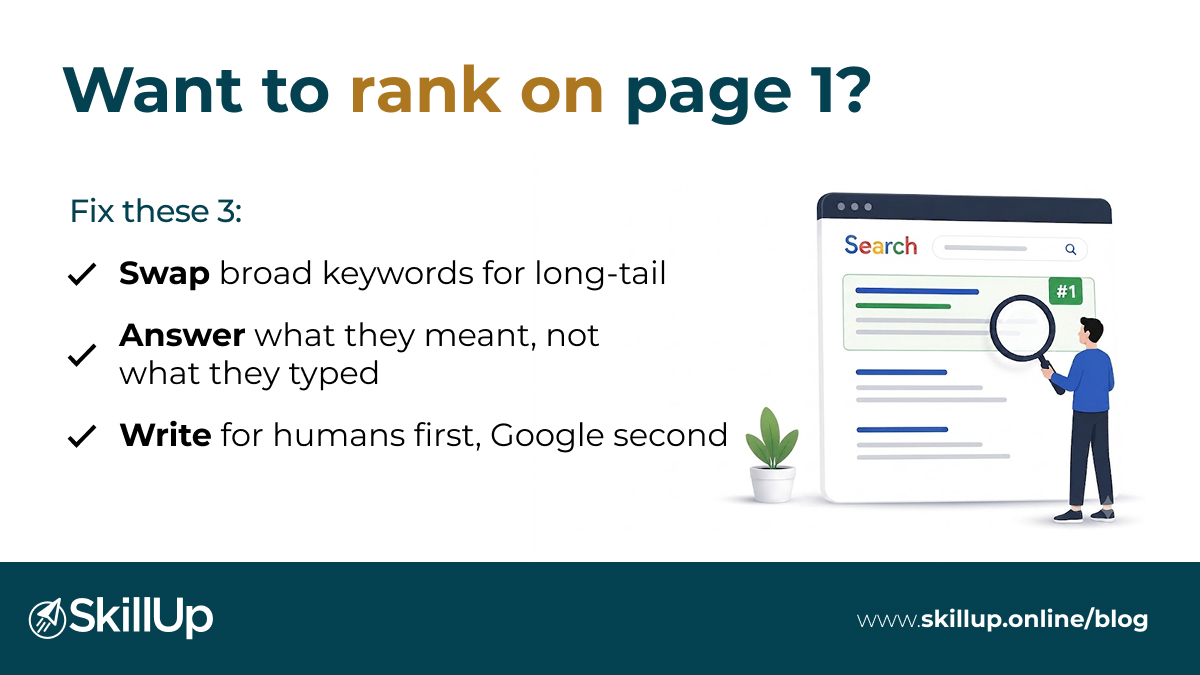
Keywords are the terms people type into a search. Start with long-tail keywords, which are the longer and more specific phrases. For instance, a keyword research guide for beginners rather than a broad term like ‘SEO’.
It helps lower the competition because it carries a clearer intent and gives a new site a realistic chance to rank. Free tools, along with Google’s autocomplete and ‘People also ask’ suggestions, are the right place to refer to.
Audit your existing site or content for quick wins
You are likely to have existing pages worth improving before creating new ones. Check which ones Google has already indexed. Once you identify them, refresh outdated content, sharpen weak titles and headings, and fix anything that is blocking pages from being crawled.
Take help from the Google Search Console, which shows which queries already bring traffic. Accordingly, modify the pages where a small edit could improve rankings.
Publish content that answers real user questions
This is a major influencer in helping to rank higher than any other single step. The goal here is to:
- Write content that genuinely helps the reader
- Anticipate the words they would search
- Answer the question behind the query instead of repeating the keyword
Useful, original, and well-organized content is the key to ranking.
SEO Skills Every Marketer Should Know
To plan, execute, and measure search performance efficiently, here are the key skills to gain hands-on experience in:
Keyword research and intent mapping
It is the base for every marketer to begin with. It means finding the terms an audience actually searches for, then finding the reason behind the search. For instance, understanding whether the user wants to learn, compare, or buy. Mapping keywords to intent keeps the content aimed at answering what people actually seek.
On-page optimization
Once the keyword and intent are clear, individual pages now need to indicate their relevance. This covers writing strong title tags, structuring content with clear headers, and crafting meta descriptions that summarize the page and earn clicks. If done properly, it helps both readers and search engines understand a page quickly.
Basic analytics
SEO without measurement is guesswork. Thus, marketers need to get comfortable with:
- Google Search Console, which shows how a site performs in search and which queries bring traffic
- Google Analytics 4, which reveals what visitors do once they arrive
Reading this data turns activity into informed decisions.
Competitor analysis
Competitors who already rank better are the best source to look for what works best in a niche. Studying their keyword targeting, content, and backlink profiles helps you understand where you are lagging.
The simplest starting point is searching for your target keywords and examining the domains that consistently appear at the top.
Content strategy fundamentals
This is where the other skills come in. A marketer needs to plan content around real audience needs, organize it by topic and search intent, and keep it current. Keyword research and on-page optimization only pay off when the content itself is worth reading.
AI tools are now part of the SEO skill stack, owing to their use for tasks like keyword discovery, content drafting, and competitor research. However, they support the marketer’s judgment and strategy rather than replacing it.
How to Get Started With SEO Marketing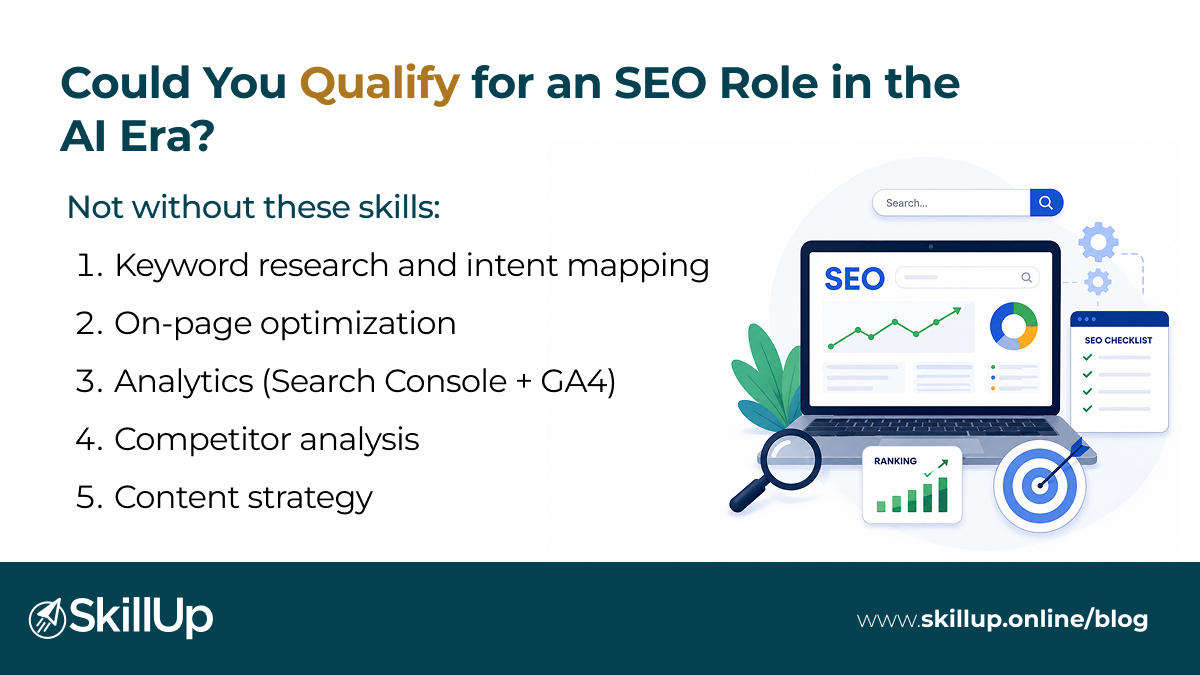
Understood the basics of SEO marketing, but still don’t have a clear plan to begin with? Here is how to start:
Learn the fundamentals through a structured course
Available options are generally haphazard. Beginners with no knowledge lack an organized learning plan, which leads them to leave the learning route halfway. A structured course covers the concepts in order, from how search engines work to keyword research, on-page optimization, and analytics. It helps build the complete foundation.
Apply them on a live site or project
SEO is learned by doing. Hence, use the fundamentals on a real website, whether your own blog, a side project, or a client site. Publishing pages, optimizing them, and watching how they perform teaches lessons no amount of theory can.
Track performance and iterate
SEO results build over time and rarely arrive on the first attempt. Use tools like Google Search Console, Semrush, or Ahrefs. Understand what is working and then adjust. Refining titles, content, and structure based on real data practically helps improve ranking and sharpen the skills.
A structured program suggestion that can bring these steps together is the Certificate Program in AI-Augmented Digital Marketing. It covers the fundamentals, offers applied practice, and the AI tools that are shaping the field, offering a guided path from learning to doing.
Conclusion
SEO marketing has evolved beyond keyword placement and technical fixes. It now brings together:
- Content strategy
- User intent
- Analytics
- Technical optimization
- AI-assisted workflows
All of these come together to help a business get found through search engines for what it offers.
Now, the professionals who understand both traditional SEO techniques and AI-powered optimization practices are likely to remain in demand. For aspiring marketers and career switchers, a practical path for entry into digital marketing is developing SEO skills.
Read More – How to Get Into Digital Marketing Career Without a Degree

SkillUp Online