AI in warehouse management is reshaping how businesses run supply chains, delivering faster, smarter, and more cost-effective operations. The shift is responsible for rapid growth, with the global market projected to reach $45.12 billion by 2030.
The reason is simple. Warehouses generate large volumes of data and run on repetitive, process-driven tasks, exactly where AI performs best. It improves accuracy, reduces operational costs, and handles rising order volumes more efficiently.
That growth makes this a strong field to build a career in. This guide breaks down how AI works in warehouse management, where it is applied today, and the roles open to professionals.
What Is AI in Warehouse Management?
AI in warehouse management refers to the integration of intelligent algorithms into supply chain systems. It forms the basis of warehouse automation, helping optimize and improve daily facility operations. It also helps businesses manage inventory, process orders faster, reduce errors, and make better decisions using the data.
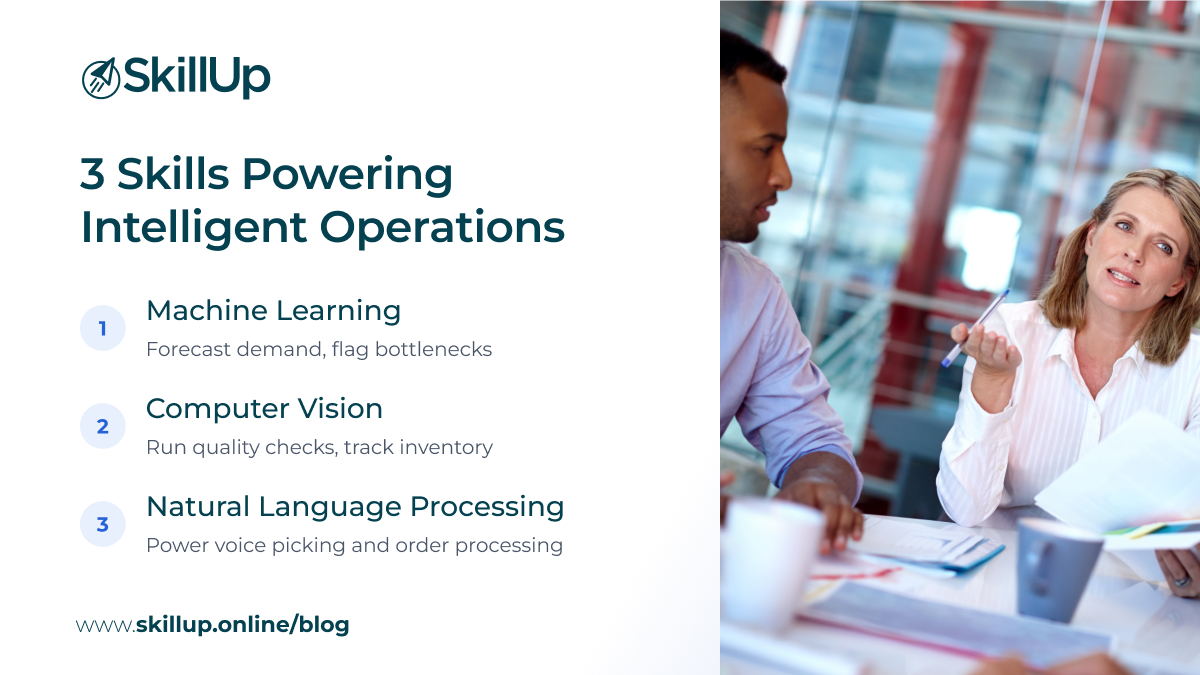
Three core AI technologies that power AI in warehouse management systems are:
Machine Learning (ML): Analyzes historical and real-time data for pattern identification. Used in demand forecasting, inventory planning, stock replenishment, and predict operational bottlenecks.
Computer Vision: Enables systems to interpret images and video feeds. Used to identify products, scan barcodes, monitor inventory, detect misplaced items, and improve quality control.
Natural Language Processing (NLP): Allows machines to understand and respond to human language. Used for voice-directed picking systems, virtual assistants, and order-processing tools to convert spoken or written instructions into actions.
How Is AI Used in Warehouse Management Today?
AI in warehouse management supports several core functions, such as:
Autonomous mobile robots (AMRs) for picking and moving
These are devices that can perform a variety of tasks without human intervention. They comprise advanced sensors, a digital layout of the installation and an AI software to be independently able to handle tasks. They combine advanced sensors, a digital map of the facility and AI software to handle tasks on their own. These AMRs are linked with the Warehouse Control System (WCS), which is further linked to the Warehouse Management System (WMS).
Computer vision for quality control and inventory checks
Computer vision allows the interpretation of visual data from cameras and sensors across the warehouse environment. It supports real-time stock monitoring and automated counting. Besides, the data can be used to detect misplaced items, damaged goods, and safety risks at a higher efficiency than manual inspection.
Predictive maintenance to prevent equipment downtime
Instead of reactive or fixed-schedule repairs to be done via detection through machine learning, AI-driven warehouse management allows predictive maintenance. Instead of reactive or fixed-schedule repairs, AI-driven warehouse management allows predictive maintenance. This is achieved via IoT sensor monitoring, anomaly detection, and prescriptive insights.
Demand forecasting for stock optimization
Stock optimization is also upgraded with AI, which works by analyzing historical sales, seasonal trends, weather, and market data. The results involve steps like data synthesis, demand sensing, and predictive scenario modeling.
Automated sorting systems
The role of AI in automated sorting can be attributed to the use of Computer Vision and 3D scanning, Machine Learning, adaptive gripping, and dynamic routing. Automated sorting applications involve high-volume parcel sortation, quality control and validate, and automated returns processing.
NLP-powered order processing
NLP allows warehouse order processing by data extraction from unstructured sources and translates them into actionable fulfillment tasks. Some of the other applications involve automated order parsing, conversational customer service, intelligent document extraction, and fuzzy matching/mapping.
Real-World Brand Reference
Amazon is the clear example of AI in warehouse management at scale, having deployed more than 1 million robots since 2012. Nine systems run the package journey:
- Sequoia used to store and retrieve inventory
- Hercules and Titan are drive units
- Vulcan is the first robot with a sense of touch
- Sparrow picks and moves individual items
- Robin and Cardinal are package-sorting arms
- Proteus is the first fully autonomous mover
How AI Improves Warehouse Efficiency
The application of AI in warehouse management converges on one outcome: a warehouse that handles more volume, at a higher speed, with fewer mistakes. Here are more insights into the benefits:
Higher throughput without proportional headcount increase
Robots handle movement and picking while software guides on optimized routes. For instance, Amazon’s DeepFleet AI reduces travel time for its robotic fleets by 10%. This allows processing more tasks compared to the manual performance and high headcount requirement.
Reduced error rates in picking and packing
Computer vision enables checking the right item against the right order before shipping. This reduces returns and rework for the business.
Faster order fulfillment cycles
AI ensures inventory reaches pickers faster and sorted parcels move straight to dispatch. The saved time helps pace up the completion of daily orders.
Safer working environments
AI flags hazards such as blocked aisles or unsafe lifting in real time. Also, robots absorb the heaviest and most repetitive tasks. The lower injury rates protect workers and reduce the costs that follow workplace incidents.
Career Opportunities in AI-Powered Warehousing
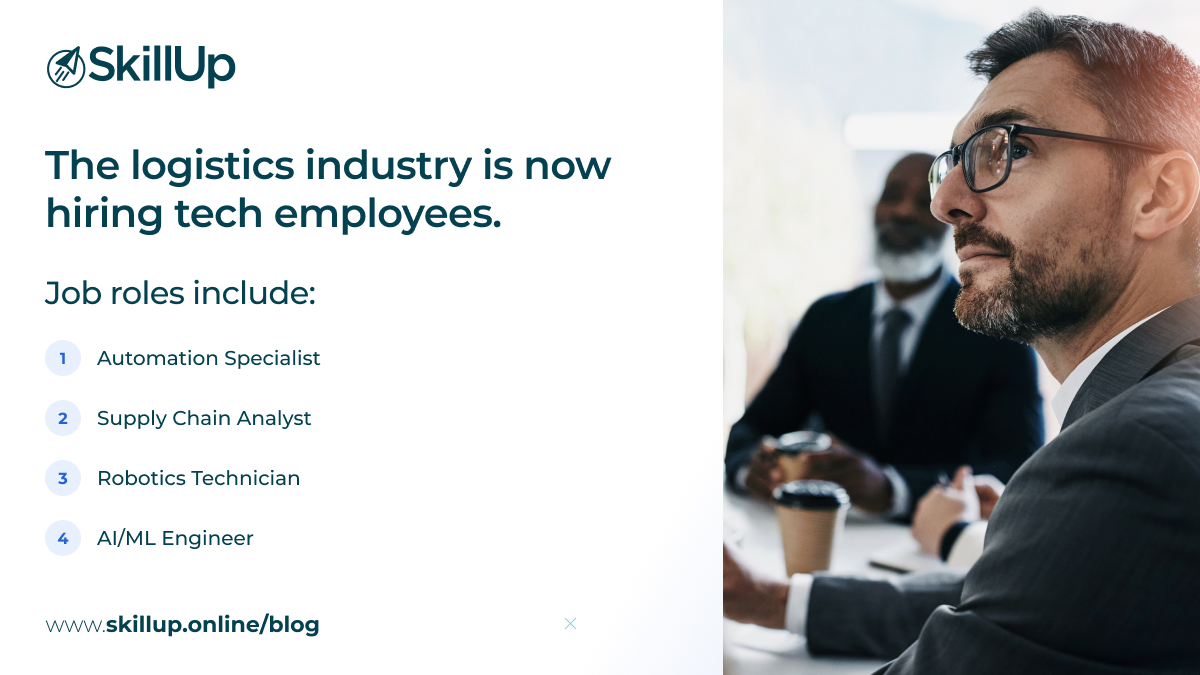
As AI in warehouse management matures, the roles emerging for both AI and warehouse operations are:
Warehouse Automation Specialist
This role deals with designing, implementation, and maintenance of the automated systems. Their work covers troubleshooting equipment, training staff, and finding process improvements. Generally, employers require a degree in engineering, computer science, or logistics.
Supply Chain Data Analyst
The analyst monitors data across sourcing, warehousing, deliveries, and scheduling, and uses it to cut costs and improve efficiency. Key skills include analytical thinking, clear communication, and experience with inventory tracking and volume forecasting tools.
Robotics Systems Technician
They are responsible for handling and ensuring the efficient operation of the machines. Hence, they install, program, test, and repair robotic systems. They also read machine data to flag faults early. Necessary skills for the role generally include troubleshooting, programming and electro-mechanical knowledge.
AI/ML Engineer (logistics-focused)
These engineers work on tasks like building the models to run the systems. For instance, working on demand forecasts, route optimization, and computer vision to guide warehouse robots. Domain knowledge about machine learning, computer vision, and IoT is crucial to work efficiently in this role.
Across the AI roles, the skills that pay off first are machine learning fundamentals, supply chain context, and knowledge about IoT.
Conclusion
AI in warehouse management is transforming warehouse operations from largely manual processes into data-driven and automated systems. They are now capable of handling higher volumes with greater speed and accuracy.
Now, as adoption continues to expand across inventory management, predictive maintenance, robotics, forecasting, and order processing, organizations are actively seeking professionals who can demonstrate the capability to get the task done. If you also hold similar career aspirations, begin by building expertise in Machine Learning, data analytics, automation, and logistics fundamentals. The TechMaster Certificate Program in AI & ML Engineering from SkillUp Online provides a pathway to develop these in-demand skills and to create valuable career opportunities.
Read More – How to Navigate Your Artificial Intelligence Career Path in 2026

SkillUp Online