If you are a working professional wondering where an artificial intelligence career fits into your next move, 2026 is the most consequential year to get that answer right. AI adoption among organizations has reached 88% (Stanford HAI, 2026 AI Index Report), and career opportunities in artificial intelligence are no longer limited to fresh graduates; they are increasingly going to professionals who combine domain expertise with targeted AI capability.
This guide breaks down the most practical AI career path options, what each role pays, and how you can transition into an artificial intelligence career from where you are today.
Why 2026 is a Defining Year for AI as a Career
The window between AI being a competitive advantage and AI being a baseline expectation is closing. Professionals who move now are set to enter a market where the supply of qualified talent still falls short of demand. Owing to this gap, immediate hiring and better compensation are in store for individuals making such a move.
The Scale of AI Job Growth
These numbers reflect demand already visible in active hiring pipelines:
- The US Bureau of Labor Statistics projects 34% growth for data scientist roles through 2034, generating roughly 23,400 new openings each year(BLS, Occupational Outlook Handbook, 2024–2034).
- For computer and information research scientists (the category that encompasses most AI engineering roles), the projection is 26% growth over the same period (BLS, 2024).
- AI engineer ranked as the fastest-growing job title on LinkedIn’s 2026 Jobs on the Rise list, based on hiring growth over the past three years.
Why Working Professionals are Best Placed to Capitalize
A financial analyst who understands credit risk brings more immediate value to a lending AI role than a computer science graduate who has never seen a loan file. Domain expertise built over years in healthcare, finance, operations, or strategy is what separates useful AI practitioners from technically capable ones. The 2026 AI market rewards people who can translate AI capability into real operational decisions, and that skill comes from experience.
The AI Industry: What’s Actually Out There
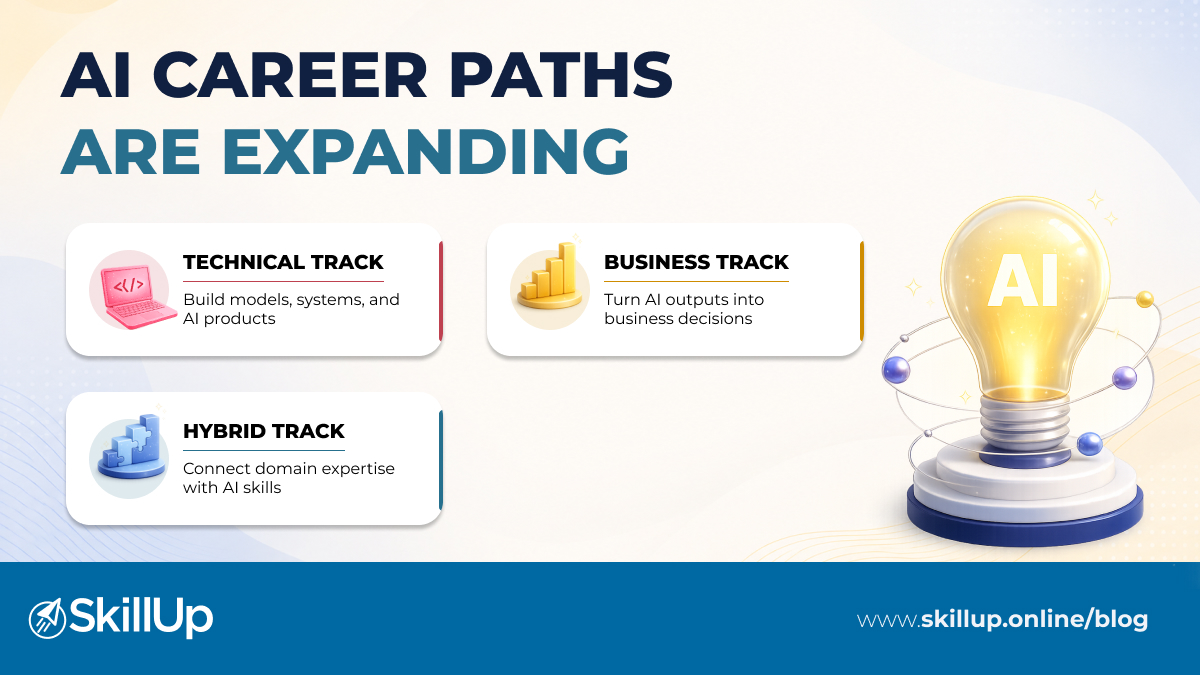
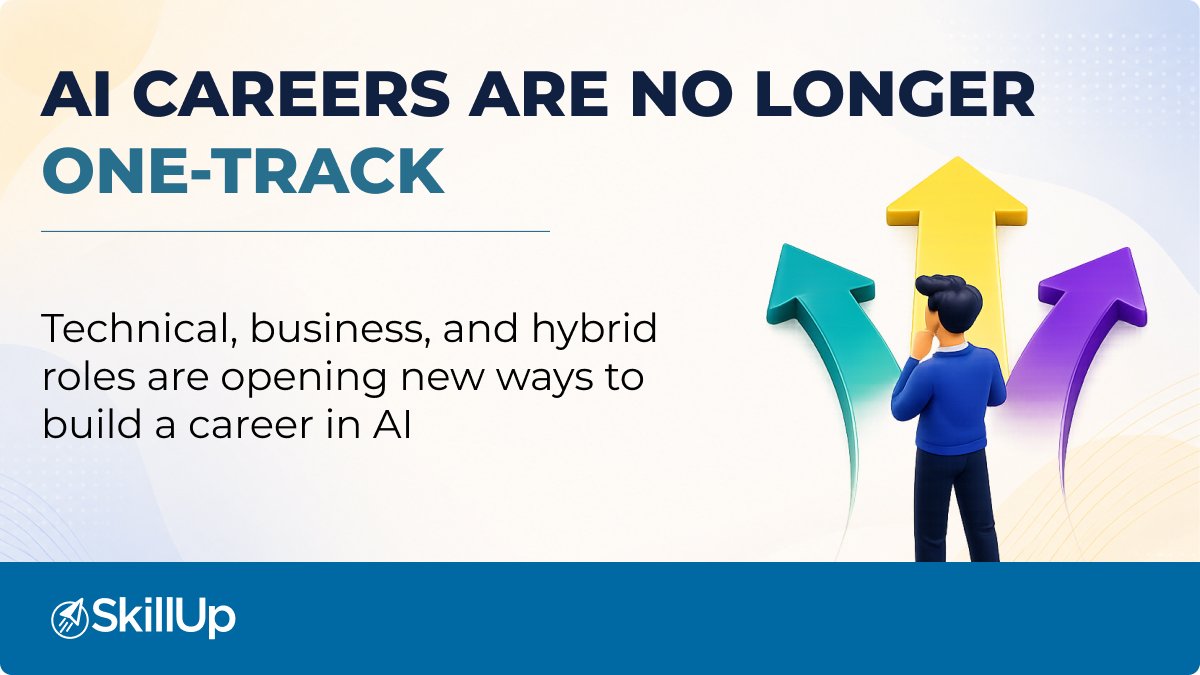
The AI industry in 2026 is far larger and more accessible than most professionals realize. Career opportunities span a much broader range of roles and entry points than the field’s research-heavy reputation suggests.
Technical AI Career Opportunities
Machine learning engineers, data scientists, NLP engineers, and computer vision engineers make up the core technical layer. Most do not require a PhD. They require either a relevant engineering background or targeted reskilling through a structured program with hands-on application.
Strategic and Business-Facing Roles in AI
AI product managers, BI analysts with AI expertise, and AI ethicists sit at the intersection of AI capability and organizational decision-making. These roles are growing because the bottleneck in most enterprises is not the technology, but the capacity to deploy it sensibly. Professionals with domain expertise in finance, operations, or strategy are well-positioned here with targeted upskilling.
Emerging AI Roles That Didn’t Exist Five Years Ago
AI has already created 1.3 million new roles globally, including forward-deployed engineers, AI safety specialists, and data annotators (World Economic Forum, citing LinkedIn data, 2026). RAG architecture specialists and AI evaluation engineers are hiring categories that simply did not exist in 2020.
Roles, Salaries, and What Each Path Requires
| Role | Career-Stage Fit | US Salary Range per year (2026) |
|---|---|---|
| Machine Learning Engineer | 3+ years of technical experience | $113,325 to $309,602 |
| Data Scientist | Quantitative background, any seniority | $78,899 to $211,206 |
| AI/ML Engineer | Software or DevOps background | $85,322 to $254,589 |
| NLP Engineer | Programming background required | $141k to $493k |
| Computer Vision Engineer | Engineering or applied math background | $92,591 to $263,669 |
| BI Analyst with AI Expertise | Existing BI or analyst background | $64,130 to $147,428 |
| Cybersecurity Analyst with AI | Security background | $55,000 to $192,000 |
Choosing the Right AI Career Path for Where You Are Now
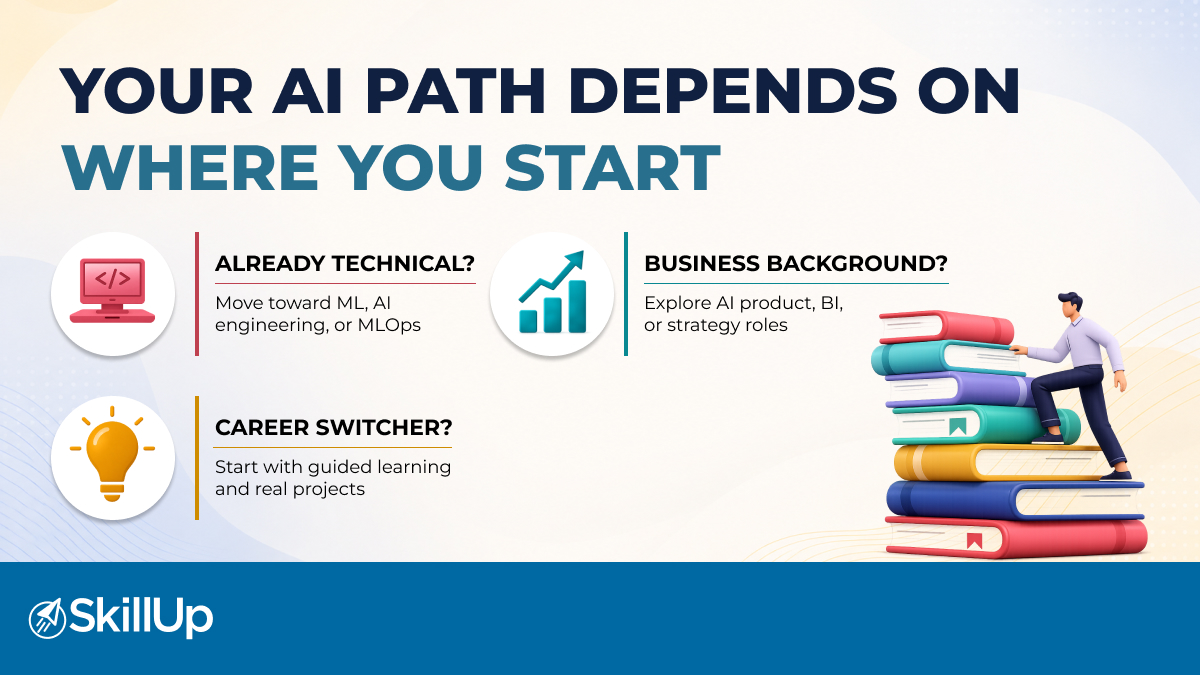
The best artificial intelligence career path is the one that builds directly on what you already know.
If You’re Already in a Technical Role
Software engineers and data analysts are closest to the transition point. The gap is tooling and specialization, not conceptual. Moving into ML engineering or AI engineering typically takes 6–12 months of focused effort alongside existing work, with hands-on project work carrying more weight in hiring than additional certifications alone.
If You’re in a Business or Strategy Role
The path runs through AI-adjacent roles first – BI with AI expertise, AI product management, or data-informed strategy. The goal is not to compete with ML engineers on technical grounds. It is to become a professional who bridges technical teams and business decisions effectively.
If You’re Considering a Full Career Switch
A full switch into a core technical AI role from a non-technical background requires realistic timeline expectations. Most professionals who succeed spend 12–24 months in structured, guided programs and not self-paced video libraries, before landing their first role in the field.
Skills That Separate Candidates in the AI Job Market
Having AI credentials is the basic requirement for an artificial intelligence career. What determines outcomes is the combination of technical depth and business relevance you bring.
Technical Skills in Demand Right Now
Python is the non-negotiable foundation across every technical AI role. Beyond that, the skills commanding salary premiums in 2026 are specific:
- RAG architecture design
- MLOps and production model deployment
- LLM fine-tuning
Engineers who can build and debug production RAG pipelines sit at the higher end of AI pay bands. Compensation data consistently shows AI engineering roles out-earning traditional data science roles.
Strategic and Cross-Functional Skills Employers Value
The 2026 Stanford AI Index identifies a significant gap between what AI can do technically and what organizations can deploy responsibly. That gap creates sustained demand for professionals who can:
- Communicate findings to non-technical stakeholders
- Navigate compliance requirements
- Connect model outputs to business decisions
These are the capabilities that come from professional experience, not from a course.
Skills to Build Based on Your Target Role
| Target Role | Core Skills |
|---|---|
| ML Engineering | Python, PyTorch/TensorFlow, model deployment, MLOps |
| Data Scientist | Python/R, SQL, statistical modeling, stakeholder communication |
| NLP Engineering | Transformers, Hugging Face, production RAG |
| AI-adjacent Business Roles | Data literacy, AI output evaluation, project coordination |
Building Your AI Career Without Starting Over
How to build your career in AI? Professionals who transition most effectively into AI are not the ones who abandoned what they knew. They are the ones who built on it without starting from scratch. Your existing experience is not a gap to apologize for – it is the foundation that the technical skills sit on.
Leveraging Your Existing Domain Experience
Your existing professional expertise is the differentiation that makes you more hire able. A professional with 8–10 years in a relevant domain who adds structured AI capability is a more complete hire than a junior engineer with no operational context.
Certifications and Programs Worth Pursuing
Programs that include mentored practice, hands-on labs, and real-world projects carry significantly more weight with hiring managers than self-paced video completion certificates. SkillUp Online’s TechMaster Certificate Program in AI & ML Engineering is a 6-month IBM-powered program that covers Python, ML, deep learning, generative AI, and MLOps with mentorship and dual certification built in, designed specifically for working professionals with existing technical experience.
Projects and Portfolio Work That Gets Noticed
A portfolio project that solves a recognizable real-world problem and documents the decisions made along the way carries more weight in a hiring conversation than a list of courses. It does not need to be technically spectacular, but it needs to show you can frame a problem, build toward a solution, and explain your reasoning.
Making the Transition – Timelines and Realistic Expectations
Many professionals exploring an AI career path either delay the move or underestimate the effort required. The ranges below reflect typical outcomes based on current hiring patterns.
Moving into AI-Adjacent Roles
Shifting into roles like data analyst, BI analyst using AI tools, or technical product manager usually takes 6–12 months with structured learning. You’ll need basic data literacy and working knowledge of Python or SQL. With consistent effort, this is achievable alongside a full-time job.
Moving into Core AI Roles
Transitioning into roles like ML engineer or NLP engineer typically takes an additional 12–18 months. Success here depends less on courses and more on building real projects, getting feedback, and improving them to production-level quality.
What Accelerates the Move
Three factors consistently separate faster transitions from slower ones:
- The presence of an experienced mentor who can close knowledge gaps directly
- Accountability structures that maintain learning momentum around a full-time job
- Access to real-world projects rather than synthetic exercises
Choosing a Program That Actually Moves Your Career Forward
There is no shortage of options for those pursuing an artificial intelligence career in 2026. The question is not whether a program covers the relevant topics, because most do. The question is whether it is structured to produce career-ready capability rather than just completed modules.
What to Look for Beyond the Curriculum
A good curriculum is necessary, but often insufficient. What actually determines outcomes is the program’s approach to applied learning. Does it include real projects on real datasets? Are there checkpoints where someone experienced reviews your work and tells you what is missing? Is the learning designed around where working professionals actually get stuck, motivation, application, and integration with existing knowledge, rather than just content delivery?
Mentorship, Structure, and Accountability
Self-directed AI learning fails most working professionals because content alone does not produce completion. Most learners stall before they build anything worth showing a hiring manager without:
- A mentor to close knowledge gaps
- A structured timeline to maintain momentum
- Peer accountability to sustain effort alongside a full-time job
The professionals who successfully transition into AI roles are consistently the ones whose learning environment was designed around those three elements.
Costs, Financing, and Measuring ROI
For a working professional paying out of pocket, which describes the majority of the US market, the financial question is not just “what does this cost?” but “what does this return?” The measure of ROI in career upskilling is role change, salary movement, or both. Programs that offer installment payment options reduce the financial risk of committing before outcomes are certain, and that reduced risk is worth factoring into the comparison. Look at what graduates of a program are actually doing 12 months after completion, not what the marketing materials promise.

SkillUp Online