Most working professionals who struggle with learning data analytics don’t do so because the subject is too complex. They are struggling because they are using an approach designed for someone else – a student, a career beginner, someone without existing career or time commitments. This guide identifies the specific issues that mid-career professionals face and lays out what a smarter path forward actually looks like.
Why Most Working Professionals Struggle With Learning Data Analytics
The problem is rarely effort – most professionals who stall in their learning data analytics journey are putting in genuine time. The issue is that the effort is pointed in the wrong direction from the start.
The Wrong Starting Point is the Real Problem
The default entry point for most online learning (pick a tool, complete a course, repeat) produces technical exposure without professional capability. Professionals who start with tools before understanding how data is actually used in their industry spend months building skills that do not translate directly to their work or the job market.
Why Your Work Experience is Actually an Advantage
Data analytics for professionals is not as difficult compared to what it is for a recent graduate. You already understand how decisions get made in your organization, what questions matter to stakeholders, and where bad data causes real problems. That context is an asset. The learning gap is narrower than it appears; what is missing is the technical layer, not professional judgment.
What Employers Expect From Data Analytics Professionals in 2026
According to an analysis of over 1,000 job postings, 69.3% of employers are looking for domain experts with specific applied skills (SQL, statistics, and data visualization) rather than generalist technical profiles (365 Data Science, Data Analyst Job Outlook 2026). Tableau is required in 28.1% of postings and Power BI in 24.7%. Microsoft Excel still appears in 41.3% of listings. Employers in 2026 want professionals who can work with data inside a business context, not engineers who learned analytics in isolation.
The Stakes Are Higher Than Most Professionals Realize
Upskilling and learning data analytics is no longer just about staying current with industry trends. It is also about remaining competitive for roles that are actively shifting beneath the professionals who hold them today.
How AI Is Reshaping Data-Dependent Roles
Machine learning mentions in data analyst job postings doubled to 14% in 2026 (365 Data Science, 2026). Routine SQL queries and basic dashboard creation are increasingly handled by AI-assisted tools. The roles that remain well-compensated are those requiring interpretation, business context, and stakeholder communication capabilities that require human judgment working alongside technical skill.
What Happens When Professionals Delay Upskilling
The average data analyst salary has risen to approximately $93,000 based on active job listings (Glassdoor). That growth is concentrated in professionals with applied, demonstrable skill. Professionals who delay the transition are not staying still; they are falling behind a market that is actively repricing analytical capability upward.
Why Mid-Career Professionals Face the Highest Risk
The 2026 data analyst job market shows the sharpest demand increase for candidates with 4-6 years of experience, a category that grew from 2% to 8% of job postings between 2025 and 2026 (365 Data Science, 2026). Mid-career professionals are the most sought-after and the most exposed if their skills do not keep pace with what those roles now require.
The Most Common Mistakes When Learning Data Analytics
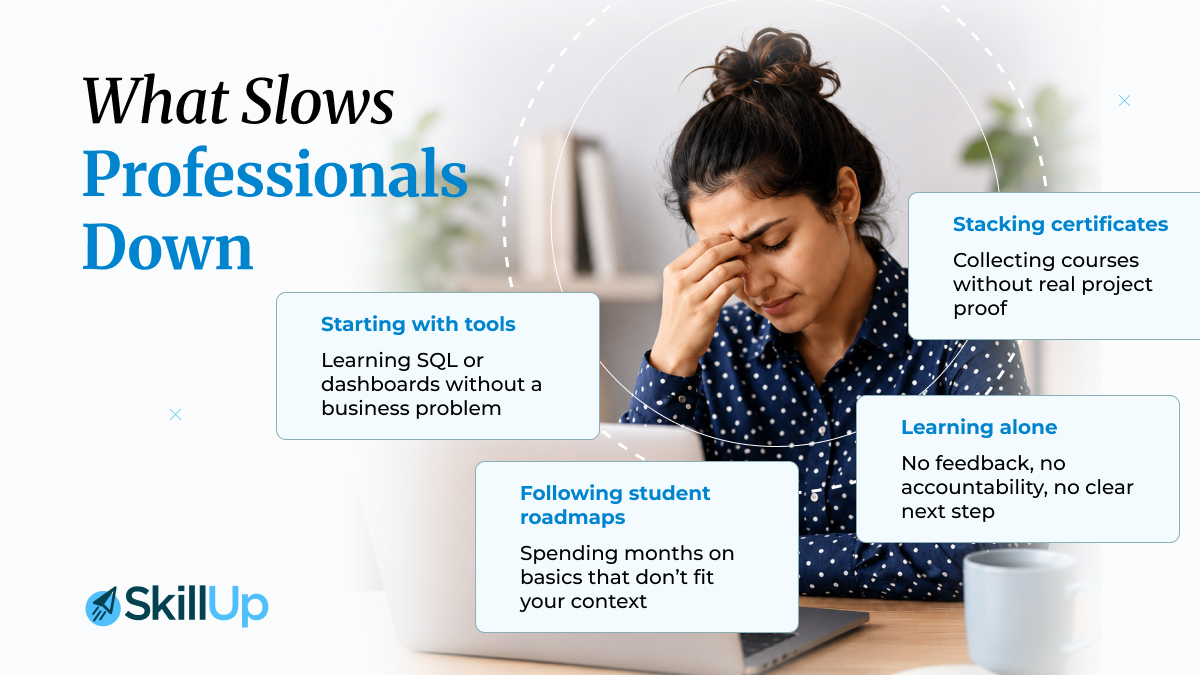
These mistakes are not unique to individuals. They are structural, so they follow directly from how most analytics learning is packaged and sold.
Mistake 1: Starting with tools instead of business problems
Learning SQL before identifying which business questions it will help you answer produces technical ability with no professional application.
Mistake 2: Following a data analytics roadmap built for students
When learning data analytics, student roadmaps start from zero and spend months on fundamentals before reaching anything applicable to a working professional’s context.
Mistake 3: Treating self-paced learning as a complete strategy
A fragmented library of videos does not produce the accountability, feedback, or applied practice that career movement requires.
Mistake 4: Stacking certifications without real-world application
Hiring managers screen for evidence of applied work, like a dashboard that solved a real problem and not a list of completed courses.
Mistake 5: Learning without mentorship or accountability
Without a mentor and a structured timeline, most professionals stall before they build anything worth showing a hiring manager.
Mistake 6: Upskilling without a clear career outcome
Learning without a defined role target produces broad exposure but no depth in the areas that matter for the next move.
Why Most Professionals Get Stuck When Learning Data Analytics Despite Doing Everything Right
| Structural Issue | What You Think Is Happening | What’s Actually Happening |
|---|---|---|
| Following a roadmap | “I’m making steady progress” | You’re learning without role direction |
| Watching courses consistently | “I’m being disciplined” | You’re consuming, not building |
| Learning multiple tools | “I’m becoming job-ready” | You’re spreading effort, not creating depth |
| Studying independently | “I prefer flexibility” | You lack feedback and course correction |
What a Smarter Data Analytics Roadmap Actually Looks Like
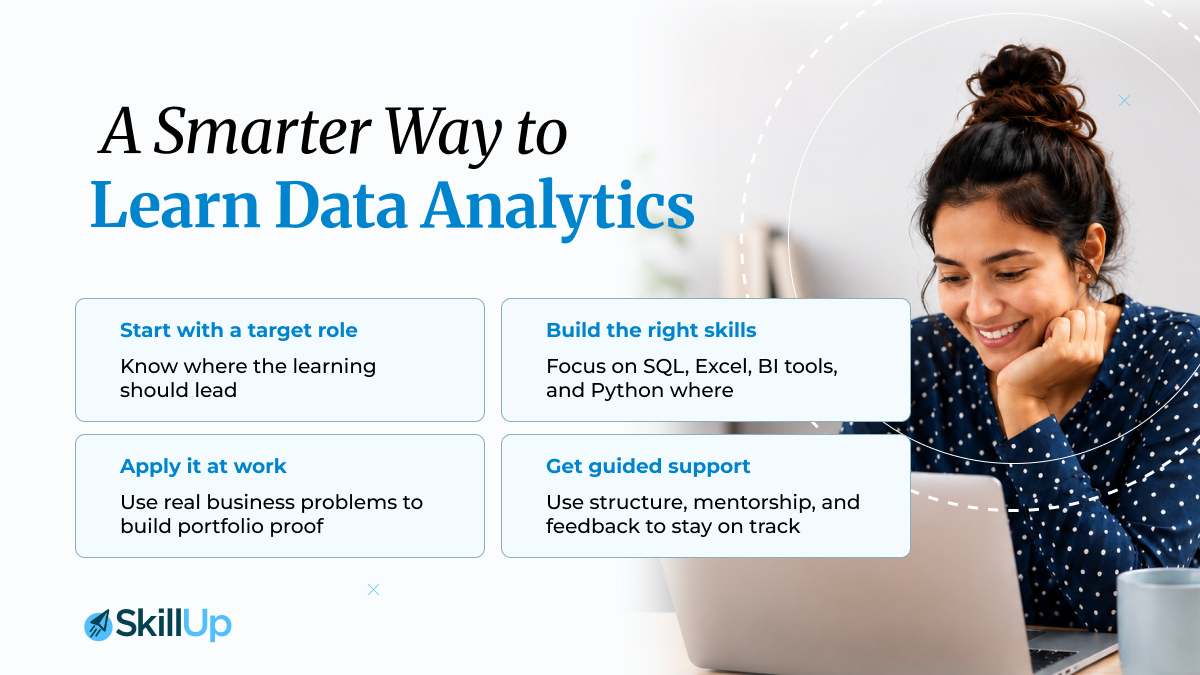
What is the best way to start data analytics in 2026 if you are already mid-career? Not with a tool list, but with a target role. A roadmap built for professionals works backward from a career outcome and builds the technical layer on top of what you already know.
Start With the Role You Want, Then Build Backwards
Identify the specific role you are targeting, then look at what five to ten active job postings for that role require. Build your learning plan around closing the exact gap between where you are and what those postings ask for.
Skills That Matter at Each Career Stage
| Career Stage | Core Skills | What It Unlocks |
|---|---|---|
| Entry-level | SQL, Excel, Tableau/Power BI | Data Analyst, Reporting Analyst |
| Mid-level | Python, Statistical Modeling, Stakeholder Communication | Senior Analyst, BI Analyst |
| Senior | Strategic Decision Support, Data Storytelling | Analytics Manager, Data Lead |
(365 Data Science, Data Analyst Job Outlook 2026)
How to Apply Learning Inside Your Current Role Immediately
The fastest route to portfolio-ready work is applying new skills to problems that already exist in your current role. An analyst learning Power BI can build a dashboard for their own team. A finance professional learning SQL can query data that their department already collects. Real application inside a familiar context accelerates both skill development and portfolio credibility.
Making Learning Work Around a Full-Time Career
For working professionals, what to learn is only half the challenge. How you learn matters just as much, which includes sequencing, support, and how quickly you can apply it. It is rarely about consuming more content.
How to Upskill in Data Analytics Without Quitting Your Job
Consistent effort in focused blocks of 8 to 10 hours per week within a structured program is sufficient for most professionals to achieve meaningful capability in 6 months. The key is structure: a defined learning path, applied milestones, and accountability systems that maintain momentum through the unavoidable competing demands of a full-time role.
Why Guided Programs Outperform Self-Directed Learning
The World Economic Forum, Future of Jobs Report, 2025, identifies AI and big data as the fastest-growing skill areas globally. The demand is real, but so is the competition. Guided programs with mentorship, instructor feedback, and real-world projects consistently produce career-ready results that self-directed learning struggles to match. For busy professionals, especially, the difference isn’t just quality but time. Why spend 18 months figuring it out alone when a structured program gets you there in six?
Accountability Systems That Keep Professionals on Track
Cohort-based learning, scheduled mentor sessions, and project review checkpoints are not supplementary features. For working professionals learning data analytics alongside existing responsibilities, they are what separate completion from dropout.
Turning New Skills Into Real Career Movement
Learning without career movement is an incomplete outcome. The goal is not skill acquisition; it is role progression.
Roles Working Professionals Can Realistically Transition Into
Data analyst, business intelligence analyst, analytics manager, and data-informed product manager are all accessible transition targets for mid-career professionals with existing domain experience. Each becomes more accessible with a portfolio that demonstrates applied capability in a recognizable professional context.
Realistic Salary Growth and Promotion Timelines
Data analyst salaries grow 8-15% annually in the first five years, with the steepest jumps coming from role changes rather than internal promotions (Careery, 2026). The BLS median for data scientists, a common progression target, is $112,590 (BLS, Occupational Outlook Handbook, 2024). The financial case for structured upskilling in data analytics is directly tied to whether the learning produces demonstrable, role-ready capability.
IBM and Microsoft certifications carry specific hiring weight in 2026 job postings. Pairing them with portfolio projects linked on LinkedIn is the most direct signal to recruiters that the capability is real, not just credentialed.
Choosing the Right Program to Upskill in Data Analytics
There is no shortage of options. The question is whether the program is structured to produce career movement, not just module completion.
What Separates a Structured Program From a Course Bundle
A course bundle gives you access to content. A structured program gives you a sequence, a mentor, applied projects, and defined outcomes. For working professionals, the difference between the two is often the difference between completing the learning and abandoning it after month two.
Questions to Ask Before You Enroll
- Does the program include real projects on real datasets?
- Is there a mentor who reviews your work and provides specific feedback?
- Are there cohort-based checkpoints that create accountability?
- What roles have graduates moved into, and how long did it take?
These questions separate programs that produce outcomes from programs that produce certificates.
Understanding Program Costs, Installments, and ROI
For the majority of US professionals paying out of pocket, the financial question is not what a program costs; it is what it returns. Programs that offer installment payment options reduce the financial risk of committing before outcomes are proven. The TechMaster Certificate Program in Data Analytics from SkillUp Online is a 6-month, IBM-powered program with mentorship, hands-on labs, and dual certification from IBM and Microsoft, with financial assistance available through Climb Credit for eligible professionals.

SkillUp Online