Data errors in the US healthcare system cost an estimated $300 billion annually. Much of this loss does not stem from unavoidable medical complexity but from data gaps that sharper analysis could close. Addressing these gaps is exactly what a healthcare data analyst is trained to do. They turn raw healthcare data into insights that improve decision-making and patient outcomes.
Moreover, as hospitals transition to value-based care and integrate AI into clinical workflows, there is an increasing need for healthcare data analysts. The global healthcare analytics market is estimated to increase from USD 55.52 billion in 2025 up to USD 166.65 billion by 2030, at a CAGR of 24.6%. Thus, this rapid growth is also creating new career opportunities for professionals with the right analytical and healthcare knowledge.
In this guide, we will cover how to become a healthcare data analyst, key skills, tools needed, and more.
What Does a Healthcare Data Analyst Do?
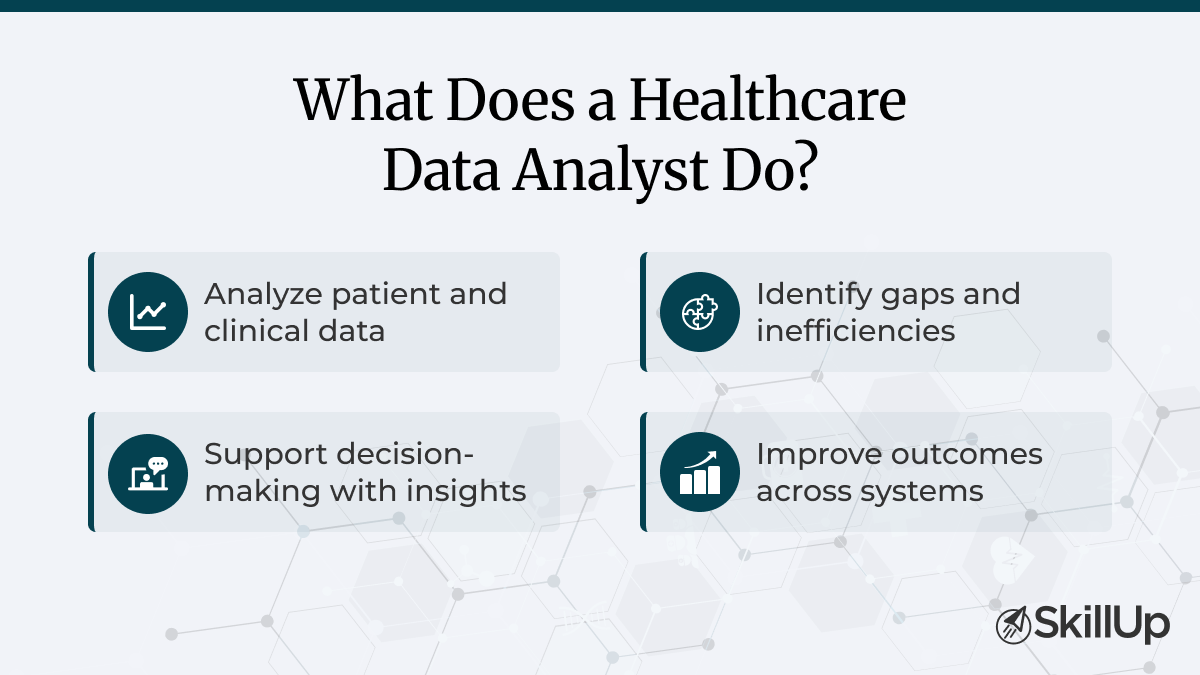
Imagine a huge hospital organization bleeding revenue through miscoded insurance claims, thousands of them, in dozens of departments, going unnoticed. This is a common type of issue that a healthcare data analyst is responsible for detecting. Practically, it translates to work across:
- Electronic health records (EHRs)
- Insurance claims
- Clinical trial data
The healthcare data analyst role also stretches into strategy modeling, like how a discharge protocol change could decrease readmission rates, or mapping to find out what patient groups are not using preventive services. A data analyst in healthcare works on technical processes, but its output is measured in outcomes, not just outputs.
Key Skills Required for a Healthcare Data Analyst
Knowledge of three types: technical implementation, domain knowledge, and communication, is essential since identifying patterns in data is one half of the task, and the other half is describing what they signify to the clinical staff.
Technical Skills
- SQL: queries of EHR databases, claims systems, and information about the work of hospitals
- Python / R: predictive analytics, statistical modeling, large datasets of patients
- Tableau / Power BI: non-technical stakeholder actionable dashboards
- Excel: data cleaning, ad hoc reporting, and data exploration
Domain Knowledge
- Healthcare systems, clinical workflows, and medical terminology
- Compliance with regulations: HIPAA (US) and other comparable data privacy regulations worldwide
- Data standards: HL7 and FHIR health record exchange between systems
Analytical & Soft Skills
- Clinical and executive data storytelling
- Making decisions using partial data or data that is inconsistent
- Cross-functional communication across engineering and clinical teams
Read More – Why Healthcare Professionals Are Upskilling in AI?
How to Become a Healthcare Data Analyst: A Step-by-Step Guide
Becoming a data analyst in healthcare means having the proper background, then proceeding to practice before finding a job.
Step 1: Build a Relevant Educational Foundation
The minimum qualification is a bachelor’s in health informatics, statistics, or data science. Further, the Certified Health Data Analyst (CHDA) certification reinforces the advanced applications.
Step 2: Learn Industry-Relevant Tools
Hands-on approach to SQL, Python, and Tableau on open healthcare data builds competency. Pair it up with course programs.
Step 3: Gain Practical Experience
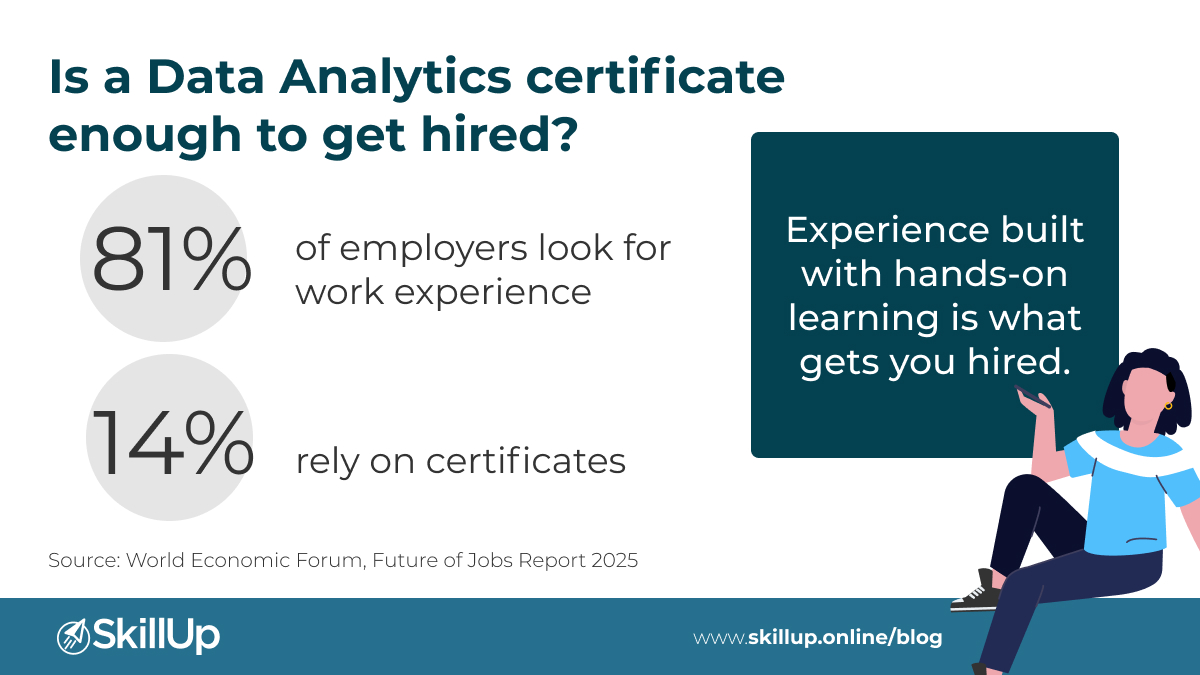
Portfolio material created through internships, freelance projects, and case study competitions is the kind of material hiring managers actually respond to. Even analytical work that is done on a volunteer basis with a clinic or a public health initiative is also considered valid.
Step 4: Build a Strong Portfolio
Applied skill can be shown much better through dashboards that report readmission rates or billing irregularities than a line item on a CV. The aim is not technical complexity but rather decision-ready outputs that demonstrate clinical and business awareness and data skills.
Step 5: Network and Apply Strategically
LinkedIn, niche job boards, and healthcare analytics forums are major factors that enhance the visibility of recruiters. Proactive participation in communities surrounding HIMSS or AHIMA will make you meet professionals who are directly involved in the hiring process.
Healthcare Data Analyst Jobs: Roles Covered
The term “healthcare data analyst” covers more ground than a single job title suggests. Depending on the organization and focus area, the role typically falls into one of the following types:
- Clinical Data Analyst: deals directly with patient records, EHRs and treatment outcome data.
- Healthcare Business Analyst: specializes in cost modeling, revenue cycle, and operational efficiency.
- Public Health Data Analyst: interprets the population-level data of the government agencies and other bodies of public health.
- Healthcare Risk Management Analyst: identifies billing abnormalities, compliance issues and fraud patterns.
- Health Informatics Analyst: oversees data infrastructure, standards such as HL7/FHIR and system integration.
Career Transition: Moving Into Healthcare Analytics
Many strong analysts in this field did not start here.
- A former ICU nurse who learns Python brings clinical context that no bootcamp teaches.
- A finance professional pivoting into health insurance modeling arrives with the knowledge of already built cost analysis frameworks.
The general timeline to become a healthcare data analyst is around 12-24 months with targeted training in SQL, Python, and healthcare data standards.
Top Tools and Technologies Used in Healthcare Data Analytics
The toolkit of a modern healthcare data analyst is a combination of programming, visualization and healthcare-specific solutions, and the precise mix varies by environment.
Data Analysis & Programming
- Python (Pandas, NumPy, Scikit-learn): data wrangling, predictive modeling, patient risk scoring
- R: preferred in biostatistics and clinical trial analysis
- SQL: foundational across nearly every healthcare data role
Visualization & Reporting
- Tableau: interactive dashboards for hospital leadership and operations teams
- Power BI: enterprise reporting in payer and large health system environments
Healthcare-Specific Platforms
- Epic/Cerner: leading EHR in the US; knowledge of EHR is a typical employment requirement
- SAS Health Analytics: applications in government health agencies and pharmaceutical research
Salary Trends and Job Outlook for Healthcare Data Analysts
According to Glassdoor, a healthcare data analyst job in the US has a median total pay of $107,000 per year, with a total pay range of $82K–$143K/yr.
Base pay sits between $67K–$116K/yr, with additional pay (bonuses, profit sharing) adding $14K–$27K/yr on top.
| Role Level | Total Pay Trajectory (US) |
|---|---|
| Data Analyst | $72K – $122K per year |
| Data Analyst Manager | $88K – $150K per year |
| Data Analyst IV | $118K – $172K per year |
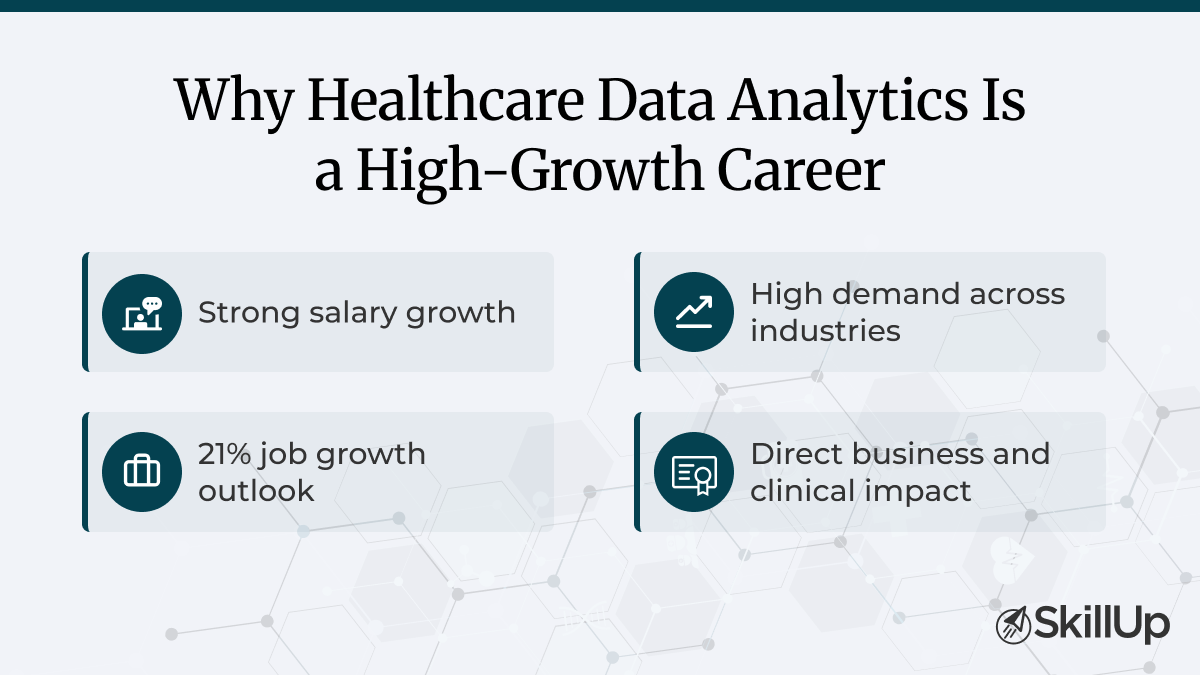
The BLS estimates a 21% increase in closely related analyst jobs between 2024 and 2034, making healthcare data analyst jobs a strong career path for future growth, with organizations reporting a payback of $4 on every dollar spent on analytics.
Why is it a Future-Proof Career?
Healthcare data is not cyclical, and a hospital will generate patient data regardless of the economy being in a high or low state or a boom or recession.
Challenges in Healthcare Data Analytics (And How to Solve Them)
Working in this field means navigating real structural friction daily:
- Data protection and compliance – HIPAA controls all pipelines; compliance is a continuous effort, not a configuration procedure. Keep up with compliance training and establish privacy checks directly into your workflow.
- Unstructured data – clinical notes, ICD codes, and claims files rarely arrive analysis-ready. Learn data cleaning early; Python modules such as Pandas can do most of this effectively.
- Siloed systems – disconnected hospital platforms mean more integration work than analysis. Manage this systematically by learning to use data pipeline tools such as Apache Airflow or dbt.
- Domain translation – explaining findings to clinicians or administrators is a skill in itself. Practice presenting in plain language, lead with the decision, not the method.
Healthcare Data Analyst Jobs: Where Can You Work?
Here are the top industries actively looking for healthcare data analysts.
Hospitals and Healthcare Providers
The largest employer base. Work centers on patient outcome modeling, operational efficiency, and resource allocation.
Insurance Companies
Payer organizations rely on analysts for claims accuracy, fraud detection, and population health modeling, with direct financial impact on every output.
Pharma and Biotech Firms
Clinical trial analysis and real-world evidence generation dominate here. R and SAS proficiency are common prerequisites alongside regulatory data experience.
Health Tech Startups
Fast-moving, cross-functional analytical work with competitive compensation. Equity in a sector growing at 24.6% CAGR adds meaningful long-term upside.
Is Healthcare Data Analytics the Right Career for You?
The career fits analytical minds, medical workers who are prepared to make a transition back to a strategic position, and tech-lovers who desire their skills to make a tangible human impact. Ask yourself:
- Am I comfortable with messy data?
- Can I explain findings to non-technical people?
- Do I want my work to influence patient outcomes?
If yes, this field is worth pursuing seriously.
Building a Future-Ready Career in Healthcare Analytics
The need for healthcare data analysts is structural, and it is only increasing. The initial step is to determine what skills you require. Next, decide on a tool you would like to grasp, and develop a portfolio project based on a practical healthcare dataset.
Remember: The access points are easy, but the long-term path? Even more promising.

SkillUp Online