If a factory floor looks the same as it did five years ago, that is worth paying attention to. AI in manufacturing has moved fast enough that companies actively deploying it are gaining measurable cost and efficiency advantages over those still evaluating. According to Grand View Research, the global AI manufacturing market is projected to reach $47.88 billion by 2030, up from $5.32 billion in 2024. This gap compounds every year it goes unaddressed.
This article covers how AI in manufacturing is being applied at scale, where the documented gains sit, and what it means for professionals inside these environments.
What Is AI in Manufacturing and What’s Actually New?
Traditional factory automation worked on fixed rules. A robotic arm set to weld at one angle does exactly that, every cycle. If the material changes or a component is adjusted, a programmer has to rewrite the instructions before production can resume.
AI in manufacturing works from data instead. It continuously draws from equipment readings and adjusts as conditions shift, without manual reprogramming. A temperature variation or a measurement change gets factored in without stopping the line. Conventional automation cannot do that. It follows the same coded sequence regardless of what happens around it. That core difference is why manufacturers treat AI as a distinct tool rather than simply the next stage of automation.
Key AI Use Cases in Manufacturing with Real Examples
How AI is used in manufacturing depends on where the operational problem sits. These AI use cases in manufacturing are running at production scale across major industrial environments:
Predictive Maintenance
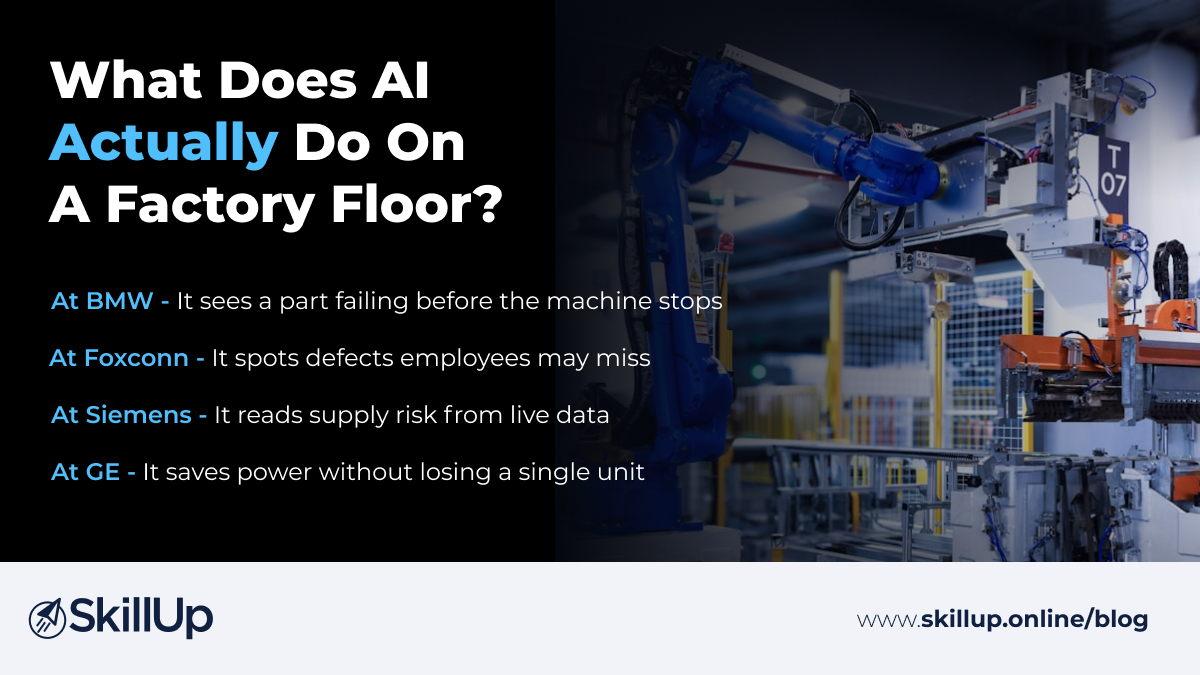
BMW’s production lines feed continuous sensor data into machine learning models that identify components showing wear patterns before failure occurs. What this changes operationally is the shift from emergency repair to planned intervention. A part that would have failed mid-shift gets replaced during a scheduled maintenance window instead, reducing both downtime and reactive costs.
Quality Control
Foxconn runs computer vision systems across electronics assembly lines, inspecting components at throughput speeds that manual processes cannot reach. The system identifies defect types it was not originally trained on as production data accumulates. Defect escape rates on high-volume lines dropped as a direct result.
Supply Chain Risk Modelling
Siemens models supply chain exposure against live variables: lead times, logistics disruptions, and demand movement. During the 2021–2022 semiconductor shortage, manufacturers with real-time supply visibility made sourcing decisions faster than those working off static procurement records.
Energy Management
GE uses machine learning across its manufacturing facilities to align energy consumption with production schedules and pricing windows. The system does not just track usage. It adjusts load distribution to avoid peak-rate periods without affecting output timelines.
The Real Benefits of AI in Manufacturing
According to the Manufacturing Leadership Council, at least 70% of manufacturers believe AI will significantly benefit over 31 areas across production, operations, and supply chain. The pros of AI in manufacturing are as follows:
Maintenance and Operations
AI analyzes equipment data continuously, flagging wear patterns before failure occurs. This cuts unplanned downtime and lowers repair costs.
Quality and Precision
AI-powered quality inspection compares output against set standards in real time, catching defects before mass production begins and reducing recall risk.
Production Efficiency
AI identifies bottlenecks in production workflows and automates repetitive tasks, freeing workers for higher-level problem-solving.
Supply Chain and Inventory
Real-time supply chain visibility helps manufacturers match stock levels to actual demand, reducing losses from overstocking or shortages.
Product Development
Digital twins allow designers to test virtual product models before physical production, cutting development time and material costs.
Cost Efficiency
AI analytics surface what is working and what is not across operations, lowering costs and shortening lead times.
Safety and Compliance
Cobots handle hazardous tasks on the floor while AI monitors environments for safety risks and compliance gaps.
Innovation and Scalability
AI integrates with IoT devices and smart sensors as operations scale, continuously generating actionable production insights.
Challenges of AI in Manufacturing That Leaders Aren’t Talking About Enough
Most AI deployments in manufacturing do not fail because the technology did not work. They fail because the environment around them was not ready. The challenges of AI in manufacturing follow a consistent pattern across the industry.
Data Quality
Bad input produces bad output, regardless of the algorithm. Before deploying any AI system, production data needs auditing for accuracy, and measurement instruments require calibration checks. Human oversight remains necessary throughout, as models can drift when input quality deteriorates.
Fragmented Data Sources
Production, procurement, and logistics data often sit in separate systems with no connection between them. Incomplete picture, incomplete analysis. Merging those sources before deployment takes time, but it determines how reliable the outputs actually are.
Implementation Costs
The upfront investment covers technology, integration work, and staff training. Cloud-based platforms with AI built in reduce this significantly by removing the need to build and maintain models from scratch in-house.
Shortage of Skilled Workers
49% of senior manufacturing decision-makers report difficulty recruiting and retaining qualified staff, particularly in engineering roles (Fictiv, 2023 State of Manufacturing Report). Hiring someone who understands how to apply AI to real production conditions is a different problem from hiring a general AI specialist.
Complex Task Limitations
Not every production process can be automated. Tasks requiring contextual judgment sit outside what current AI handles reliably. Manufacturers with complex, custom production runs find fewer automation opportunities than those running high-volume, repetitive processes.
Technology Complexity
AI systems connect to IoT sensors, smart devices, and wider infrastructure, each carrying its own maintenance demands. Without periodic expert review, performance that is strong at launch can quietly degrade without triggering any obvious alert.
What AI in Manufacturing Means for the People Inside It
The concern most manufacturing professionals carry is whether AI in manufacturing eliminates their role. The short answer is no, but where the work sits is shifting.
AI takes on repetitive, rules-based, and physically demanding tasks. High-volume visual inspection, production log entry, and fault pattern matching are areas where it outperforms manual effort at scale. These also happen to be the tasks most associated with physical strain and high turnover.
Judgment, exception-handling, and cross-functional coordination remain outside what AI manages reliably. A supplier failure mid-production or a quality dispute escalating across departments draws on operational experience that no current model replicates.
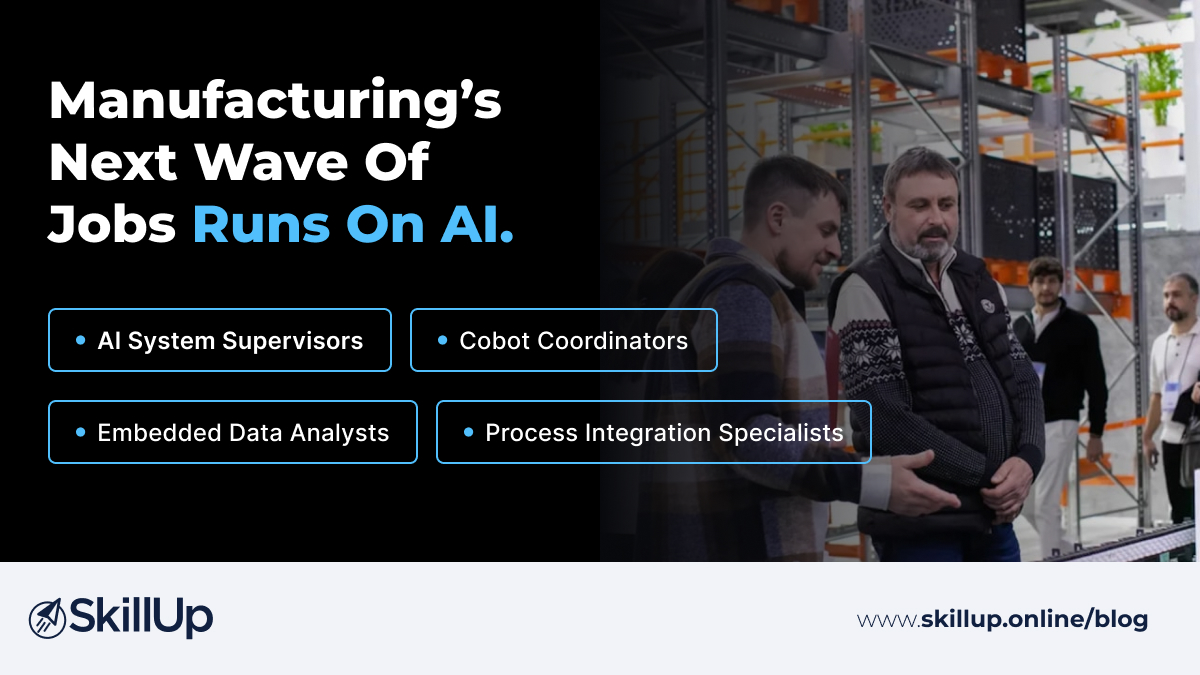
One challenge of AI in manufacturing is that it raises capability expectations for existing staff. The roles it is generating require domain expertise alongside technical fluency:
- AI system supervisors
- Cobot coordinators
- Data analysts embedded within operations teams
- Process integration specialists
None of these roles function on technical knowledge alone. Operational experience is what separates a capable hire from a qualified one.
Final Thoughts
The career risk for manufacturing professionals is not replacement outright. It is staying in the same position while the capability requirements around it shift. Professionals who build structured AI and machine learning skills on top of existing domain knowledge are better placed for the roles these deployments are creating. SkillUp Online’s TechMaster Certificate Program in AI & ML Engineering is designed for working professionals in technical and operations roles who need to build that foundation without stepping away from their current position.
Read More – How to Navigate Your Artificial Intelligence Career Path in 2026

SkillUp Online