A decade ago, social media was a support act. A place to boost a campaign, run a contest, or maybe post behind-the-scenes content. In 2026, it is the campaign. The centre of modern marketing has shifted away from television and print and moved towards feeds, creators, algorithms and audiences that now consume content faster than brands can produce it. With US social commerce sales expected to surpass $100 billion this year businesses are investing in digital visibility with unprecedented urgency. But who keeps that ecosystem moving? Who maps audience behavior before a campaign goes live? Who notices when engagement drops on a Tuesday afternoon and knows exactly what to do social media managerabout it? That’s the Social Media Manager.
In 2026, the role sits at the crossroads of branding, analytics, communication, and strategy. It is one of the most dynamic, fast-moving careers in marketing today. If you’ve been wondering what it takes to build a career here, this guide covers everything: what the job actually looks like day-to-day, the skills employers are hiring for, what you can expect to earn, and how to get started, even if you’re coming from a completely different field.
What Does a Social Media Manager Do?
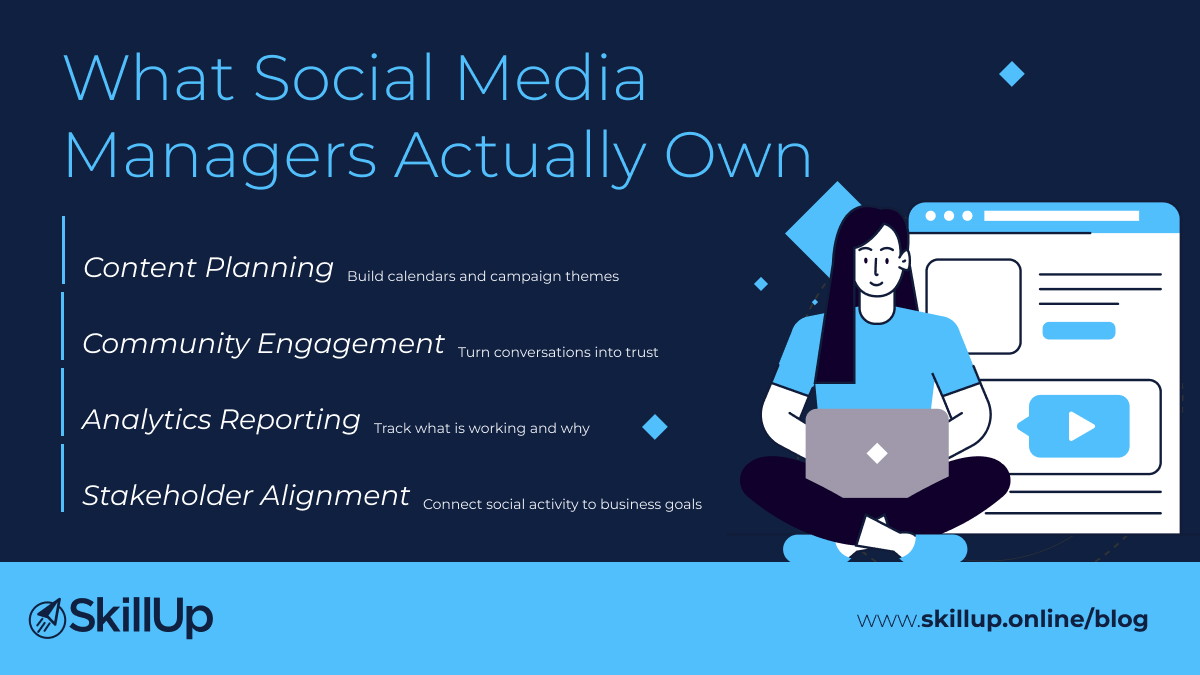
At its core, a social media manager is responsible for how a brand shows up online across platforms like Instagram, LinkedIn, TikTok, YouTube, Facebook, and X. But the job is a lot more layered than posting content and responding to comments.
Here’s a breakdown of what the role typically involves:
| Responsibility | What It Involves | Why It Matters |
|---|---|---|
| Content Strategy and Planning | Building content calendars, campaign themes, and platform-specific plans | Keeps messaging consistent and tied to real business goals |
| Campaign Execution | Publishing content, coordinating creative assets, monitoring rollout | Improves efficiency and gets campaigns in front of the right people |
| Community Engagement | Responding to comments, DMs, and audience conversations | Builds the kind of trust that turns followers into customers |
| Analytics and Reporting | Tracking engagement, conversions, and campaign performance | Gives leadership the data they need to make smarter decisions |
| Social Listening | Monitoring trends, competitors, and what people are saying about the brand | Catches reputation risks early and surfaces new opportunities |
| Stakeholder Communication | Collaborating with design, product, sales, and leadership | Connects social efforts to what the rest of the business is doing |
One thing worth knowing: the actual scope of the job varies a lot depending on where you work.
- At a startup, you’re likely handling everything yourself, whether it is strategy, content, analytics, community management, or anything else that comes up.
- At an agency, you’re juggling multiple client accounts at once, often with tight turnarounds and very different brand voices.
- At a large enterprise, responsibilities tend to be divided. One person owns analytics, another handles creative, another manages strategy. More structure, but also more collaboration.
Core Social Media Manager Skills Employers Look For
In 2026, brands expect a lot more from social media teams than they used to. It’s not enough to know how to schedule posts or follow trending sounds. Companies want people who can think strategically, read data, understand paid advertising, and increasingly, work with AI tools to move faster and smarter.
That means the skill set breaks down into two categories.
Technical Skills
The day-to-day role of a social media manager involves working with content systems, scheduling platforms, analytics dashboards, and AI-assisted workflows. Employers favor candidates who are equally comfortable creating content and managing the operational side of things because both are essential to the role.
| Skill | What It Means in Practice |
|---|---|
| Content Creation | Writing and producing posts, videos, reels, and platform-specific formats |
| Video Editing | Cutting short-form video for TikTok, Instagram Reels, and YouTube Shorts |
| Meta Business Suite | Managing Facebook and Instagram publishing, ads, and insights |
| Hootsuite / Buffer | Scheduling and publishing across multiple accounts |
| Sprout Social | Tracking engagement and monitoring what your audience is responding to |
| SEO Basics | Using keywords and hashtags strategically to improve organic reach |
| Paid Social Ads | Setting up and managing ad targeting across platforms |
| Analytics Tracking | Measuring reach, clicks, engagement rates, and conversions |
| AI Tools | Leveraging tools like ChatGPT or Claude for captions, ideation, and workflow support |
| Reporting | Pulling together clear performance reports for campaigns |
Strategic Skills
Technical ability only gets you so far. The best social media managers are also sharp communicators who can think on their feet, work across teams, and explain what the numbers actually mean to people who aren’t in the weeds every day.
| Skill | Why It Matters |
|---|---|
| Copywriting | Every caption, headline, and CTA has to work hard |
| Communication | You need to translate social results into language leadership understands |
| Adaptability | Platforms change fast, and a skill that was cutting-edge last year might be table stakes today |
| Creativity | Fresh ideas are what keep audiences from scrolling past |
| Trend Awareness | Spotting trends early, before they’re oversaturated, is where real value gets created |
| Collaboration | Social doesn’t happen in a vacuum, and you’re constantly working with design, marketing, and sales |
| Time Management | Deadlines are real, and posting schedules don’t move |
| Audience Understanding | Knowing what your specific audience responds to, not just what performs generally |
| Decision-Making | When a campaign goes sideways mid-flight, you need to move quickly |
| Data Storytelling | The ability to make numbers meaningful is increasingly a hiring differentiator |
Tools Social Media Managers Commonly Use
Most managers work across several platforms daily. Here’s a quick look at the most common categories:
- Scheduling & Publishing: Buffer, Hootsuite, CoSchedule
- Social Listening: Brand24, Sprout Social
- Analytics: Google Analytics, Metricool
- Content Creation: Canva, Motion Array
- AI Workflows: ChatGPT, Gemini, Claude
- Influencer & Audience Research: Audiense, Onalytica
The right stack really depends on your company’s size, workflow, and goals. A solo manager at a startup might live in Canva and Buffer. A senior strategist at an enterprise brand might be running Sprout Social alongside custom reporting dashboards.
Social Media Manager Salary: What the Role Actually Pays
Compensation in this field varies based on experience, industry, location, and what you specialize in. According to recent Indeed data, the average social media manager salary in the US sits at around $64,120 per year, though experienced professionals often land considerably higher, in the $74,000–$90,000 range.
| Career Level | Typical Salary Range |
|---|---|
| Entry-Level | $55,000 – $70,000 |
| Mid-Level | $75,000 – $100,000 |
| Senior / Strategist | $110,000 – $150,000+ |
A few things that tend to push compensation higher:
- Hands-on experience with paid social advertising
- Strong analytics and reporting skills
- Fluency with AI tools and workflow automation
- Industry specialization (tech, e-commerce, and finance tend to pay more)
- Experience managing remote or distributed teams
- Creator marketing and influencer strategy background
The pattern is consistent: managers who can tie social activity to measurable business outcomes, revenue, leads, and customer growth earn more than those focused primarily on publishing and engagement.
How to Get Started as a Social Media Manager
In order to get started as a social media manager, you must follow these steps:
Step 1: Learn Platform Behavior
Each platform rewards different content styles and audience behavior. Study:
- Content formats
- Engagement patterns
- Platform algorithms
- Audience expectations
Understanding why content performs matters more than copying trends blindly.
Step 2: Build Practical Experience
Hiring managers increasingly look for evidence of practical capability rather than generic familiarity with social platforms. A strong portfolio helps demonstrate how you think, plan campaigns, and understand audiences.
Useful portfolio pieces can include:
- Content calendars
- Campaign concepts
- Short-form videos
- Account audits
- Engagement strategies
- Analytics snapshot
- Sample performance report
It is best to strengthen your profiles through Certificate Program in AI-Augmented Digital Marketing, social media analytics, paid advertising, and AI-assisted content workflows, especially when transitioning into digital marketing roles.
Step 3: Learn Analytics Early
Businesses increasingly hire professionals who understand performance data. Focus on learning:
- Engagement metrics
- Audience insights
- Reporting dashboards
- Conversion tracking
- Campaign measurement
Analytics knowledge often becomes the difference between entry-level and mid-level opportunities.
Step 4: Learn Paid Social and AI Workflows
Organic reach continues to shrink. More brands are supplementing organic content with paid campaigns on Meta, TikTok, and LinkedIn, and they want managers who understand both sides. At the same time, AI tools are reshaping how content gets produced, scheduled, and optimized.
Professionals who can run a paid campaign and leverage AI to work more efficiently are genuinely more competitive right now. This is one of the fastest-changing parts of the job, which also means it’s one of the biggest opportunities to differentiate yourself early.
Social Media Manager Career Path: Where This Role Can Take You
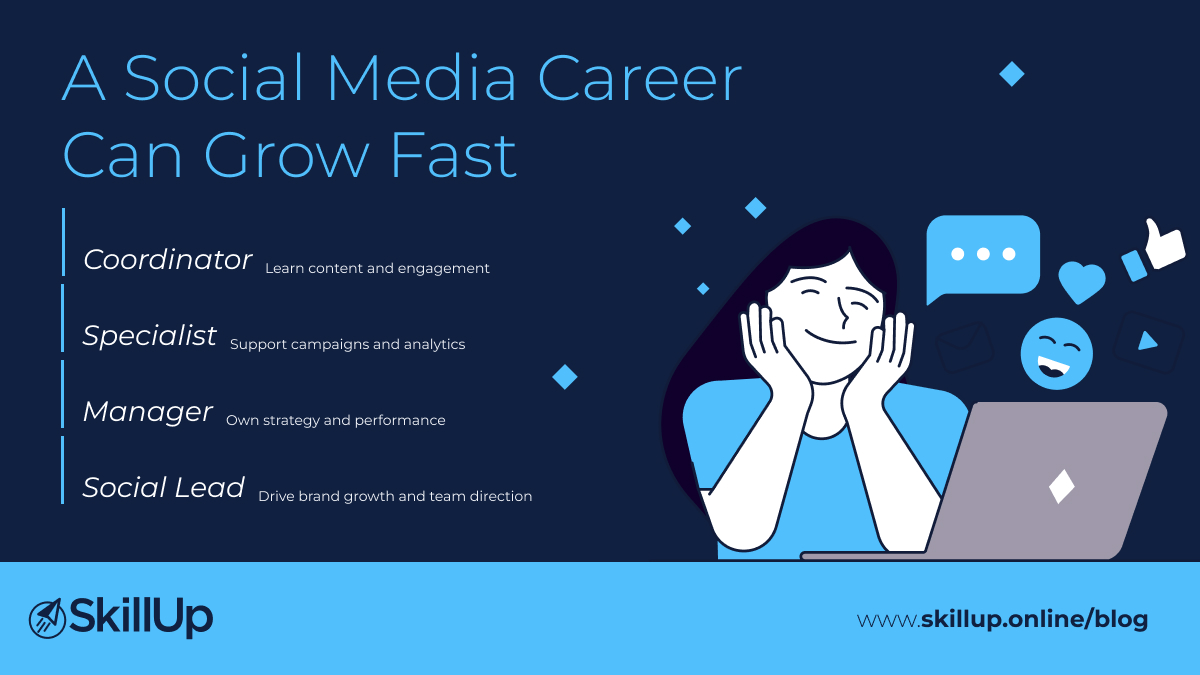
One of the best things about starting in social media management is the range of directions your career can go. The skills you build transfer across a lot of marketing functions.
| Career Stage | Common Roles | Main Focus |
|---|---|---|
| Beginner | Social Media Coordinator, Community Assistant | Scheduling, engagement, basic content |
| Intermediate | Social Media Specialist, Community Manager | Campaign support, analytics, audience growth |
| Advanced | Social Media Manager, Social Media Analyst | Strategy, reporting, performance tracking |
| Senior | Senior Social Strategist, Content Strategist | Multi-platform planning, ROI, brand positioning |
| Leadership | Head of Social, Digital Marketing Director | Team leadership, business growth |
From there, many professionals specialize into areas like influencer marketing, content strategy, paid media, brand strategy, or analytics. AI fluency is also starting to accelerate career progression noticeably. People who can automate workflows, improve reporting, and scale content operations are moving into senior roles faster than the traditional path would suggest.
Final Thoughts
Social media isn’t going anywhere, and neither is the demand for people who know how to run it well. But the job has evolved. It’s no longer about posting consistently and hoping something lands. Today’s social media managers are expected to understand audiences deeply, read performance data clearly, work alongside AI tools, and connect everything back to business results.
The good news? You don’t need years of experience to get there. Start with hands-on projects. Build your portfolio. Learn the analytics side early. Get familiar with paid social and AI workflows. And consider structured certification programs that give you practical, employer-relevant skills, especially if you’re making a transition from another field.
The foundation is learnable. And the industry is hiring.
Read More – How to Get Into Digital Marketing Career Without a Degree

SkillUp Online