The rules of professional growth are being rewritten – quietly, but decisively. Roles are no longer defined by job titles alone; they are shaped by how effectively individuals adapt to data, automation, and evolving business models.
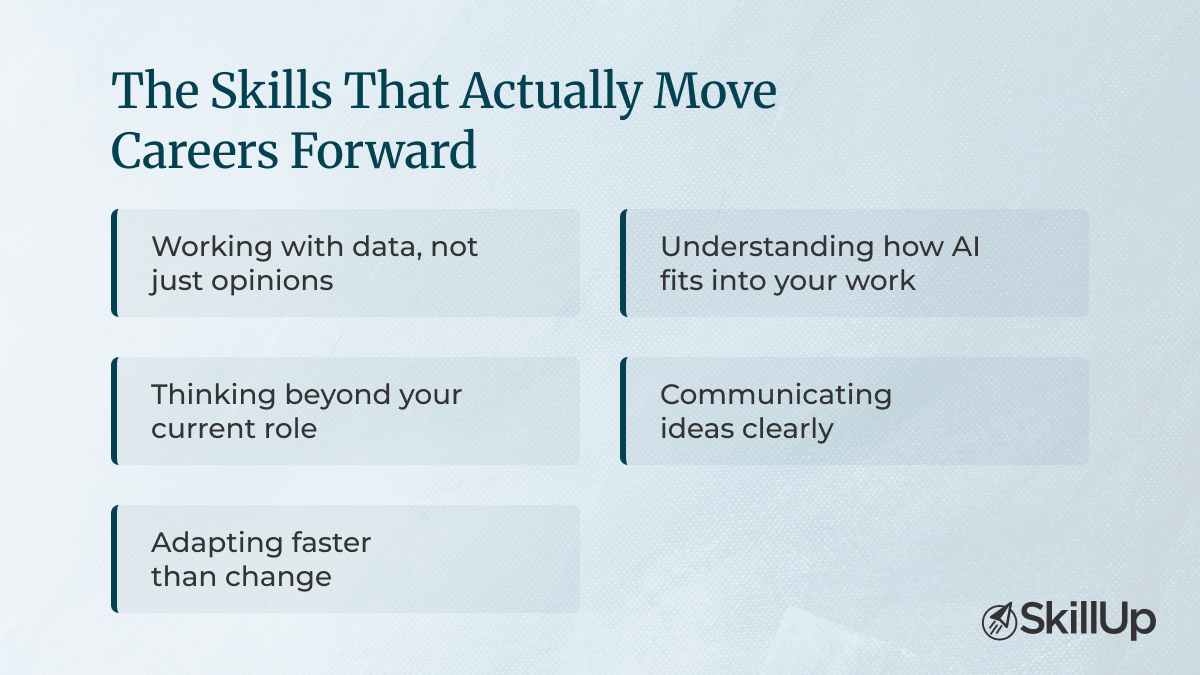
AI is not just transforming industries; it is redefining expectations from professionals at every level. Growth is no longer about experience alone; it is about relevance. This is where career growth skills are becoming a strategic priority and why the best future skills for professionals are no longer optional for those planning long-term career growth.
If you have been asking yourself what skills should working professionals learn in 2026, this guide is built to give you clarity. It is not about trends for the sake of trends, but skills that actually move careers forward.
Why Skills Are Now Defining Career Growth
The shift from degree-based careers to skills-based careers is no longer a prediction; it is already happening. Employers are prioritizing capability over credentials, and roles are becoming increasingly hybrid.
Here’s what’s driving this change:
- Roles now require both technical and business understanding
- Industries are evolving faster than traditional education systems
- Professionals are expected to continuously adapt, not just perform
It is observed that:
- Over 50% of professionals will need significant reskilling by 2026 to remain competitive.
- Moreover, reskilling is preparing 1 billion people for tomorrow’s economy.
This is why investing in skills for career growth for professionals is the need of the hour.
Top Skills Working Professionals Should Learn in 2026
1. Data Analytics & Data-Driven Decision Making
Data is no longer confined to analysts; it is part of everyday decision-making across functions. Whether you are in marketing, finance, HR, or operations, understanding data is a competitive advantage.
Key capabilities to build:
- Data interpretation using Excel and SQL
- Data visualization (Power BI, Tableau)
- Storytelling with data
Why it matters:
- Enables faster, evidence-based decisions
- Reduces reliance on guesswork
- Improves business outcomes
Programs like the TechMaster Certificate Program in Data Analytics help professionals translate raw data into actionable insights; they are some of the best upskilling skills for professionals today.
2. Artificial Intelligence & Machine Learning Fundamentals
AI is no longer a niche skill; it is becoming foundational. From predictive analytics to automation, AI is embedded in how businesses operate. According to experts, the AI market is expected to reach $757.58 billion globally by 2026, with more than 90% of the leading companies investing in it.
What professionals should focus on:
- Understanding AI tools and use cases
- Basics of machine learning models
- Applying AI for process optimization
Why it matters:
- Enhances efficiency and productivity
- Supports better forecasting and decision-making
- Helps professionals stay relevant in AI-driven workplaces
The TechMaster Certificate Program in AI & ML Engineering focuses on practical applications, making it easier for non-technical professionals to build confidence in AI.
3. Full Stack Development & Application Engineering
Even if you are not a developer, understanding how digital products are built is becoming increasingly important.
Core areas to explore:
- Front-end basics (user interfaces)
- Back-end systems and databases
- Application architecture
Why it matters:
- Improves collaboration with tech teams
- Enables better product thinking
- Opens opportunities in tech-driven roles
The TechMaster Certificate Program in Full Stack Application Engineering bridges the gap between coding knowledge and real-world application. As a result, it emerges as one of the career growth skills in tech-enabled environments.
4. Digital & Business Strategy Skills
Technology alone does not drive growth; strategy does. Professionals who can align business goals with digital capabilities stand out.
Key focus areas:
- Strategic thinking and problem-solving
- Understanding digital transformation
- Innovation and business model design
Why it matters:
- Prepares professionals for leadership roles
- Helps organizations navigate change
- Drives long-term business impact
This is where which skills help professionals grow careers faster become clear for those who think beyond execution.
5. Communication & Cross-Functional Collaboration
Technical skills are powerful, but without communication, they lose impact. In fast-paced environments where aligning ideas across teams, functions, and stakeholders is critical to driving meaningful outcomes and business success, communication and collaboration cannot be overlooked.
Companies with effective workplace collaboration enjoy higher team engagement and 23% higher profitability.
Skills to develop:
- Translating complex ideas into simple insights
- Stakeholder communication
- Storytelling and presentation
Why it matters:
- Improves influence within teams
- Strengthens leadership presence
- Enables better decision alignment
In today’s environment, collaboration across departments is constant. This makes communication and collaboration one of the most underrated skills.
6. Adaptability, Critical Thinking & Learning Agility
If there is one meta-skill defining success in 2026, it is adaptability. It is the ability to continuously learn, unlearn, and respond effectively to rapid changes in technology, business models, and evolving workplace expectations.
What this includes:
- Critical thinking and problem-solving
- Comfort with ambiguity
- Continuous learning mindset
Why it matters:
- Helps professionals navigate uncertainty
- Encourages innovation
- Supports long-term career resilience
These are no longer soft skills. They are essential skills aiming for career growth for professionals.
How to Choose the Right Skill Based on Your Career Stage?
For Early-Career Professionals
- Build strong technical foundations
- Focus on certifications and practical exposure
- Experiment with different domains
For Mid-Career Professionals
- Combine domain expertise with new-age skills
- Explore lateral career moves
- Invest in high-impact skills like data and AI
For Senior Professionals
- Focus on leadership and strategic thinking
- Understand technology to guide teams effectively
- Build decision-making capabilities using data
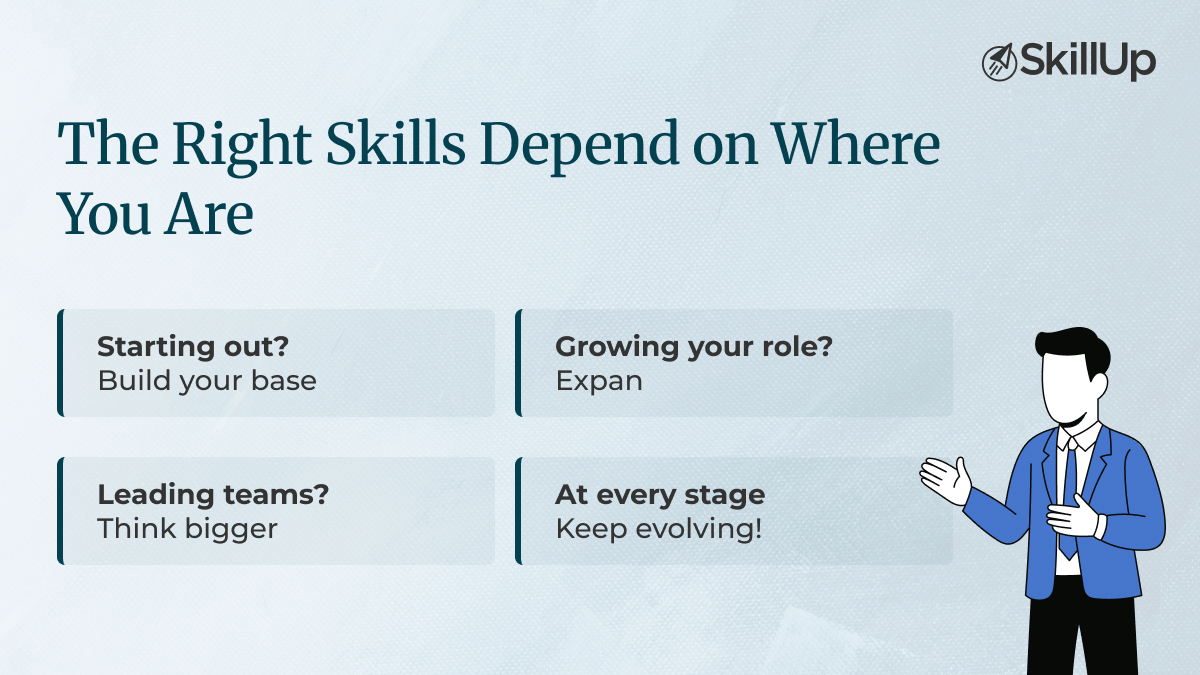
Understanding how professionals can upskill for career growth depends largely on where they are in their career journey.
The Real Challenge Isn’t Learning, It’s Direction
Building new skills isn’t the hard part anymore. The real problem is not knowing what to learn, what to ignore, and how to move forward without getting lost.
That’s where structure and guidance make a difference.
When you’re learning with the right direction, and not figuring everything out alone, progress becomes clearer. You know what to focus on, what comes next, and how it connects to real work.
If you’re looking to move forward, here are a few areas worth exploring:
- Data Analytics to make better, data-backed decisions
- Full Stack Application Engineering to understand how products come together
- AI & Machine Learning to work more effectively with evolving tools
What matters just as much is how you learn. When it involves real projects, reflects how work actually happens, and fits into your schedule, it’s easier to stay consistent and actually improve.
That’s where platforms like SkillUp Online come in, bringing structure, guidance, and practical learning together so you’re not just learning more, you’re learning better.
Common Mistakes Professionals Make While Upskilling
Even with the right intent, many professionals struggle to see results. Here is why:
- Learning without a clear career goal
- Focusing only on theory without hands-on practice
- Ignoring emerging technologies like AI
- Not building a portfolio or showcasing projects
Avoiding these mistakes is critical when investing in the best upskilling skills for professionals.
Future Trends: Skills That Will Define Careers Beyond 2026
A few clear trends are shaping the future of work:
- Rise of AI-powered and automation-driven roles
- Integration of technology across all industries
- Increasing demand for hybrid professionals (tech + business)
- Continuous evolution of job roles
Professionals who focus on the best future skills today will be better positioned for tomorrow’s opportunities.
Build Skills That Keep You Relevant, Not Replaceable
The most important shift professionals need to make is to stop thinking of learning as a phase, and start treating it as a continuous process.
Today, when roles evolve faster than ever, the ability to adapt, learn, and apply new skills is what sets professionals apart. This is exactly why investing in skills for career growth and building the best future skills for professionals is no longer a choice, but it is a long-term strategy.
To help professionals grow faster in their careers, the answer lies in combining technical expertise with strategic thinking and adaptability. The opportunity is clear. The question is – are you ready to act on it?

SkillUp Online