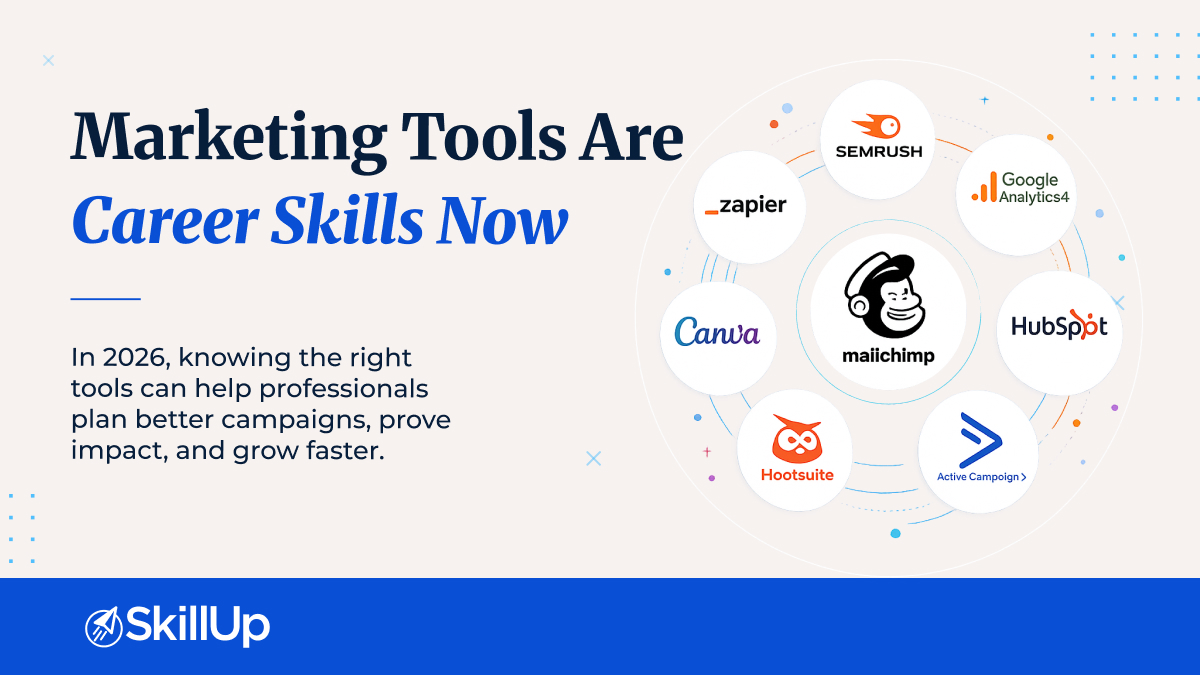
Be it the product, service or experience, reaching the customer requires resonating with the right audience in the right manner. Professionals who can identify audience behavior, analyze campaigns, and act on data are the ones employers trust with bigger roles. Proficiency in the right marketing tools is what separates those who grow from those who stagnate. Here are 9 marketing tools worth mastering in 2026.
What Makes a Marketing Tool Worth Learning for Career Growth
While watching an ad or its marketing approach, were you able to pinpoint what the company did wrong and where they could have improved?
If your answer is yes, you already hold some experience and think in a way that is valuable in marketing. This kind of business awareness can become a career advantage when combined with the right tools and practical skills. It can even become a stepping stone for career growth.
But the worth of the choice of marketing tools to learn is determined by how they improve job relevance, decision-making, business impact, and earning potential. The best tools can attract customers, measure performance, and drive revenue with ease.
Tools With Wide Industry Adoption Across Roles and Sectors
The right approach while choosing is to prioritize tools used across industries, such as retail, healthcare, finance, education, technology and e-commerce. Platforms like Canva, Google Ads, Salesforce, and Mailchimp hold value due to their application across multiple business functions.
Platforms That Appear in Job Descriptions at Scale
This is the more relevant and specific approach for the role and sector. Learning such tools and demonstrating practical experience improves resume value, helps get past ATS, and increases hiring competitiveness.
Tools Linked to AI and Automation Capabilities
Efficiency is one of the most valued aspects in every company and industry. Tools that offer AI content support, smart targeting, automated workflows, and predictive insights can help save time and improve results. Choosing them increases workplace value.
The 9 Marketing Tools Worth Adding to Your Professional Skill Set
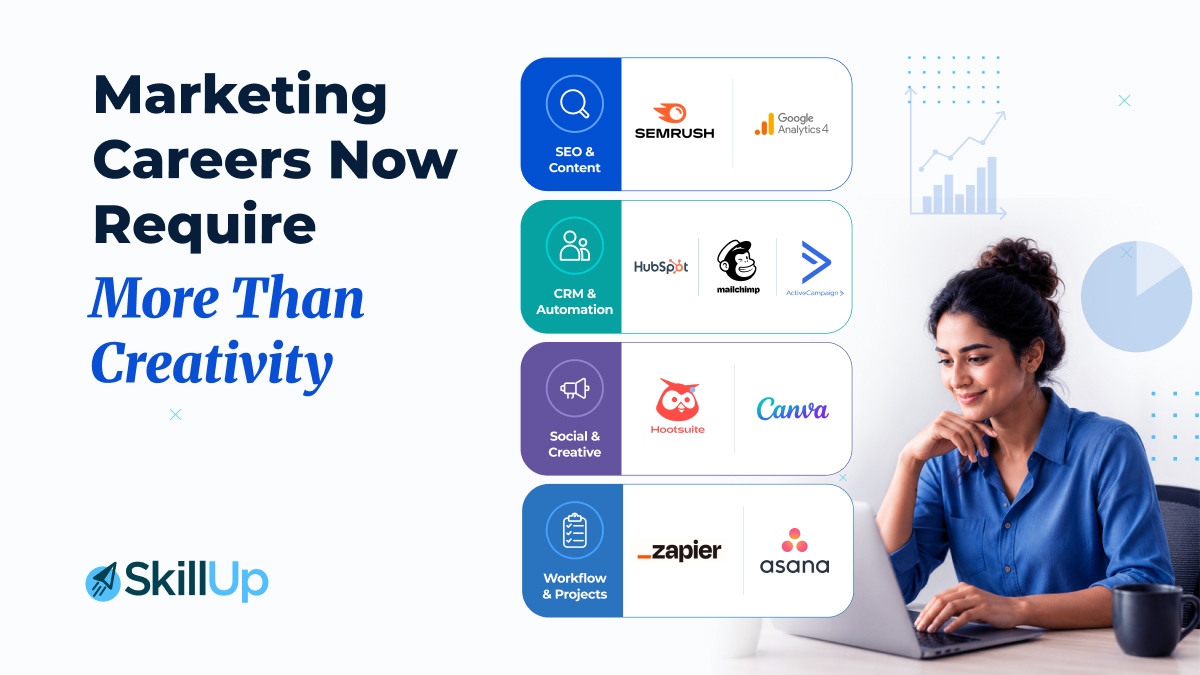
Marketing tools are known for their wide variety of features. Knowing their capabilities and understanding the skill gap offers an idea of how to begin when considering what the best marketing tools in 2026 are. The top marketing tools that fit in a wide number of sectors are as follows:
SEMrush: SEO, Competitive Research, and Content Strategy at Scale
Among SEO tools, SEMrush is a software system and a comprehensive digital marketing platform that helps users improve their websites and rank better on search engines. It possesses features like keyword research, rank tracking, AI SEO and content optimization.
The proficiency in SEMrush strengthens practical skills in SEO analysis, competitor research, content planning and digital growth strategy. It makes professionals valuable in performance-driven marketing roles.
Google Analytics 4 (GA4): The Standard for Marketing Analytics and Performance Reporting
Google Analytics 4 (GA 4) is an AI-powered, privacy-centric platform and one of the most popular marketing analytics tools. It offers comprehensive analytics and advanced features to measure website and app engagement.
It is an event-based data model that is based upon user interactions like video plays, form submissions and clicks. The tool helps develop skills like the ability to optimize ad spend and understand campaign ROI. These are preferred for data-driven decision making and audience targeting highly valued across industries.
HubSpot: All-in-One Marketing Automation, CRM, and Campaign Management
HubSpot is a customer platform that offers customer service, data management, marketing, sales and content management features necessary for businesses to attract and retain customers.
Learning the tool helps professionals understand customer journeys, campaign management, lead nurturing and business communication from a centralized system. The platform also develops skills in campaign analysis, customer engagement and others which employers seek in performance-driven roles.
Hootsuite: Social Media Management and Performance Tracking Across Channels
Hootsuite is a social media marketing tool designed to offer one dashboard for engagement, scheduling, analytics, and listening to multiple social media platforms. It is best suited to save time, measure ROI, and manage team workflows.
The platform is worthy for professionals aiming to build practical skills in social media strategy, campaign coordination, audience engagement and performance analysis. The businesses investing in multi-platform digital presence would value the skills, as they can strongly benefit from digital marketing.
Canva: Visual Content Creation for Marketing Professionals Without a Design Background
Canva is a web-based graphic design platform that offers space to design posters, presentations, social media graphics, documents, and others. It comes loaded with features that allow room for creativity.
Using Canva allows professionals to quickly translate ideas into visually engaging content without requiring formal design training. It builds practical skills in visual communication, branding consistency, content storytelling and marketing creativity. This is widely required in content-driven roles and digital marketing.
Mailchimp: Email Marketing, Audience Segmentation, and Campaign Automation
Mailchimp is among the well-known email marketing tools that find uses in business for email marketing, audience segmentation, automation, and analytics. It allows measuring engagement, building subscriber lists, and more through its built-in features.
The hands-on experience with Mailchimp can be applied to demonstrate the relevant skills like performance analysis, marketing automation and others. These skills are valued in digital marketing roles due to their ability to support customer acquisition, retention and data-driven campaign optimization.
ActiveCampaign: Advanced Email Automation and Behavior-Based Customer Journeys
ActiveCampaign is an all-in-one platform that supports marketing automation and CRM. Its applications in industries involve creating personalized customer experiences through automated email, SMS, and messaging workflows.
ActiveCampaign develops skills like customer journey mapping, marketing automation strategy, lead nurturing and data-driven personalization. The roles in CRM management or lifecycle marketing require professionals with these skills.
Zapier: Workflow Automation That Connects Your Entire Marketing Stack
Zapier is a no-code automation platform that builds and scales AI workflows and agents across over 9000 apps. It offers numerous built-in tools and features for professionals, like data formatting, scheduling, webhooks and multiple AI productivity features.
Zapier adds value to the career by developing practical skills in workflow automation, system integration, process optimization, and no-code AI orchestration. It enhances the candidature by enabling faster operations, reducing manual effort, and improving productivity across operations, marketing, and business automation roles.
Asana: Project and Campaign Management for Marketing Teams
Asana is a work management platform best suited for workflow automation, project tracking, and team collaboration. It allows creating automated rules, setting up tasks, utilizing diverse views, and managing team goals as per strategic objectives.
Familiarity with the tool builds strong project coordination, campaign execution and task prioritization among the professionals. These are required in marketing and operation roles to help with accountability, delivery speed and structured execution of complex projects across teams.
Building a Tool Stack That Matches Your Career Direction
The key to expecting results while learning marketing automation tools is to make a systematic choice. It means the list that will be appropriate for a candidate will match their current role, future goals and the kind of responsibilities they are aiming for. Here are some suggestions for different types of professionals on how they can proceed:
The Core Tools Every Marketing Professional Should Know First
Marketing professionals must be familiar with:
- Customer relationship management (CRM)
- Email marketing tools
- Social media management tools
- Advertising tools
- AI tools
- Lead capture and conversion tools
- Search engine optimization (SEO) tools
Tools to Prioritize if You Are Moving Into a Senior or Strategy Role
Stepping into a senior or strategy role requires focus on growth decisions, ROI, and cross-channel strategy. Professionals aiming for manager, head or other such roles should prioritize advanced analytics tools like Google Analytics (GA4), CRM platforms like Salesforce, HubSpot, dashboard tools and customer insight platforms.
Tools to Prioritize for Revenue and Growth Roles
If your goal is business growth, sales alignment, or demand generation, focus on tools linked to leads and conversion. Email marketing tools, social media marketing tools, ad platforms, landing page tools, and funnel analytics tools are valuable here.
How to Actually Demonstrate Tool Proficiency to Employers
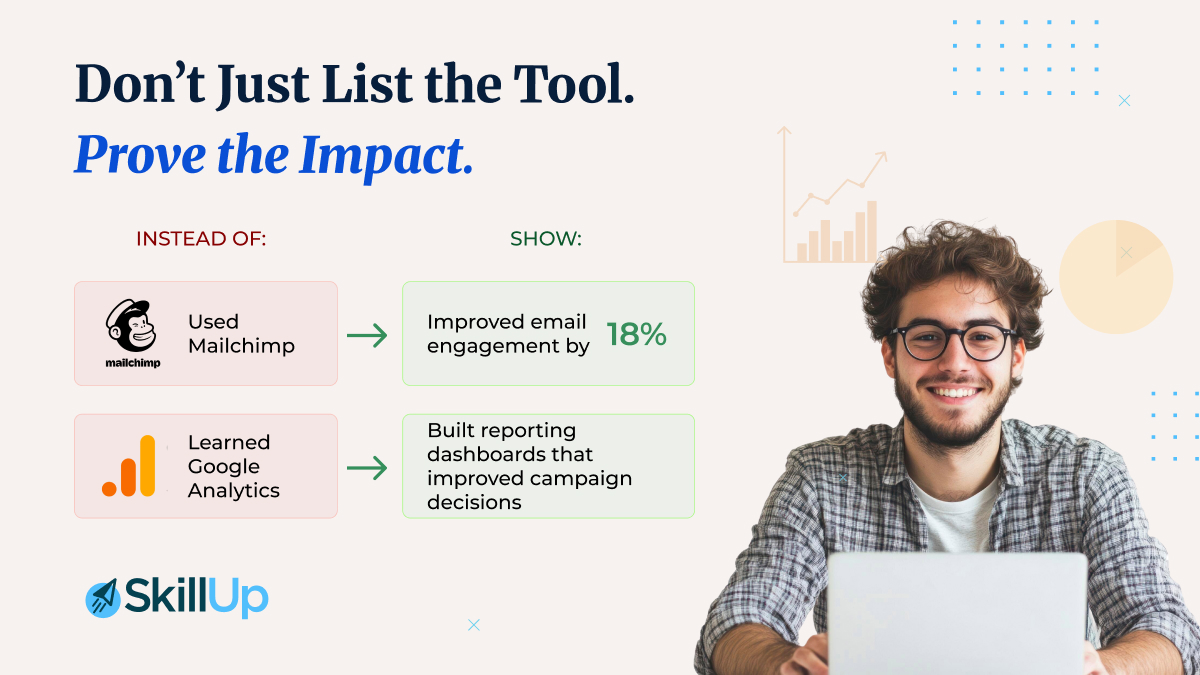
Post learning, the demonstration is the next task to deal with to benefit from the efforts. Even this is how recruiters and hiring managers assess tool familiarity. They look for figures rather than words like ‘completed’ or ‘earned a certificate’. So, showcase the proficiency in terms of what matters, i.e., by creating business impact. Let’s learn how:
Showing Tool Experience Without a Formal Job Title Change
Use the learned tools in the existing role (as you would have chosen them based on the skill gap in your job responsibilities). While you may have come across use cases, here are some additional suggestions to use:
- A sales agent can use HubSpot to track leads and improve follow-up response time
- A product manager can use Hotjar or user behavior tools to improve the sign-up flow
- A founder can use Mailchimp to improve customer retention through email campaigns
Portfolio Signals That Prove Competency Beyond Certifications
This is another great example to showcase your capabilities both in the existing role and to other employers in the market. The portfolio would boast about your capabilities like this:
- The SEO project increased organic traffic in six months
- Google Ads campaign reduced cost per lead by 2%
- Canva brand kit used across multiple campaigns
- Looker Studio dashboard tracking weekly marketing ROI
Highlight Outcomes
In short, instead of just writing the tool name, quantify the outcome. Mention how the tool helped increase leads, contributed to the team’s efficiency, improved reporting speed, reduced costs, or optimized campaigns.
Be Updated and Relevant
Employers would be more impressed with what they currently use, both in terms of the tool and its version. Thus, prioritize commonly adopted platforms within your company, role, and sector.
Where AI Fits Into the Modern Marketing Tool Stack
AI is being used at two stages. One is for data collection, which comes from search engines like Perplexity or Google’s AI Mode. The other is for marketing via:
- Sentiment analysis and customer insights
- Content creation
- Predictive analytics and forecasting
- Hyper-personalization
- Marketing automation
- Search Engine Optimization (SEO)
This saves the time and effort of the marketing team. Even with the help of AI, the first drafts are quicker with similar opportunities for creativity, the content is well-aligned as per the engagement data, the daily workflow in campaign planning and data reporting becomes efficient, and much more is seen.
Which of These Tools Now Have Native AI Capabilities
Numerous commonly used tools have upgraded themselves to offer native AI capabilities. While the list goes on, a few examples are:
- HubSpot has ‘Breeze’
- Salesforce has ‘Einstein’
- Canva has ‘Magic Studio’
- SEMrush has ‘ContentShake’
Skills That Remain Human-Led Even as Automation Expands
While AI has changed and enhanced efficiency, there are still certain shortcomings. These can be fulfilled by humans, and this is exactly what the recruiters look for. In the marketing industry, these gaps include a lack of creative and new ideas, an inability to empathize, offering biased AI content, and much more.
Human candidates who can identify and overcome these are not only welcome, but also highly valued. These can be worked upon by setting the goals and brand direction, crafting emotionally resonant and culturally sensitive content, ensuring data privacy, and developing brand strategies that are more valued.
This serves as the direction on where to identify the problems and how to act on them.
The Smartest Way to Learn These Tools Without Starting From Scratch
Professionals seeking career growth do not need to restart their careers. For them, the smartest approach involves enhancing their experience by upgrading their deliveries in their current responsibilities.
Why Scattered Tutorials Produce Surface-Level Knowledge
The one thing that seems intriguing and is freely available is random YouTube videos. While they seem like an obvious choice to start, what you get here is a disconnected tutorial that teaches either one aspect or surface-level knowledge.
It may familiarize you with basic functions or some additional details, but it will not provide detailed knowledge like running a campaign, building a dashboard or solving business problems.
For example, watching separate videos on Google Ads may teach campaign setup, but will lag on budgeting, targeting, conversion tracking, and optimization together.
Structured Learning Paths That Build Real Working Proficiency
Instead, the recommended actions here include opting for a structured path that is actually implementable due to the completeness of the information. This is because these paths combine setup, execution, troubleshooting, reporting, and strategy.
For instance,
HubSpot: CRM basics → pipeline setup → automation → reporting
Canva: Brand kit setup → templates → social creatives → presentations → campaign assets → team collaboration
Zapier: App connections → trigger/action basics → workflow automation → multi-step zaps → error handling → process optimization
Applying Each Tool Within Your Current Role Before Switching Jobs
This is the next step of implementation after learning. It helps demonstrate results by allowing instant application within the current job. For instance, marketing executives can use Google Analytics 4 to identify top-converting channels.
Similarly, a customer success manager can use ActiveCampaign to automate onboarding emails, renewal reminders and customer engagement sequences. Existing social media managers can use Hootsuite to schedule posts, monitor engagement and manage multiple brand accounts from one dashboard.
If you are a professional seeking a structured path or assistance for hands-on experience, SkillUp offers exactly what you need. Explore the Certificate Program in AI Augmented Digital Marketing that offers market-relevant guidance right from experts, along with the opportunity to develop in-demand skills within a duration of 4 months.
Read More – What Is a Digital Marketing Specialist? Skills, Salary, and How to Become One

SkillUp Online