AI in Healthcare for professionals is reshaping how clinical and operational decisions are made. If you are a healthcare professional navigating career growth today, this guide will help you understand how AI is influencing roles, workflows, and future career paths and how you can stay relevant.
Maybe you have seen AI pop up in meetings, in project plans, or even tossed around by leadership as the next big thing in your hospital’s strategy. And honestly, it feels intimidating.
But here is the truth: AI is not here to replace you. It is here to upgrade you. Professionals who understand this are choosing to upskill in AI not out of fear, but out of career strategy and confidence.
This shift isn’t about hype, it is about employability, credibility and future role continuity. Let us explore why AI really matters in healthcare and what’s driving mid-career professionals to upskill.
How AI is Reshaping Healthcare Right Now?
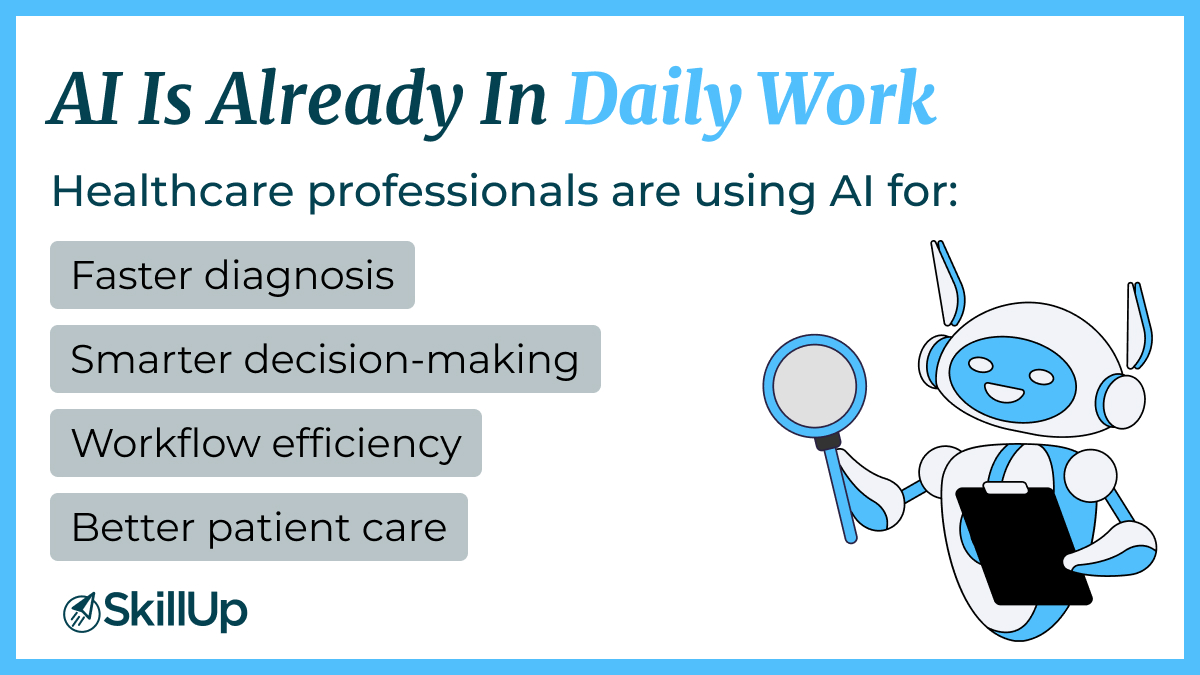
AI adoption in healthcare is no longer an experiment. It is real, measurable and accelerating across the world.
AI is quickly becoming a trusted assistant in healthcare, with doctors around the world increasingly relying on intelligent tools to support faster diagnoses, smarter decisions, and more efficient patient care.
What does that mean? Tools are moving from optional add-ons to daily workflow components in hospitals and clinics.
Clinicians are rapidly embracing AI in their daily work, using intelligent tools to enhance diagnosis, streamline workflows, and deliver more efficient patient care. This isn’t some niche trend. This is transforming how care is delivered, and healthcare professionals are noticing it really fast.
Why Mid-Career Healthcare Pros Are Choosing to Upskill?
Let’s get something straight: AI isn’t stealing jobs. But it is reshaping roles. And that’s exactly why the mid-career professionals are proactively upskilling in AI.
Here’s what’s driving the shift-
1. Job Security in a Changing Landscape
One of the biggest reasons healthcare pros are learning AI is job continuity.
AI tools are automating repetitive, manual tasks like documentation, scheduling, billing, coding, and basic data entry. This automation does not eliminate jobs, but it changes what work gets done manually.
Rather than being anxious about elimination, mid-career professionals are choosing to move upstream, towards tasks that require judgment, communication and decision support.
2. Workflows Are Already AI-Enhanced
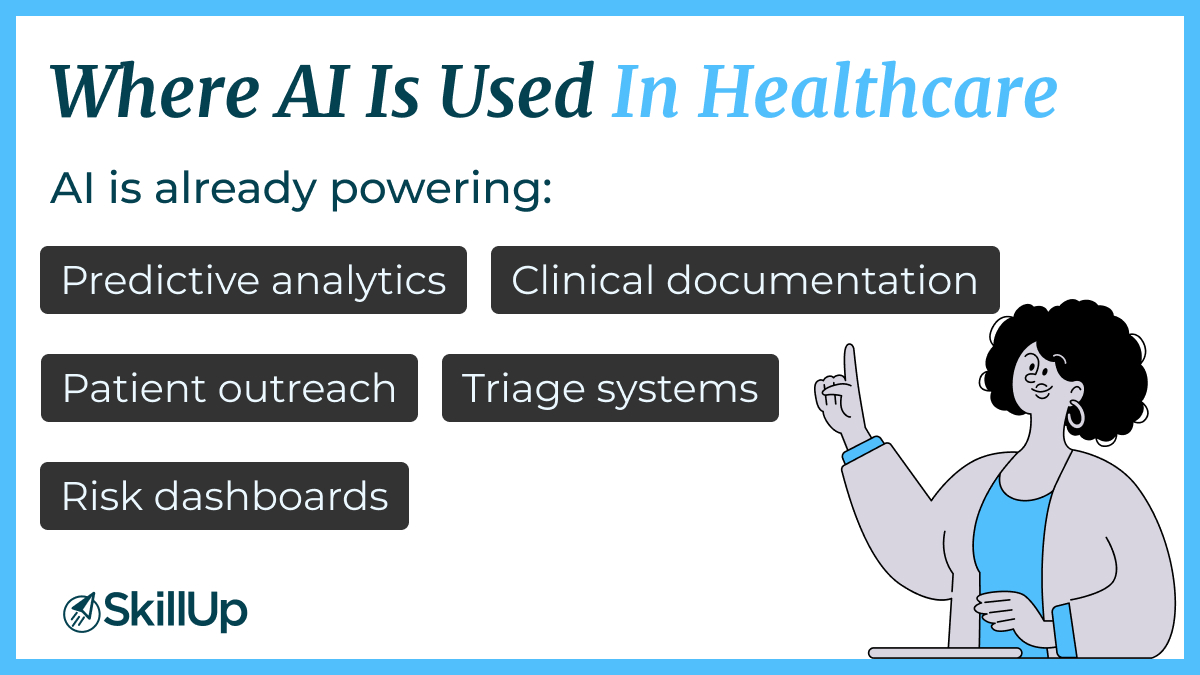
Whether you are in the clinic, on the admin floor or coordinating care, AI is already influencing workflows-
- Predictive analytics for risk stratification
- Automated clinical documentation
- Intelligent patient outreach reminders
- AI-assisted triage systems
- Data dashboards that highlight at-risk patients
These tools don’t operate in a vacuum; they require humans who can validate outputs, interpret insights and make ethical decisions. Those who understand AI become the professionals whose judgment is trusted in hybrid human-AI workflows.
3. AI Upskilling Brings Career Flexibility
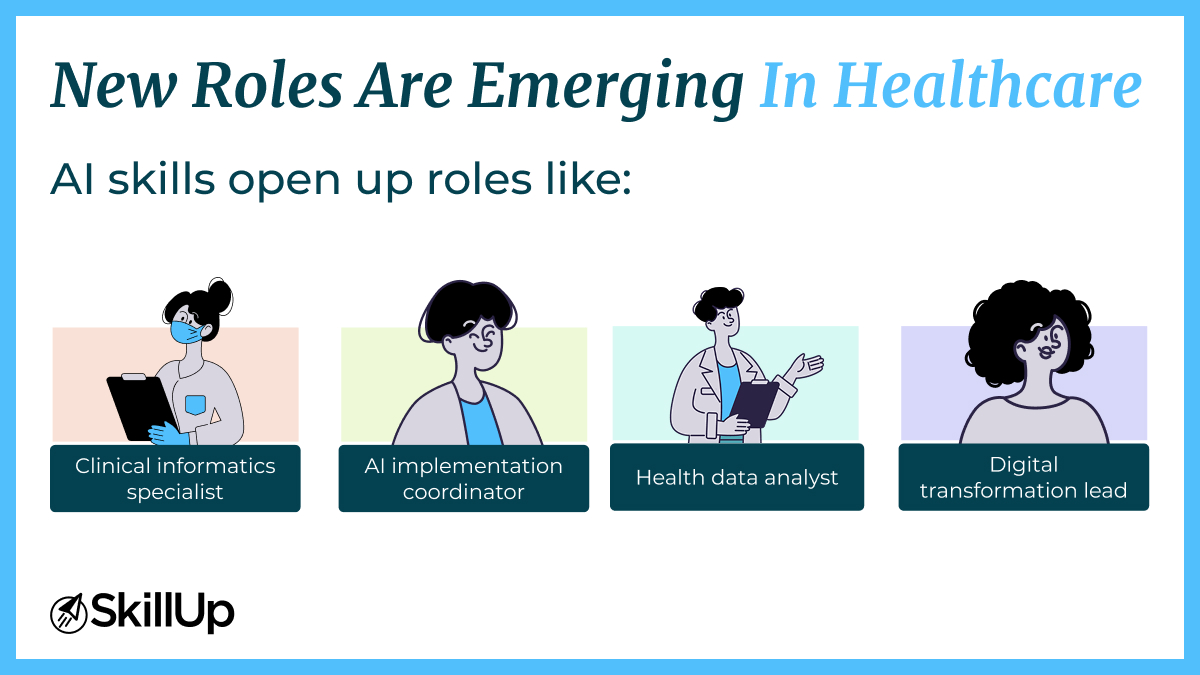
AI skills don’t just prepare you for one specific role, they open up a wide range of career opportunities, such as a career in:
- Clinical Informatics Specialist
- AI Implementation Coordinator
- Health Data Analyst
- Digital Transformation Lead
- Workflow Innovation Manager
- Patient Engagement Strategist
- Quality and Safety Analyst
These are not just for technical titles. They are also for the hybrid healthcare roles that blend your clinical insight with practical tech competence.
4. AI Skills Increase Decision Making Confidence
Let’s be honest: nobody wants to guess when it comes to patient outcomes and workflow decisions. AI tools generate data, trends and predictions; but they don’t interpret context. That’s your domain.
Healthcare professionals who upskill in AI:
- Understand how outputs are generated
- Know when to trust, question, or override suggestions
- Can explain and rationalize decisions
- Add a layer of evidence plus experience
That’s not replaceable by a machine. That’s your expertise enhanced.
The Market is Rewarding AI-Fluent Professionals
Here’s the exciting part: AI adoption isn’t shrinking jobs; it’s creating them.
The rapid adoption of AI in healthcare is opening thousands of new technology careers, creating exciting opportunities for professionals skilled in healthcare and emerging technologies.
This isn’t limited to data scientists or coders. These emerging roles demand people fluent in healthcare and technology; professionals with clinical insight who can bridge gaps between care delivery, IT, and management planning.
AI isn’t Just Clinical – It is Everywhere in Healthcare
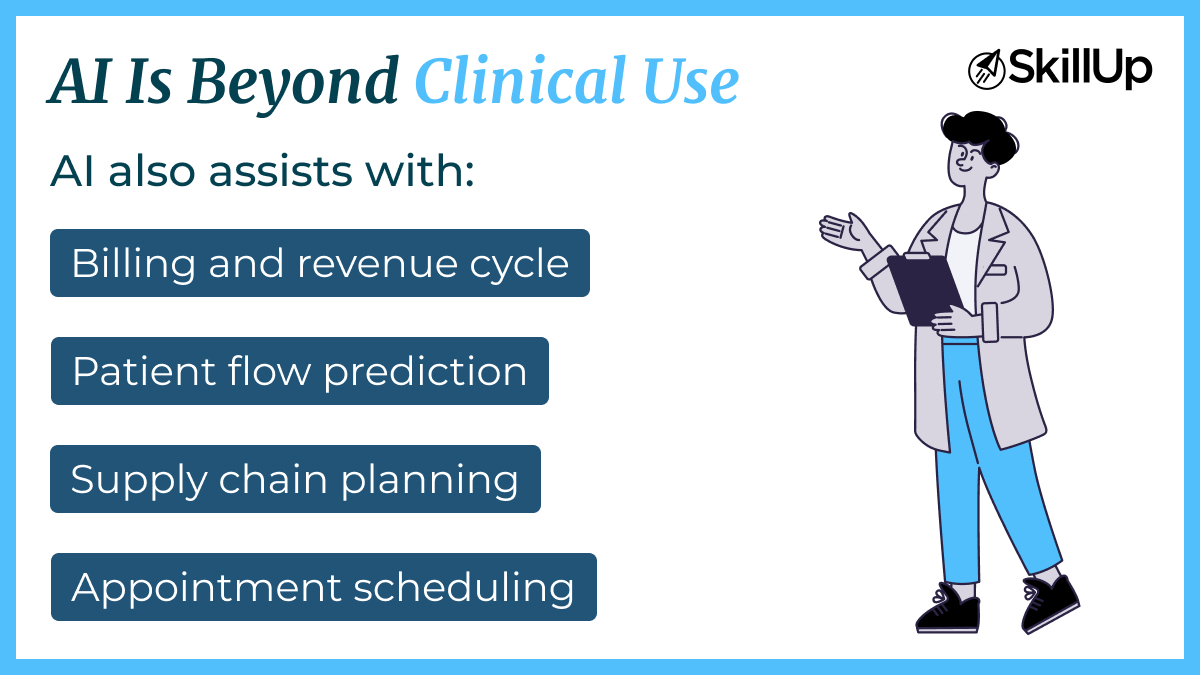
People often assume AI is only for radiology or diagnostics. That is not the case. AI is already integrated into-
- Administrative automation
- Revenue cycle and billing support
- Patient flow prediction
- Population health analytics
- Risk management alerts
- Supply chain forecasting
- Appointment scheduling optimization
For example, automation systems in revenue cycle management have helped process millions of transactions, saving thousands of staff hours per month and allowing employees to focus on more strategic tasks. That’s not a job loss, that’s role transformation.
Upskilling in AI Is About Staying Employable, Not Becoming a Coder
Let us dispel a myth: you do not need to become a software engineer to benefit from AI knowledge. AI fluency in healthcare means-
- Understanding how AI tools interpret data
- Knowing when to trust outputs and when human oversight is needed
- Applying AI insights to improve decisions
- Communicating technology-driven outcomes to peers and leadership
- Using AI ethically and responsibly
AI adoption isn’t exclusive to high-tech departments. Nearly every hospital project is asking for people who get tech as well as healthcare. That’s where AI upskilling becomes a necessity.
AI Upskilling Combines Experience + Digital Fluency
Look at AI like a multiplier. You already have years of clinical experience, empathy, coordination skills and patient care instincts. Add an AI upskilling foundation and you get a professional who can-
- Turn raw data into meaningful patient insights
- Lead improvement initiatives with evidence
- Collaborate confidently with IT teams
- Save time on manual tasks
- Reduce errors and improve outcomes
That relevance is keeping leaders ahead of change!
Overcoming Anxiety: Embrace AI as a Partner, Not a Replacement
It is understandable to feel uneasy. Any major shift in your profession can stir anxiety. But consider this: AI shines brightest when paired with human judgment.
- When administrative tasks are automated, nurses spend more time with patients.
- When documentation is handled by AI, clinicians can focus on critical thinking and care delivery.
- When data points are analyzed by machines, professionals can make informed decisions.
AI doesn’t erase your role, it redistributes your efforts toward what matters most.
Where Do You Start? Upskilling with Purpose
If you are ready to take this seriously, it’s important to choose a certificate program that is healthcare-focused, practical, and designed for working professionals.
Not generic AI courses or theory-heavy certificates. But applied, healthcare-centric AI learning that fits your schedule. Here is what you should look for in a good program-
- Real-world healthcare use cases
- Clinician-friendly language (no deep coding prerequisite)
- Scenario application in clinical and administrative workflows
- Ethical and governance frameworks
- Leadership and strategy emphasis
That is the kind of training that helps you stay employable and confident for future needs.
Level Up Your Career with SkillUp Online
Building AI credibility in healthcare today requires more than just theoretical knowledge, it demands hands-on, real-world application. The Certificate Program in AI for Healthcare is designed specifically for clinicians, administrators, and allied professionals who want to develop skills that can be applied immediately in their roles.
With a strong focus on practical learning, the program helps professionals stay relevant, confident, and prepared for evolving responsibilities in a data-driven healthcare environment. From understanding AI use cases to applying them in day-to-day workflows, the learning is structured to deliver real impact.
This isn’t just about keeping up with change, it is about being ready to lead it. Start your AI in Healthcare journey with SkillUp Online because your career deserves momentum, not uncertainty.
Final Thoughts: Your Career, Your Choice
Healthcare is not going anywhere. But the way you practice healthcare is evolving fast. Upskilling in AI does not mean you are chasing trends. It means you are positioning yourself for long-term relevance, confidence and role continuity.
If you want a future where your experience and expertise continue to matter and expand; AI skills are not optional. They are essential.
Choose to grow, lead and stay indispensable!

SkillUp Online