If you have ever wondered whether AI is coming for your job or if it’s just another overhyped tech term, you are definitely not alone. But let’s get this straight: AI isn’t here to replace you, it’s here to expand what you can do.
For nurses, operations teams, care coordinators and support staff, AI is creating new roles, greater career mobility, and opportunities to grow with healthcare transformation; not to shrink your role.
The reality is simple: as hospitals adopt more AI tools, they need people who understand both care and tech. That is where AI skills become power moves and not just threat indicators. Let us explore what is driving this shift, how AI skills unlock new roles, and what it means for your career in healthcare.
AI Adoption in Healthcare is Accelerating – Really Fast!
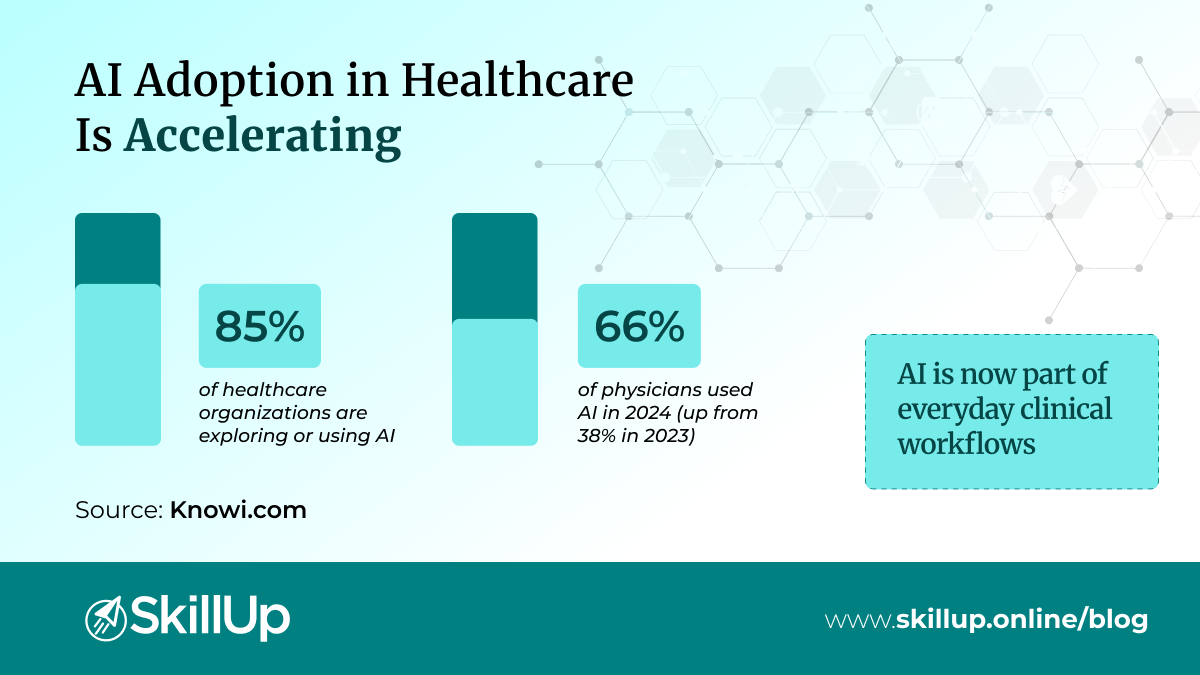
AI adoption in healthcare is still not coming, it is already here. Recent industry data shows that around 85% of healthcare organizations in the United States are exploring or actively adopting AI technologies, reflecting a rapid shift toward AI-driven operations and clinical decision support. Additionally, 66% of U.S. physicians reported using AI tools in their practice in 2024, up from about 38% in 2023 – embedding AI in everyday healthcare delivery.
This shift is not just about diagnostics or big tech, but it directly affects workflow, clinical decision support, patient monitoring, and back-office tasks. With more hospitals adopting AI every day, new job functions are emerging right alongside traditional roles.
Why AI Skills Matter for Healthcare Staff?
You are already skilled in patient care, coordination, and operations and that’s your superpower. Adding AI skills amplifies that expertise by helping you interpret data, collaborate with technology teams and make more informed decisions.
Here is why healthcare workers should care:
1. AI Makes Tasks Easier, Not Redundant
AI can automate repetitive work like documentation, scheduling and basic predictive tasks, freeing up time for higher-impact work like patient interaction and critical thinking. For example, AI tools have been shown to reduce documentation time and increase patient contact time for nurses, helping healthcare staff focus on what matters.
2. New Roles Are Emerging That Don’t Exist Yet
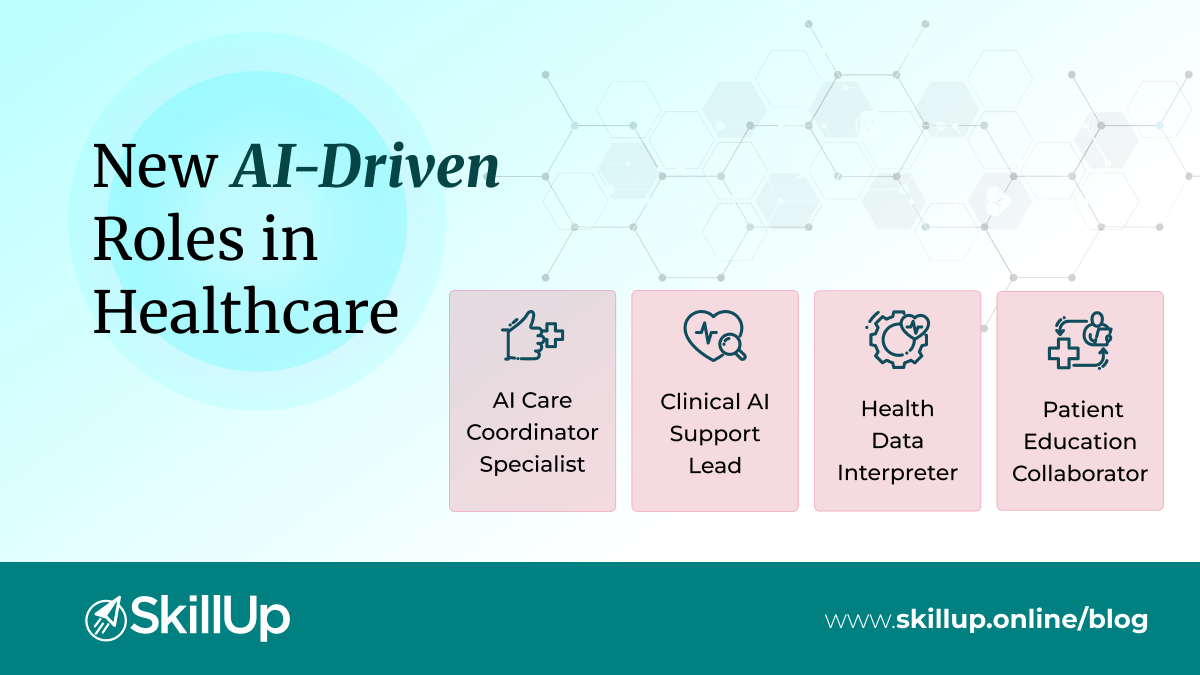
AI is not just a tool, it is also a source to generate new roles. Hospitals are hiring for positions such as-
- AI Care Coordinator Specialist: Integrates AI recommendations into patient scheduling and outreach routine
- Clinical AI Support Lead: Helps clinicians to interpret tool outputs
- Health Data Interpreter: Reviews AI-generated analytics for quality and compliance
- Patient Education Collaborator: Uses AI to create personalized education pathways
These roles blend healthcare knowledge with tech fluency, perfect for professionals who understand both.
Real Growth, Not Hype: Jobs AI Will Create
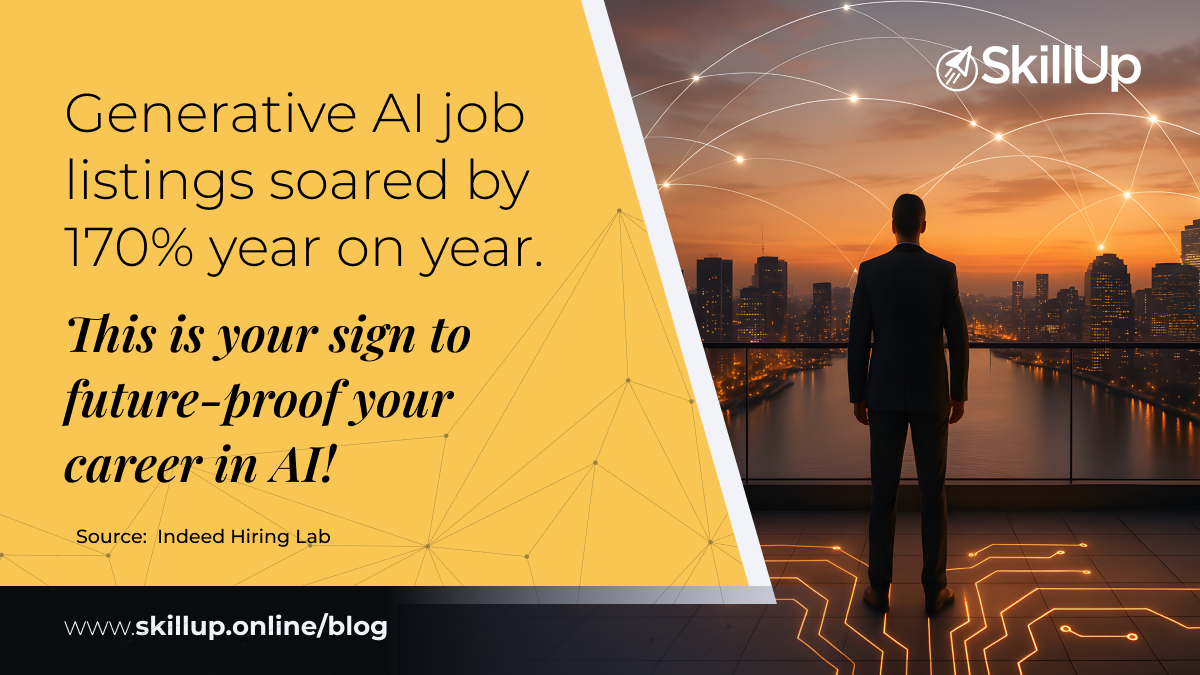
The AI trend in healthcare is lifting hiring, not shrinking it. In the US’s healthcare sector, 95% of net new jobs added in early 2026 came from healthcare. AI related job postings in the U.S. increased by about 25% year-over-year in 2025.
That’s huge! Many of those roles will require a mix of clinical insight and digital skills, especially in analytics, workflow optimization, informatics, and patient support coordination.
The Rising of Non-Clinical (Support) Roles with AI
AI in healthcare is often associated with diagnostics or advanced robotics, but its influence goes far beyond clinical decision-making. It is also transforming non-clinical and operational roles that keep healthcare systems running efficiently.
- Data Workflow Coordinators: Ensure patient and operational data moves smoothly between departments, AI platforms, and analytics systems.
- AI Process Facilitators: Help translate clinical requirements into practical AI solutions and support teams in adopting these tools effectively.
- Quality and Compliance Monitors: Ensure AI-driven recommendations align with healthcare regulations, safety standards, and organizational policies.
- Digital Health Liaisons: Bridge communication between clinicians and IT teams to ensure AI solutions enhance patient care and operational efficiency.
In many ways, these roles are evolutions of existing operational and coordination positions. The difference is that professionals now work alongside intelligent technologies to deliver more efficient and data-informed healthcare services.
Nurses Lead Adoption and Evolution
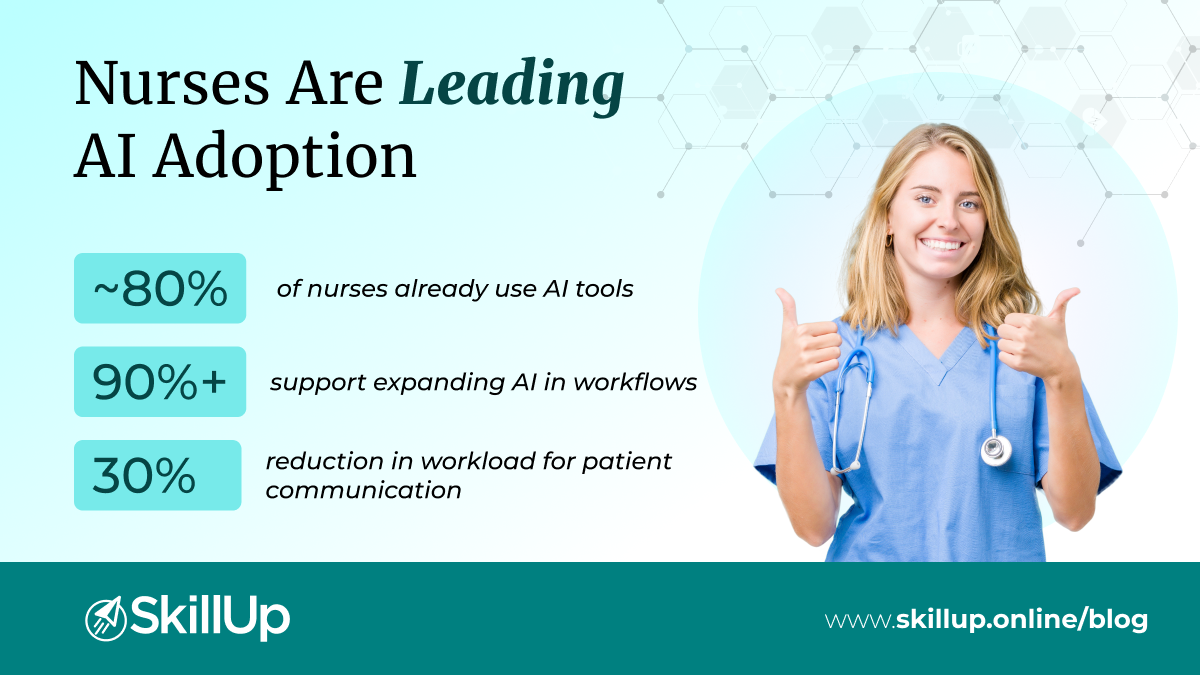
Nursing is often the backbone of patient care and nurses are at the forefront of meaningful AI adoption:
- Studies show that around 80% of nurses already use AI tools in patient care
- More than 90% of nurses now support expanding AI in clinical workflows
- AI-powered tools produce up to 30% reduction in nurse workload for patient communication.
AI isn’t sidelining nurses, but it is enhancing their impact. For example, predictive analytics can show early risk signals, helping nurses intervene earlier and more effectively. That is not replacement, that’s augmentation.
Operations Staff and Care Coordinators: AI Speaks Your Language Tool
Operations teams and care coordinators are already multitasking in complex systems. AI skills can help you:
- Forecast patient flow more accurately
- Prioritize tasks using predictive insights
- Create automated alerts for patients at high risks
- Improve communication between teams with intelligent collaboration tools
AI can reduce repetitive work and let staff operate smarter, not harder. You don’t have to become a coder – you just need to know how to interpret, work with and guide AI tools in your workflow.
How AI Skills Expand Career Mobility?
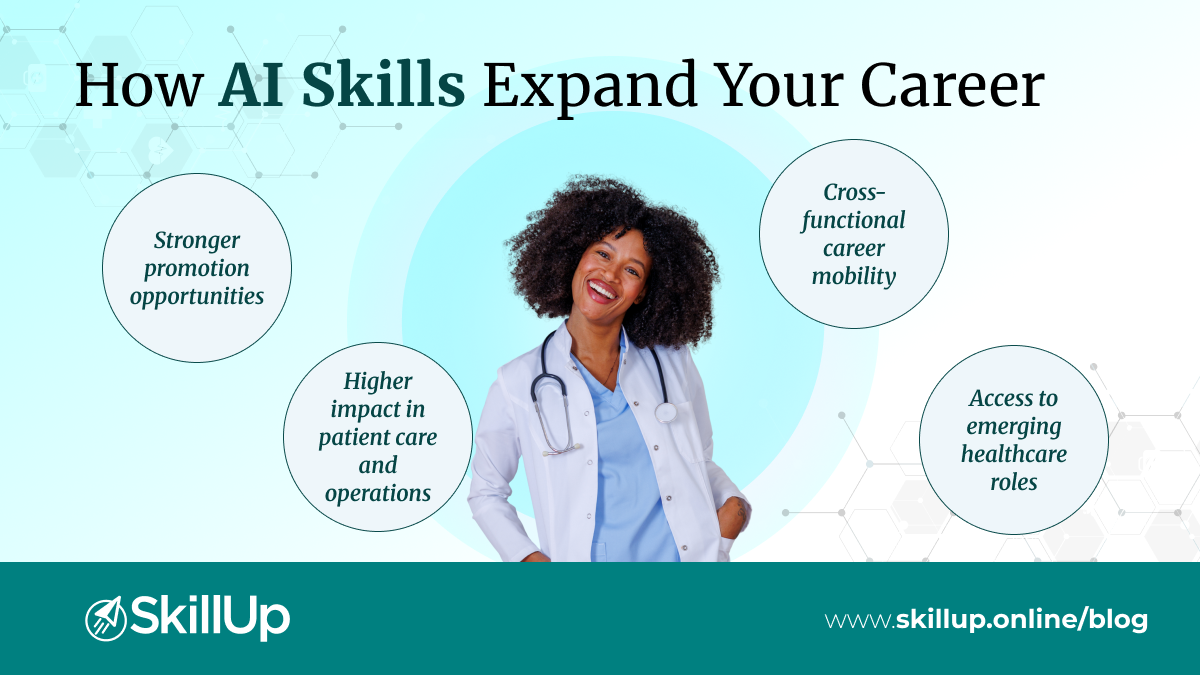
Adding AI skills to your resume today signals adaptability to employers who are expanding digital health initiatives. It directly influences:
- Internal promotions
- Diverse growth opportunities across departments
- Leadership pathways in clinical and administrative domains
- Eligibility for specialized and advanced roles
AI skills differentiate you; not just in technical teams, but across care delivery, patient engagement, operations, and management. It is a professional multiplier, the kind that keeps you relevant even with the evolving workflows.
Overcoming Fear: AI Is a Partner, Not a Competitor
Let us address a common concern in healthcare today: Will AI replace human jobs?
It is a question many professionals naturally ask when new technology enters the workplace. However, current workforce trends suggest a different reality. Rather than replacing people, AI is increasingly being used to support them by taking over repetitive and time-consuming tasks.
In healthcare, this often means automating administrative work such as documentation, scheduling, and data processing. By reducing these burdens, AI frees up time for what truly needs human expertise like patient care, empathy, critical thinking, and informed decision-making.
Healthcare will always rely on people. What is changing is the need for digitally empowered professionals who can work alongside intelligent technologies to deliver better outcomes.
What You Can Do Today to Strengthen Your Career?
The jobs of tomorrow don’t require you to be a tech wizard, but they do require digital fluency. Here is a practical roadmap you can start now:
- Take short courses on AI basics in healthcare
- Learn how AI impacts clinical workflows
- Understand how AI tools interpret and present data
- Explore how AI augments patient care and support roles
The key is not memorizing code, but it is understanding the context and application of AI tools in real hospital settings.
Final Thoughts: Your Next Move
Healthcare is one of the most stable, meaningful, and essential industries in the world and AI is amplifying that stability, not undermining it.
For nurses, operations staff, care coordinators and allied professionals, AI skills open doors to new roles that recognize your experience and augment your impact rather than replace it. Whether you are aiming for leadership, mobility, or simply more fulfilling work – AI fluency is a career multiplier and not a threat.
If you’re ready to embrace this shift with confidence, it may be worth exploring structured, industry-relevant AI learning. Look for programs like Certificate Program in AI for Healthcare that focus on practical modules, real-world case studies, and on-the-job application.
The goal isn’t just to understand AI tools, but to use them responsibly, enhancing patient outcomes while building skills that keep your career relevant and future-ready.

SkillUp Online