Healthcare organizations are under constant pressure to do more with limited time and resources. Hospitals, clinics, and health systems need to manage staffing challenges, rising administrative workloads, complex patient needs, large amounts of data, and growing pressure to improve both patient experiences and operational performance.
This is where artificial intelligence is becoming increasingly relevant.
The impact of AI on healthcare is not limited to futuristic robots or automated diagnosis. Today, AI can help healthcare teams organize information, automate repetitive work, forecast demand, improve patient flow, support clinical decisions, and identify operational risks.
The most useful applications are often the ones that help people do their jobs more effectively. AI can take on repetitive tasks and analyze large amounts of information, while healthcare professionals remain responsible for judgment, communication, patient care, and accountability.
The FDA notes that AI and machine learning can help derive insights from the large amounts of data created during healthcare delivery. At the same time, these technologies require careful management across their lifecycle.
What Is AI in Healthcare?
AI in healthcare refers to the use of technologies that can analyze information, recognize patterns, make predictions, generate content, or support decisions in healthcare settings.
Several types of AI are already relevant to healthcare operations:
- Machine learning identifies patterns in data and can make predictions or classifications.
- Generative AI can create summaries, drafts, reports, and other content from information provided to it.
- Natural language processing helps computers understand and work with human language.
- Computer vision analyzes images and other visual information.
For example, an AI system could forecast how many appointments a clinic may receive next week. Another could flag a patient who may need additional monitoring. A generative AI tool could prepare a first draft of an operational report.
These tools can support healthcare teams, but they should not automatically become the final decision maker. Human review remains important, particularly when patient safety, clinical judgment, privacy, or compliance is involved.
How Is AI Used in Healthcare?
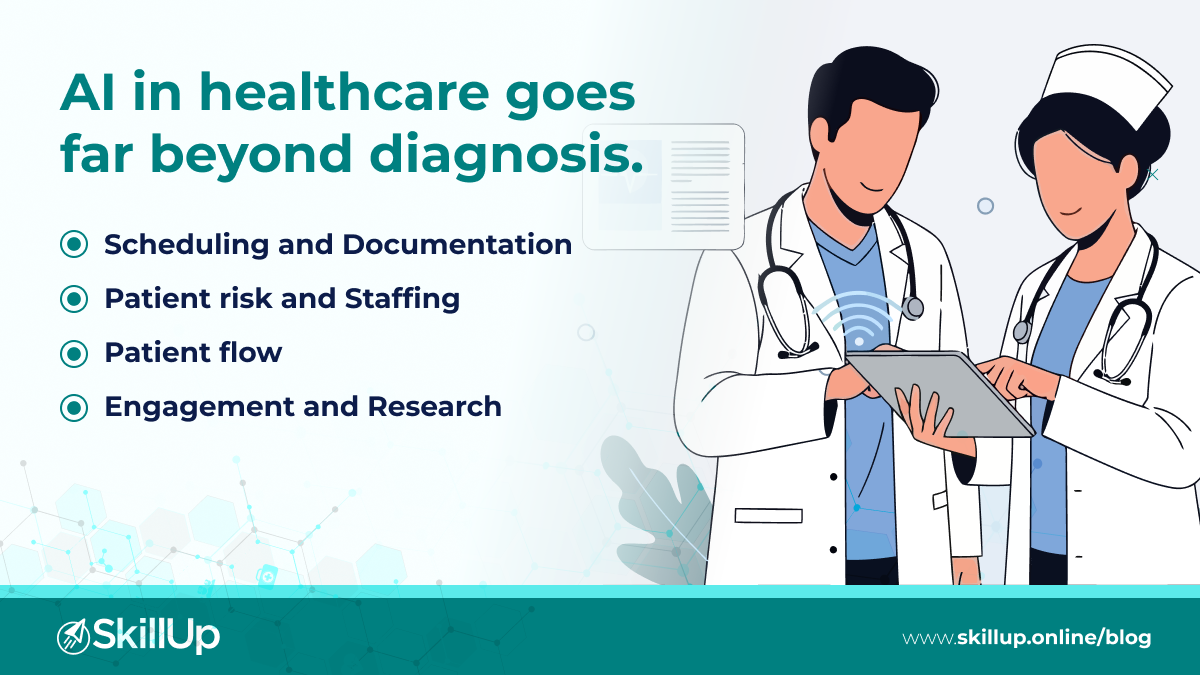
The question “how is AI used in healthcare?” has a much broader answer than clinical diagnosis. For healthcare operations managers, some of the most valuable applications involve the day to day processes that keep hospitals and clinics running.
1. Administrative Automation
Healthcare teams spend significant time handling scheduling, documentation, claims, referrals, and other repetitive processes.
AI can support:
- Appointment scheduling and reminders
- Patient registration and intake
- Insurance eligibility checks
- Medical coding support
- Claims processing
- Prior authorization workflows
- Referral management
- Call center assistance
- Document classification
- Workforce scheduling
These applications can reduce manual work and help teams handle high volumes more consistently. However, the staff still needs to review exceptions and correct errors when AI produces an inaccurate result.
2. Clinical Decision Support
AI can also support clinicians by organizing information and highlighting issues that may need attention.
For example, an AI enabled system may help:
- Highlight relevant information in an electronic health record
- Flag potential patient risks
- Support early warning systems
- Prioritize cases for review
- Support care coordination
- Assist with certain types of medical image analysis
The important point is that these systems are designed to assist, not replace, qualified healthcare professionals.
The FDA recognizes that AI enabled medical devices can provide information or support to healthcare providers, with medical devices subject to applicable regulatory pathways based on their risk and intended use.
3. Predictive Analytics and Patient Risk
Healthcare organizations collect enormous amounts of information. AI can analyze this data to identify patterns that may be difficult for people to spot manually.
Potential applications include:
- Readmission risk prediction
- Patient deterioration alerts
- Fall risk identification
- Chronic disease management
- Medication adherence support
- Preventive care outreach
- Population health management
For operations teams, this can help answer practical questions such as which patients may need additional support or where resources should be allocated.
However, a prediction is not a guarantee. Incomplete information, historical bias, and changes in patient populations can affect results. Healthcare teams need to validate AI outputs before acting on them.
4. Medical Imaging Support
AI is also used in areas such as radiology, pathology, dermatology, ophthalmology, and cardiology.
Computer vision can help identify patterns in medical images or prioritize cases for review. This may help clinicians work more efficiently, particularly when healthcare systems are dealing with large volumes of images.
However, AI should be viewed as a support tool rather than a universal replacement for trained professionals.
5. Generative AI and Documentation
Generative AI has created new possibilities for reducing documentation workloads.
Healthcare organizations may use these tools to help with:
- Drafting clinical notes
- Summarizing patient encounters
- Preparing discharge instruction drafts
- Organizing referral information
- Creating patient education materials
- Summarizing research
- Turning conversations into structured documentation
These applications can save time, but AI generated content must be reviewed carefully. A system can leave important information, misunderstand terminology, or produce information that sounds correct but is not accurate.
6. AI for Healthcare Operations
This is one of the areas where the impact of AI on healthcare can be especially meaningful for operations managers.
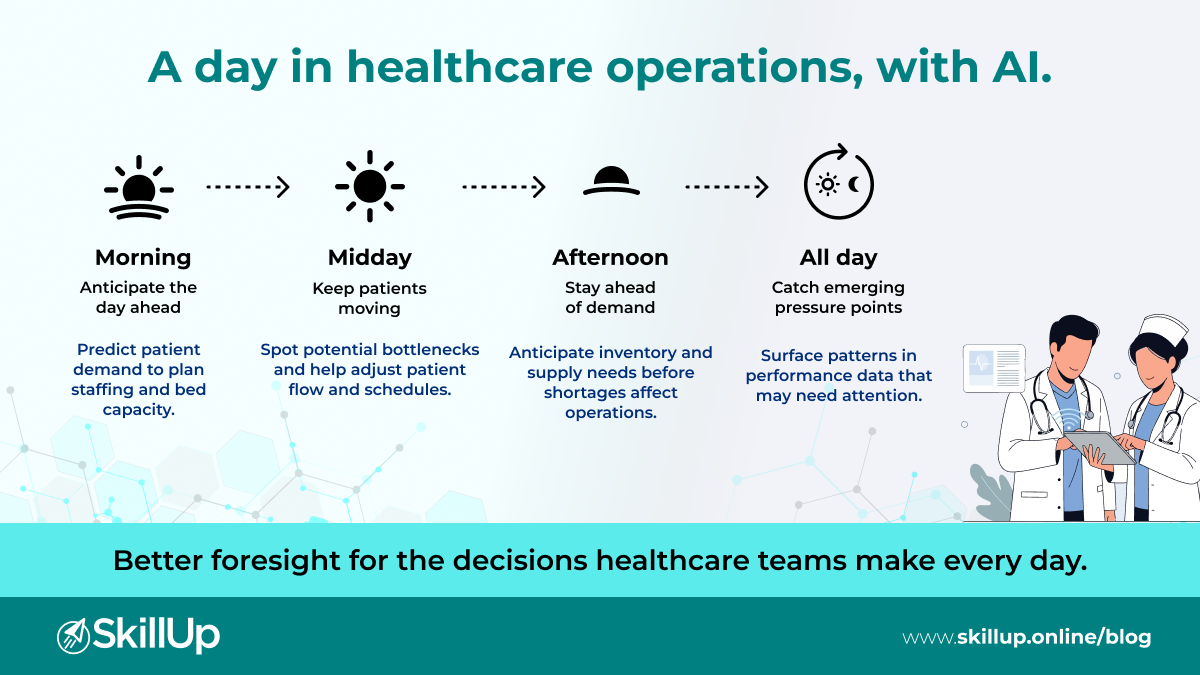
AI can support operational planning through:
- Bed capacity forecasting
- Staff and shift planning
- Emergency department demand forecasting
- Patient flow optimization
- Operating room scheduling
- Inventory monitoring
- Equipment maintenance
- Supply chain planning
- Revenue cycle monitoring
- Quality and performance dashboards
7. Patient Engagement
AI can also support routine patient communication.
Healthcare organizations may use AI for:
- Appointment reminders
- Frequently asked questions
- Service navigation
- Post discharge follow ups
- Patient education
- Multilingual communication
- Routine information requests
These tools can make communication more accessible, but patients should know when they are interacting with an automated system. Urgent or complex concerns should be directed to qualified healthcare professionals.
8. Research and Population Health
AI also has applications in clinical research, drug development, disease surveillance, clinical trial recruitment, and population health.
Healthcare operations leaders need to understand how research and population level insights can affect resource planning, care delivery, and organizational priorities.
The U.S. Department of Health and Human Services has identified AI as relevant to healthcare delivery, public health, biomedical research, and internal operations, while also emphasizing privacy, security, workforce training, and responsible use.
Benefits of AI in Healthcare
The benefits of AI in healthcare depend heavily on how well the technology fits the problem and how responsibly it is implemented.
- Improved operational efficiency
- Faster access to healthcare information
- Better staffing and resource planning
- Reduced administrative workload
- Earlier identification of potential risks
- Improved patient communication and support
- Better patient flow and care coordination
- Support for quality and safety initiatives
- More informed, data-driven decision-making
- More time for healthcare professionals to focus on tasks requiring human judgment
Will AI Replace Healthcare Workers?
AI is unlikely to replace healthcare workers as a whole. Instead, it is more likely to automate certain tasks and change how many healthcare professionals perform their jobs.
Routine activities such as scheduling, data entry, documentation, claims processing, coding support, and basic reporting may increasingly be handled with AI tools.
However, healthcare still requires human judgment, communication, empathy, physical care, and accountability. AI can support these responsibilities, but it cannot replace the people responsible for making decisions, managing complex situations, and caring for patients.
The focus, therefore, is shifting from whether AI will replace healthcare workers to how healthcare professionals can work effectively alongside these tools.
How AI Is Changing Healthcare Jobs
The impact of AI on healthcare is changing the responsibilities and skills required across many healthcare roles.
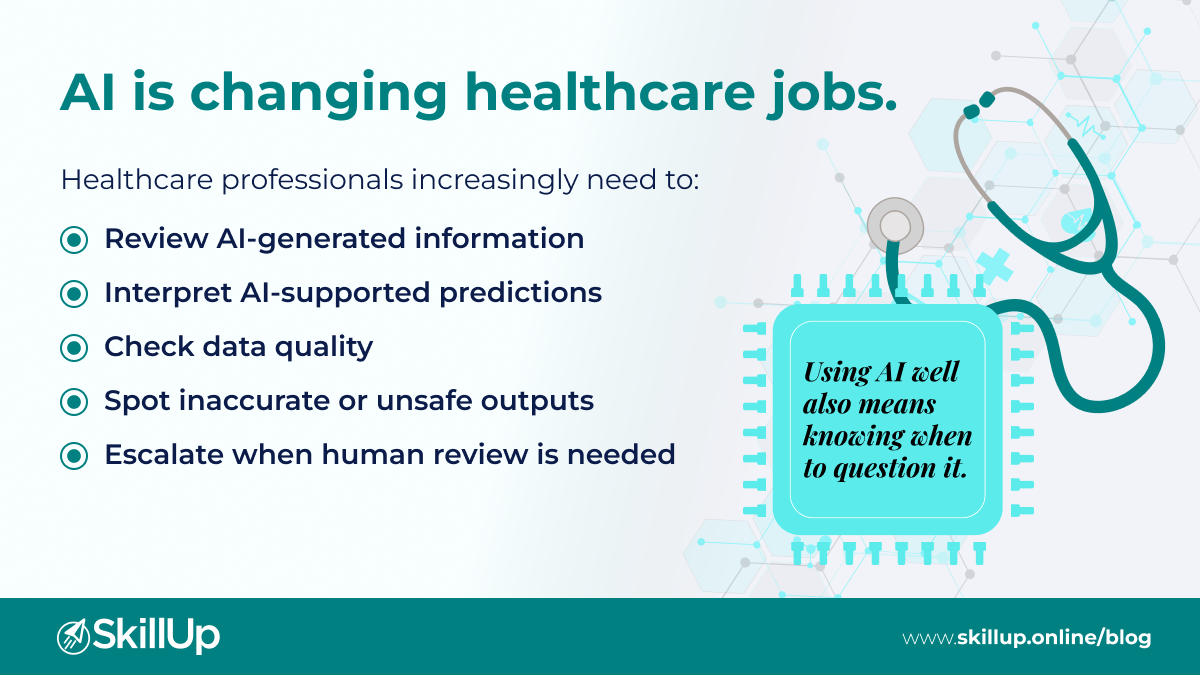
Healthcare professionals may increasingly need to:
- Review AI generated information
- Interpret AI supported dashboards and predictions
- Monitor system performance
- Check data quality
- Identify inaccurate or unsafe outputs
- Escalate issues when AI results require human review
- Understand the limitations of AI tools
For healthcare operations managers, these changes can create additional responsibilities. They may need to:
- Identify suitable AI use cases
- Review and improve existing workflows
- Evaluate technology vendors
- Define performance and success measures
- Develop business cases
- Coordinate AI implementation
- Train and support employees
- Monitor results after implementation
- Manage workflow and workforce changes
- Establish processes for reviewing and escalating AI-related issues
As a result, healthcare operations managers can play an important role in connecting technology with the practical needs of hospitals, clinics, and healthcare teams. AI adoption is not only a technology decision. It also involves workflow design, staff training, performance management, and responsible leadership.
Risks and Challenges of AI in Healthcare
The impact of AI on healthcare comes with important risks that organizations need to address.
Patient Privacy and Data Security
Healthcare data is highly sensitive. Organizations need appropriate controls for protected health information, access, vendor relationships, data retention, and system security.
Using AI does not automatically make a particular workflow compliant with HIPAA. Organizations must evaluate how information is collected, processed, stored, shared, and protected.
Bias and Health Inequities
AI systems can reflect problems in the data used to develop them. Healthcare organizations should monitor performance across relevant patient populations and look for unequal outcomes.
Incorrect Outputs
Generative AI can produce information that sounds convincing but is wrong. Human review is essential when AI-generated information could affect patients, records, operations, or compliance.
Lack of Explainability
Healthcare leaders would need to understand why an AI system produced a particular recommendation or alert. Systems that are difficult to understand can make oversight harder.
Regulatory Requirements
Healthcare AI may involve privacy rules, medical device regulations, professional requirements, reimbursement considerations, and state specific laws. The applicable requirements depend on what the technology does and how it is used.
Workflow Problems
Even a technically capable tool can fail if it creates extra work, produces too many alerts, or does not fit the way employees actually work.
A Practical Approach to Responsible AI Implementation
Healthcare operations leaders can take a structured approach to adoption of AI.
- Start with a clear problem: Choose a specific operational challenge where AI can provide measurable value.
- Review data and risks: Check data quality, privacy, security, and potential risks before implementation.
- Evaluate and test the tool: Assess vendors and test AI systems with representative data before wider deployment.
- Prepare your team: Define who is responsible for reviewing AI outputs and train employees on appropriate use and limitations.
- Monitor and improve: Track performance, accuracy, staff adoption, and operational results, and adjust or stop the system when it does not deliver safe, useful results.
HHS also emphasizes governance, risk management, privacy and security, workforce development, and ongoing oversight as important parts of responsible AI adoption.
The Future of AI in Healthcare
The future of AI in healthcare will likely involve technology becoming more closely integrated with everyday healthcare workflows.
Healthcare organizations may see greater use of:
- AI assistants within EHR workflows
- Ambient documentation tools
- Predictive staffing and capacity planning
- Personalized patient communication
- Remote monitoring
- Clinical trial support
- Population health analytics
- Automated operational reporting
- AI governance and monitoring systems
The biggest change may not be the technology itself. It may be the growing need for healthcare professionals who understand how to connect technology with real operational problems.
The future of AI in healthcare will require more than technical tools. Healthcare organizations will need people who can evaluate use cases, manage implementation, monitor results, address risks, and help employees adapt.
Building Skills for AI Enabled Healthcare Operations
Healthcare professionals who want to prepare for this changing environment can consider the Certificate Program in AI for Healthcare Operations Managers from SkillUp Online.
The program is designed for professionals working in healthcare operations, administration, clinical management, revenue cycle management, quality, and related leadership roles. It covers practical areas such as AI use case identification, vendor evaluation, medical billing and denial management, clinical workflow optimization, predictive staffing, patient flow, risk and governance, and implementation planning.
It also addresses the practical side of AI adoption. Learners work with areas such as ROI cases, workflow designs, AI implementation roadmaps, governance frameworks, and role specific AI playbooks. The program does not require prior coding or programming experience.
For healthcare operations managers, these skills can help bridge the gap between what AI can do and what a healthcare organization actually needs.
How AI Is Changing Healthcare and the Workforce
The impact of AI on healthcare will be significant, but technology alone will not determine whether that impact is positive.
AI can help healthcare organizations reduce repetitive work, improve operational planning, identify potential risks, support clinicians, and strengthen patient communication. At the same time, organizations must address privacy, security, bias, accuracy, explainability, regulation, and workforce readiness.
The key opportunity is not to remove people from healthcare. It is to help healthcare professionals use better information and better tools while keeping human judgment at the center.
As AI becomes more common across hospitals, clinics, and health systems, healthcare operations managers will have an increasingly important role in selecting, implementing, monitoring, and governing these technologies.
The future of healthcare will need professionals who understand both healthcare operations and responsible AI adoption.
Frequently Asked Questions
What is the impact of AI on healthcare?
The impact of AI on healthcare includes faster administrative processes, improved data analysis, clinical decision support, predictive risk identification, better resource planning, and more personalized patient engagement. It also creates challenges involving privacy, bias, safety, regulation, and workforce adaptation.
How is AI used in healthcare?
AI is used in healthcare for scheduling, documentation, medical imaging support, patient-risk prediction, claims processing, resource planning, patient communication, research, and clinical decision support.
How does AI help healthcare?
AI can help healthcare organizations reduce repetitive work, organize large amounts of information, identify potential risks, improve operational forecasting, and support more informed decisions.
What are the benefits of AI in healthcare?
The benefits of AI in healthcare may include improved efficiency, reduced administrative workload, faster access to information, better resource allocation, patient support, and assistance with quality and safety initiatives.
Will AI replace healthcare workers?
AI is unlikely to replace healthcare workers as a whole. It may automate certain tasks, particularly repetitive administrative activities, but healthcare professionals remain essential for patient care, communication, ethical judgment, complex decisions, oversight, and accountability.
What is the future of AI in healthcare?
The future of AI in healthcare will likely include greater use of AI assistants, predictive analytics, automated documentation, personalized patient engagement, intelligent operations planning, and stronger requirements for governance and ongoing monitoring.
What skills do healthcare operations managers need for AI adoption?
Healthcare operations managers need skills in workflow analysis, data literacy, AI evaluation, vendor assessment, privacy and security, change management, performance measurement, staff training, and responsible AI governance.
Read More – What is the AI Certificate Program for Healthcare Operations Managers?

SkillUp Online