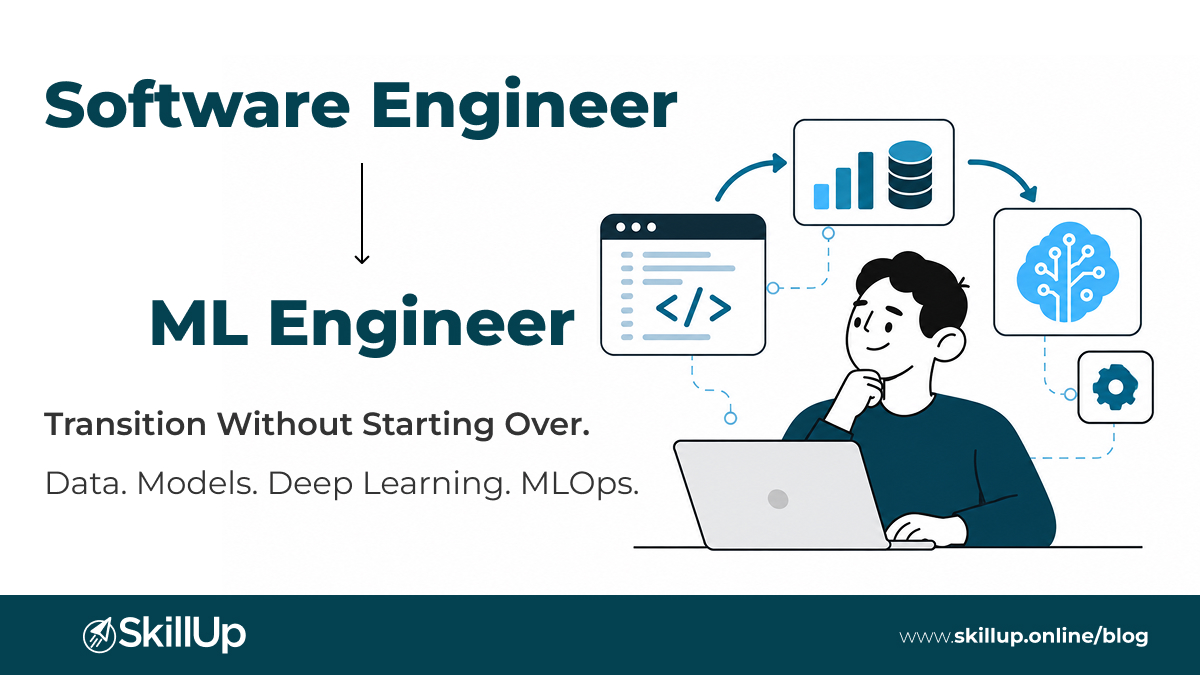
Moving from software engineering into machine learning is a practical career path for developers who want to work with data, predictive models, and AI applications. Software engineers already have a strong foundation in programming, system design, APIs, testing, and deployment.
The main shift is learning how to work with data driven models and the systems that support them. A software engineer to machine learning engineer transition requires additional knowledge of statistics, machine learning algorithms, deep learning, and MLOps.
The transition does not require starting from scratch. Your existing engineering skills provide a strong foundation while you build the ML specific skills needed for the work.
What Is the Difference Between Software Engineering and Machine Learning Engineering?
Software engineering and machine learning engineering share many core practices, but they solve problems in different ways.
Traditional software engineering relies mainly on rules and logic written by developers. The engineer defines how the system should behave for different inputs and builds the application around those requirements.
Machine learning engineering adds data and trained models to that process. Instead of defining every rule manually, engineers prepare data, train models, evaluate their performance, and integrate those models into software systems.
For a software engineer, the main differences are:
| Software Engineering | Machine Learning Engineering |
|---|---|
| Writes explicit application logic | Builds systems around trained models |
| Works mainly with structured requirements | Works with data, features, and model behavior |
| Tests whether software behaves as expected | Evaluates model performance using metrics and test data |
| Focuses on application reliability and scalability | Balances model performance with reliability and scalability |
| Uses standard CI/CD and deployment practices | Adds model versioning, monitoring, retraining, and MLOps |
The transition therefore involves more than learning new frameworks. You need to understand how data affects model behavior, how to select and evaluate models, and how to maintain them after deployment.
Your existing skills in Python, APIs, system architecture, testing, Git, CI/CD, and cloud deployment remain valuable. The new areas to develop are statistics, data preparation, machine learning algorithms, deep learning, model evaluation, and MLOps.
This makes the transition more of a skills extension than a complete career reset. The stronger your software engineering foundation, the more you can focus your learning on the parts of ML that are new to you.
Step by Step Roadmap for a Machine Learning Career Transition
There is no single timeline for a machine learning career transition. Your existing experience, learning pace, and target role will influence the path.
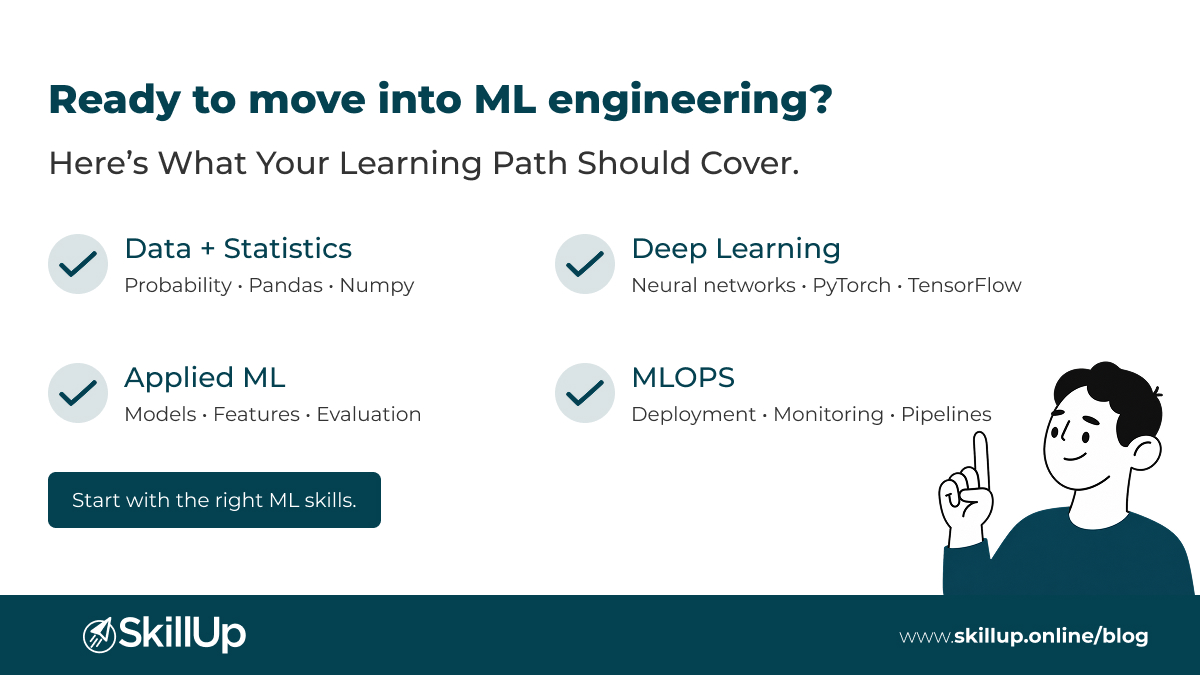
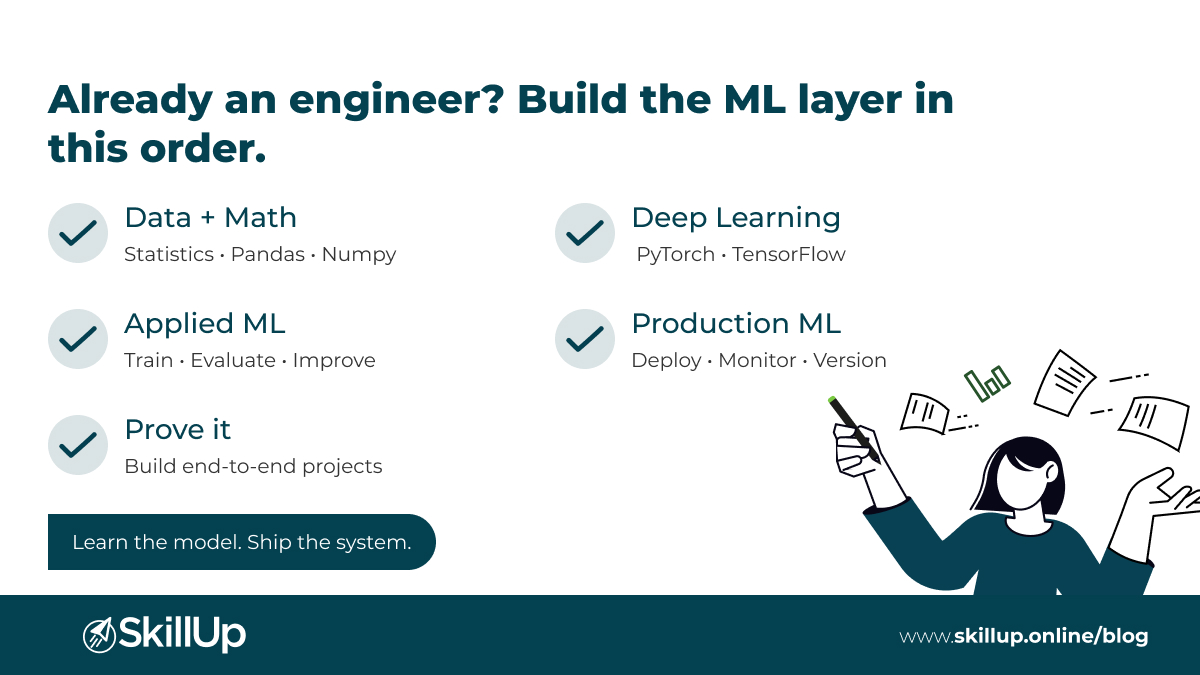
Step 1 – Strengthen Math and Data Foundations
- Build a working knowledge of
- Linear algebra and basic calculus
- Probability and statistics
- Data cleaning and preparation
- NumPy and Pandas
- Data analysis and visualization
Step 2 – Learn Applied Machine Learning
Learn supervised and unsupervised learning, regression, classification, clustering, feature engineering, and model evaluation using tools such as Scikit Learn.
Focus on the basic workflow of preparing data, training a model, evaluating results, and improving performance.
Step 3: Build Skills Based on Your Target ML Role
Not every machine learning engineering role requires deep learning. Once you understand core ML concepts, identify the type of work you want to pursue and build the relevant skills.
Deep learning is useful for roles involving areas such as computer vision, NLP, generative AI, and transformer-based applications. Other ML roles may place more emphasis on classical machine learning, data pipelines, model deployment, or MLOps.
Frameworks such as PyTorch and TensorFlow can be added when they match your target role. For developers interested in modern AI applications, knowledge of large language models (LLMs) and related tools can also be useful.
Step 4 – Develop MLOps and Production Skills
Learn how to take ML models into production through
- Model deployment
- Docker and cloud platforms
- CI/CD
- Model monitoring
- Data and model versioning
- ML pipelines
These skills connect machine learning development with your existing software engineering and DevOps knowledge.
Step 5 – Build a Practical Portfolio
Create end to end projects that demonstrate your ability to work with data, build models, and deploy ML applications.
Document the problem, approach, model evaluation, deployment process, and limitations. Relevant GitHub projects can give employers a clearer view of your practical work.
What Machine Learning Engineer Skills Are Needed?
Software engineers already have many transferable skills, but machine learning engineering adds skills related to data, model development, evaluation, and production systems.
Google Cloud’s current description of the machine learning engineer role highlights programming, data and ML pipelines, model architecture, MLOps, metrics interpretation, deployment, monitoring, and model optimization as key areas of the role.
Source- https://cloud.google.com/learn/certification/machine-learning-engineer
For software engineers planning a machine learning career transition, the skills to build can include:
| Skill Area | Software Engineering Foundation | ML Engineering Skills to Add |
|---|---|---|
| Programming and Data | Python, APIs, data structures | NumPy, Pandas, data preparation |
| Modeling | Algorithms and application logic | Machine learning algorithms, model evaluation, role-specific ML methods |
| Frameworks | Application frameworks | Scikit-Learn, PyTorch, TensorFlow, or other relevant tools |
| Architecture | Microservices, system design | ML pipelines, model serving, data workflows |
| Deployment and Operations | Git, CI/CD, DevOps | MLOps, monitoring, Docker, cloud platforms |
| AI Applications | Application development | LLM integration and AI evaluation where relevant |
The specific skills will vary by role. A developer moving into an MLOps-focused position may need more emphasis on deployment and infrastructure, while someone working with NLP, computer vision, or generative AI may need additional model-specific knowledge.
The goal is to build on your existing engineering foundation while adding the ML skills required for the type of role you want to pursue.
How Long Does It Take to Become a Machine Learning Engineer?
There is no fixed amount of time required to complete a machine learning career transition.
Your current programming experience, knowledge of mathematics and data, learning pace, and target role will all affect the process.
Instead of following a fixed timeline, set skill based goals. You should be able to work with data, build and evaluate models, deploy ML applications, and understand the systems supporting them.
What Career Paths Can Machine Learning Engineers Pursue?
Machine learning engineering can lead to several technical directions, depending on the systems you work with and the skills you build over time.
Potential career paths include
- Machine Learning Engineer
- AI Engineer
- MLOps Engineer
- NLP Engineer
- Computer Vision Engineer
Some of these paths involve a narrower technical focus. Work in natural language processing may require additional knowledge of language models and text processing, while computer vision often involves specialized techniques for working with images and video. These areas can require further hands-on experience beyond core machine learning skills.
Your next career move should therefore depend on the type of ML systems you want to build, and the additional expertise that role requires.
Why Consider a Structured AI and ML Engineering Program?
Self study can work well for experienced developers, but a structured program can provide a clear learning path and organized hands on practice.
When evaluating an AI and ML engineering program, consider the curriculum, practical projects, technologies covered, deep learning content, deployment, and MLOps training.
SkillUp Online’s TechMaster Certificate Program in AI & ML Engineering is designed for learners who want to build skills across machine learning, deep learning, AI applications, and production workflows. The program can provide a structured way for software professionals to build on their existing technical foundation while developing ML specific capabilities.
If you are searching for the best online AI and ML certificate program for software developers, compare the curriculum, hands on work, technologies, learning format, and how closely the program aligns with your career goals.
Frequently Asked Questions
How to transition from software engineer to machine learning engineer smoothly?
Build on your software engineering foundation while adding skills in statistics, data preparation, machine learning, deep learning, and MLOps. Practical projects can help connect these areas.
How to become a machine learning engineer if you already know Python?
Use your Python experience as a starting point and focus on statistics, data handling, ML algorithms, model evaluation, deep learning, and deployment.
What is the best online AI and ML certificate program for software developers?
There is no single program that suits every developer. Compare the curriculum, projects, frameworks, MLOps content, learning format, and program requirements before choosing one.
What machine learning engineer skills are missing from traditional software developer toolkits?
Common additions include statistics, data preparation, ML algorithms, model evaluation, deep learning, ML pipelines, model monitoring, and MLOps.
Why should software developers enroll in a structured AI and ML engineering program?
A structured program can provide an organized learning path and practical projects while helping developers focus on the ML skills they need to add to their existing experience.
What skills should software engineers focus on when moving into machine learning?
Focus on data handling, statistics, machine learning algorithms, deep learning, model evaluation, deployment, and MLOps while continuing to use your existing software engineering skills.

SkillUp Online