Finance is changing quickly, and choosing the best AI courses for finance professionals can help individuals adapt as artificial intelligence becomes increasingly integrated into forecasting, reporting, risk management, research, and everyday analysis. Professionals who understand both finance and AI can work more efficiently, interpret data more effectively, and contribute to technology-driven business decisions. That is why AI courses are becoming a practical career investment for finance professionals in 2026.
Why Finance Professionals Need AI Skills in 2026
Finance professionals today work in an environment where data-driven decision-making is the norm. AI is becoming a core part of financial workflows across industries. From automating reports to improving forecasts, intelligent technology is changing how financial tasks are performed. As organizations continue to adopt these systems, professionals who build relevant capabilities can gain an advantage in efficiency, accuracy, and career growth.
The AI Transformation of the Finance Industry
Banks, investment firms, accounting teams, insurers, and corporate finance departments use AI to process data, automate repetitive work, and generate insights. Generative AI can summarize reports, draft commentary, compare documents, and support research. As adoption grows, AI training for finance professionals is becoming relevant across traditional and modern finance roles.
How AI Is Changing Finance Careers
AI can reduce time spent on repetitive analysis while giving professionals more time for judgment and strategy. Analysts can automate parts of reporting, managers can compare scenarios faster, and executives can use AI-assisted insights during planning.
Future Skills Every Finance Professional Needs
Important skills include prompt engineering, financial data analytics, AI-assisted modeling, forecasting, automation, and responsible AI use. An AI program for finance professionals can bring these skills together in a structured learning path.
What Is AI in Finance?
AI in finance refers to the use of intelligent systems that can analyze large volumes of financial data, identify patterns, and support decision-making processes. It helps professionals move beyond manual analysis and use data-driven insights to improve efficiency and productivity. As financial systems become more complex, AI can simplify operations and support better business decisions.
Artificial Intelligence Explained for Finance Professionals
AI systems can analyze information, recognize patterns, generate content, and support decisions. In finance, these systems can work with transactions, market data, financial statements, customer records, and business reports.
AI vs Machine Learning vs Generative AI
Machine learning focuses on finding patterns and making predictions. Generative AI creates content such as summaries, reports, scenarios, and explanations. Understanding these differences helps professionals identify the right learning path for their career goals.
Common AI Applications in Finance
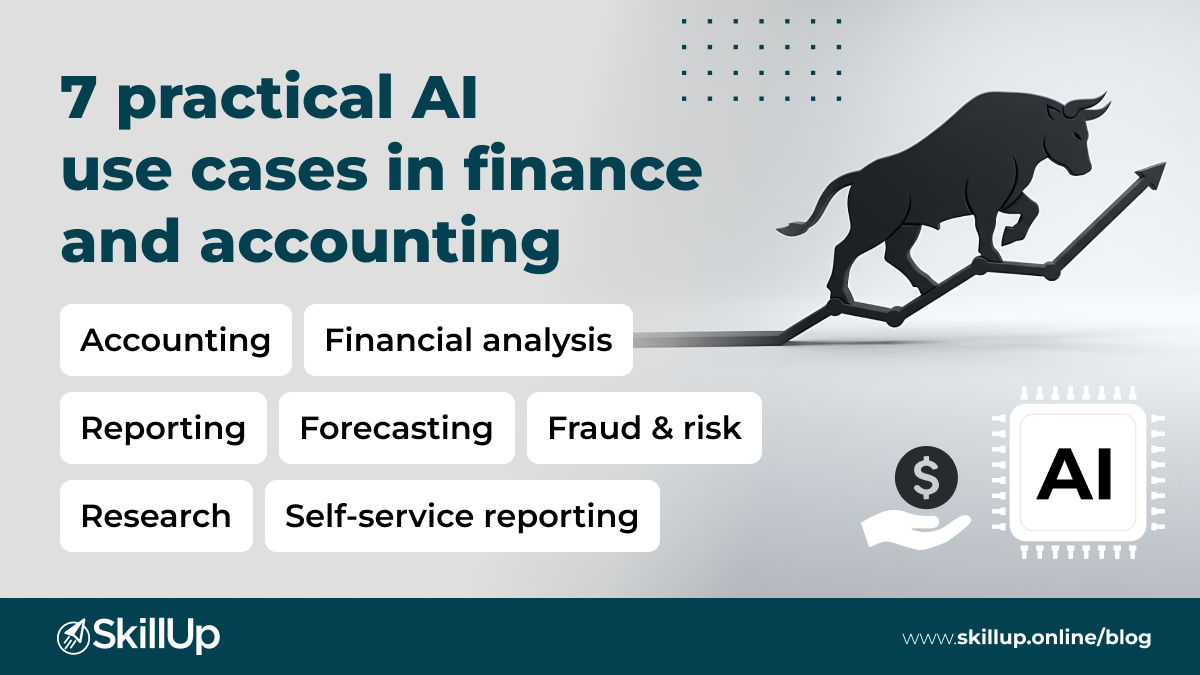
Common uses include forecasting, fraud detection, credit analysis, investment research, compliance monitoring, customer service, reporting, and document analysis.
Best AI Courses for Finance Professionals
Beginner courses should cover AI fundamentals and finance use cases. Intermediate programs can add modeling, forecasting, analytics, and automation. Executive programs should emphasize strategy, governance, and adoption. University, corporate, and self-paced options can suit different schedules and professional goals.
When comparing the best AI courses for finance professionals, consider the curriculum, practical projects, instructor expertise, flexibility, and relevance to your current role.
Best AI Courses by Job Role
Financial analysts may prioritize forecasting and data analytics. Finance managers can focus on scenario planning and automation, while CFOs need AI strategy and governance. Investment bankers can use AI for research, accountants for reconciliation, and risk professionals for prediction and monitoring.
The right course should match the problems you handle at work and the skills you want to develop next.
Best AI Certificate Courses for Finance Professionals
Certificate courses can help validate structured knowledge and demonstrate professional development. However, the value of a credential depends on its curriculum, practical relevance, and recognition among employers.
Professional Courses
An AI certificate for finance professionals can demonstrate structured knowledge and commitment to professional development. Prioritize programs that include practical finance applications instead of focusing only on technical theory.
University Courses
University-backed programs may suit professionals who value formal academic learning. Before enrolling, compare the curriculum, projects, duration, faculty, and relevance to your career objectives.
Executive Education and Vendor Certificate
Executive education focuses on leadership and business impact, while vendor credentials demonstrate proficiency with specific technologies. A strong AI certificate for finance professionals should connect technology with real workplace requirements.
What You Will Learn
A structured AI program for finance professionals should cover prompt engineering for finance, AI for financial modeling, forecasting, generative AI for reporting, financial data analytics, fraud detection, risk prediction, and automation.
These capabilities can help build practical AI skills for finance professionals that apply to everyday financial tasks.
AI Tools Every Finance Professional Should Know
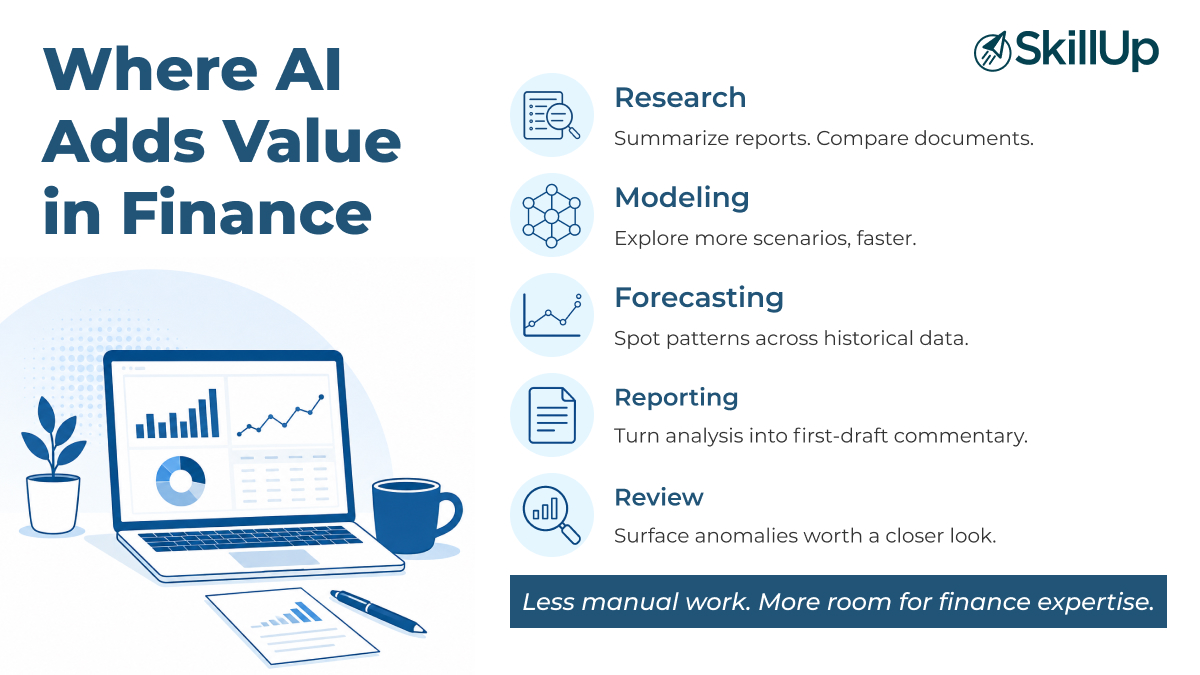
Finance professionals do not need to master every AI platform. Instead, focus on tools that align with daily responsibilities.
ChatGPT and Claude can support research, summarization, drafting, and analysis. Microsoft Copilot and Excel Copilot can assist with productivity and spreadsheet-based workflows. Google Gemini can support research and document-related tasks. Power BI Copilot and Tableau AI can assist with data analysis and visualization.
For professionals working with larger datasets, Python and SQL can provide stronger analytical capabilities. The right combination depends on your role, technical background, and business needs.
Real Business Use Cases
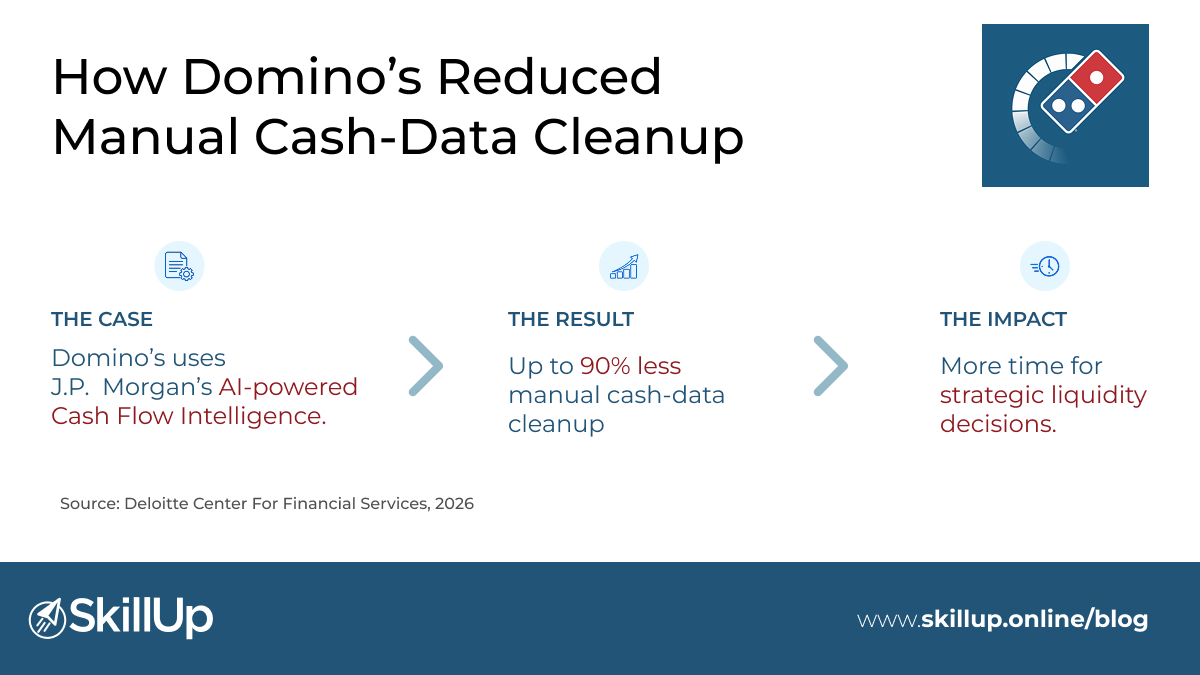
AI can support financial forecasting by analyzing historical information and identifying patterns. In budget planning, it can help compare scenarios and highlight variances. Cash flow analysis can benefit from automated data processing and trend identification.
Domino’s uses J.P. Morgan’s Cash Flow Intelligence, an AI‑powered forecasting module, to cut weekly manual cash‑data cleanup by up to 90% and shift treasury effort from operational reporting to strategic liquidity decisions.
Other applications include investment research, credit risk analysis, fraud detection, regulatory compliance, financial reporting, and expense management. These use cases show why practical AI training for finance professionals should focus on business applications rather than theory alone.
Benefits of AI Training for Finance Professionals
Faster Decision-Making
AI can process large amounts of information quickly, helping professionals prepare analysis and compare scenarios more efficiently.
More Informed Forecast
AI-assisted forecasting can provide insights from historical and current data, potentially supporting more informed financial planning.
Higher Productivity
Automating repetitive activities gives finance teams more time for strategic work, stakeholder communication, and decision-making.
Career Growth
Professionals who combine finance expertise with technology capabilities can qualify for emerging roles and expanded responsibilities.
Leadership Readiness
Finance leaders increasingly need to understand how AI can affect processes, controls, costs, and business strategy.
How to Choose the Right AI Course for Finance Professionals
Start by identifying your career stage and current responsibilities. A beginner may need foundational concepts, while an experienced manager may benefit more from strategy, automation, and practical projects.
Your learning style also matters. Self-paced courses can work well for busy professionals, while structured programs may provide stronger accountability. Compare course duration, project work, instructor support, curriculum depth, and overall value before making a decision.
The best AI courses for finance professionals should connect AI concepts with real finance workflows and provide skills that can be applied beyond the classroom.
AI Learning Platform for Finance Professionals
For finance professionals looking for a focused learning option, SkillUp Online offers a dedicated program rather than a broad list of unrelated courses.
SkillUp Online
The Generative AI for Financial Professionals Program from SkillUp Online is designed around the practical use of generative AI in finance. It can be a suitable option for professionals who want structured training focused on financial applications, workplace productivity, analysis, and emerging AI capabilities.

Career Opportunities After AI Training
AI knowledge can support career paths such as AI financial analyst, finance transformation consultant, AI strategy manager, FinTech product manager, AI risk analyst, and financial data scientist.
These roles combine traditional financial knowledge with analytical and technology skills. Professionals can also apply AI capabilities within their existing roles instead of moving into a completely new career.
Preparing for the Future of AI in Finance
The future of finance will continue to involve AI-assisted analysis, automation, forecasting, reporting, and decision support. Professionals who build these capabilities early can adapt more easily as job responsibilities evolve.
Recommended Learning Path for Finance Professionals
Start with AI fundamentals, then move into finance-specific applications and practical projects. From there, build capabilities in forecasting, modeling, analytics, automation, and responsible AI use. Hands-on practice can help turn theoretical knowledge into workplace skills.
Skills to Develop Next
Focus on prompt engineering, financial data analytics, AI-assisted modeling, forecasting, automation, and AI governance. These capabilities can help professionals work effectively with emerging financial technologies.
The best AI courses for finance professionals should provide more than theoretical knowledge. Look for a program that connects AI concepts with real financial workflows, practical applications, and measurable workplace outcomes.
SkillUp Online provides a practical starting point through its Generative AI for Financial Professionals Program. For professionals seeking relevant AI Skills for Finance Professionals, the right program should connect technology with real financial decisions.
Frequently Asked Questions
Which AI course is best for finance professionals?
The right option depends on your role, experience, and career goals. Look for finance-specific projects, practical tools, forecasting, analytics, automation, and generative AI applications.
Do finance professionals need coding skills?
Not always. Many AI tools can be used without programming. Python and SQL become more useful for advanced analytics, automation, and large datasets.
Can ChatGPT replace financial analysts?
No. ChatGPT can support research, summaries, analysis, and drafting, but financial professionals still need judgment, verification, context, and accountability.
Which AI certification is most recognized?
Recognition varies by employer, industry, and market. A useful AI certification in finance should demonstrate practical knowledge that aligns with the requirements of the target role.
How long does it take to learn AI?
The timeline depends on your starting point and learning goals. Basic AI concepts can be understood relatively quickly, while advanced analytics and automation require consistent practice.
Is AI useful for accountants?
Yes. AI can assist with reconciliation, document review, reporting, anomaly detection, transaction analysis, and other repetitive accounting activities.
Which AI tools should finance professionals learn first?
Start with tools that fit your existing workflow, such as ChatGPT, Microsoft Copilot, Excel Copilot, Power BI, or other approved workplace platforms.
Can beginners learn AI without programming?
Yes. Beginners can start with foundational concepts and no-code AI tools before moving into technical skills such as Python or SQL.
What is the ROI of AI training?
The return depends on how effectively the skills are applied. Saving time on repetitive work, improving analysis, supporting better decisions, and qualifying for new responsibilities can all contribute to professional ROI.
How can AI improve financial decision-making?
AI can process large datasets, identify patterns, compare scenarios, and generate useful summaries. Financial professionals should always review and validate AI-generated outputs before using them for important decisions.
Read More – AI Use Cases for Finance and Accounting

SkillUp Online