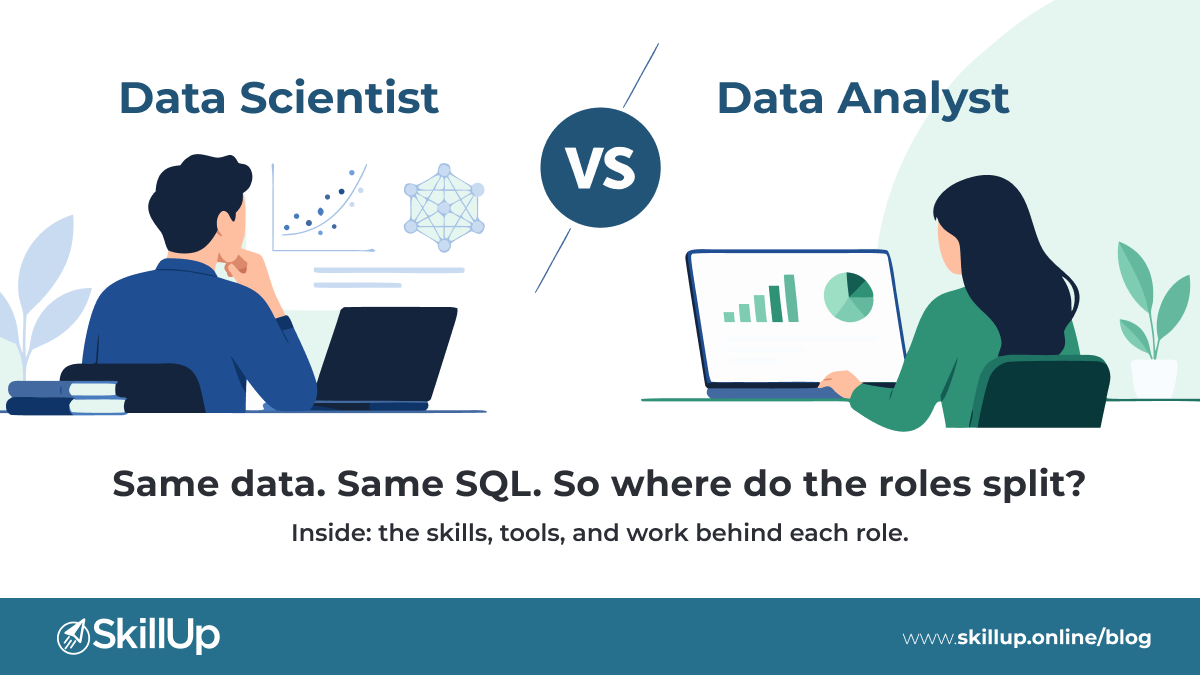
Data analysts and data scientists both work with data, but they do not always solve the same problems. This is why choosing between the two can be confusing, especially if you are considering a career change or starting your first technical role.
The simplest distinction is that analysts generally use existing data to understand what happened and why, while data scientists often use statistics, programming, and machine learning to model what could happen next. However, the roles overlap more than this definition suggests.
The real difference comes down to the depth of technical skills, type of problems, and level of responsibility involved.
How Are the Roles Different?
A data analyst role is often closely connected to business decision making. Analysts work with existing datasets to identify trends, track performance, answer business questions, and communicate findings through reports and dashboards.
A data scientist role can involve these same activities but usually extends into predictive modeling, machine learning, experimentation, and more complex data problems.
Both roles can involve data cleaning, SQL, statistical analysis, visualization, and communication. The distinction is often in the depth of analysis and the outcome expected from the work. Analysts typically focus on producing insights that help teams understand performance and make decisions. Data scientists may use those same foundations to develop models, test predictions, and solve more technically complex problems.
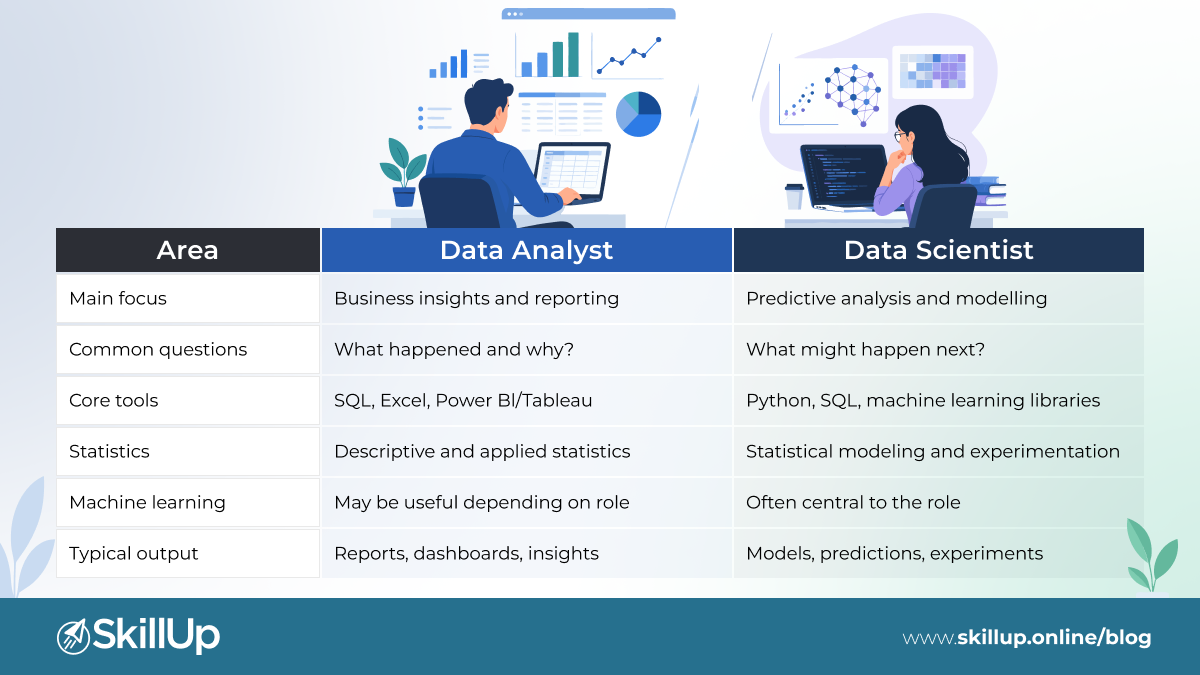
| Area | Data Analyst | Data Scientist |
|---|---|---|
| Main focus | Business insights and reporting | Predictive analysis and modeling |
| Common questions | What happened and why? | What might happen next? |
| Core tools | SQL, Excel, Power BI/Tableau | Python, SQL, machine learning libraries |
| Statistics | Descriptive and applied statistics | Statistical modeling and experimentation |
| Machine learning | May be useful depending on role | Often central to the role |
| Typical output | Reports, dashboards, insights | Models, predictions, experiments |
Job descriptions vary by employer, so these boundaries are not absolute.
Data Analyst Skills vs Data Scientist Skills
Both careers require a similar core of analytical and statistical knowledge, along with the ability to prepare data and communicate insights clearly.
The difference becomes more noticeable as technical depth increases.
Common data analyst skills include
- SQL and Excel
- Data cleaning and transformation
- Power BI or Tableau
- Descriptive statistics
- Basic Python or R
- Business intelligence
- Data visualization
- Communication and stakeholder management
Data scientist skills generally require a deeper technical foundation, including:
- Advanced Python or R
- Probability and statistics
- Linear algebra
- Machine learning
- Feature engineering
- Model evaluation
- Data preprocessing
- Machine learning libraries such as scikit learn
- Experience working with larger or more complex datasets
That does not mean every analyst needs to avoid machine learning or every data scientist needs advanced tools such as Spark. Requirements depend on the employer and specialization.
Data Analyst Salary vs Data Scientist Salary
Salary can vary significantly across data roles depending on experience, location, industry, specialization, and employer, so these figures are best treated as current market benchmarks rather than guaranteed earnings.
As of September 2026, Salary.com reports an average U.S. salary of $97,717 per year for Data Analysts. Its reported 25th to 75th percentile range is approximately $87,370 to $107,611.
For Data Scientists, Salary.com reports an average U.S. salary of $118,415 per year, with a 25th to 75th percentile range of approximately $108,704 to $128,372.
These numbers provide a useful snapshot of the difference in current compensation levels, but they should not be treated as a direct prediction of what someone will earn after completing a course or entering either career. Experience, technical specialization, geographic market, and the responsibilities attached to a specific role can all influence compensation.
For career planning, salary is only one factor to consider. The skills required, type of work, technical depth, and progression opportunities can be equally important when deciding between data analytics and data science.
Which Career Path Fits Your Current Experience?
Choosing between the two starts with understanding what you already know.
A data analytics path can be a practical starting point if you are:
- New to technical data work
- Comfortable with business or operational problem solving
- Interested in dashboards and reporting
- Willing to build SQL and spreadsheet skills
- Interested in turning data into actionable business insights
A data science path may be more appropriate if you already have:
- Strong programming experience
- A solid foundation in statistics and mathematics
- An interest in machine learning
- Experience working with complex datasets
- An interest in predictive modeling and experimentation
These are not permanent categories. A professional can start in analytics and later build the programming, statistics, and machine learning knowledge needed for more advanced data science work.
How to Become a Data Analyst?
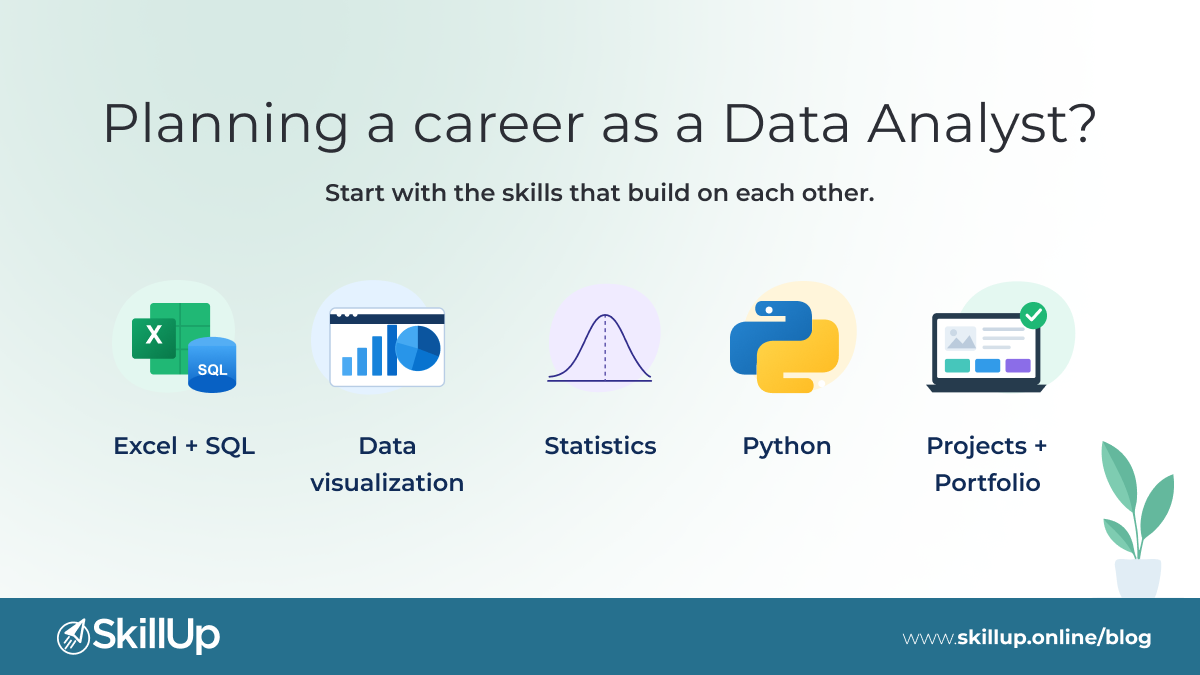
Starting a career as a data analyst requires a strong foundation in data handling, analysis, visualization, and business problem solving. A practical progression looks like this:
1. Build Excel and SQL skills – Learn formulas, pivot tables, data manipulation, queries, joins, and database fundamentals.
2. Develop visualization skills – Practice creating clear dashboards and reports with tools such as Power BI or Tableau.
3. Strengthen statistics – Build an understanding of descriptive statistics, distributions, correlations, and other concepts used in data analysis.
4. Add Python – Use Python for data cleaning, analysis, and automation as your technical skills develop.
5. Build a project portfolio – Work on projects that demonstrate your ability to prepare data, analyze a business problem, create visualizations, and communicate your findings.
The TechMaster Certificate Program in Data Analytics can support this progression with training in Excel, SQL, Python, Power BI, data wrangling, visualization, and hands on projects.
How to Become a Data Scientist?
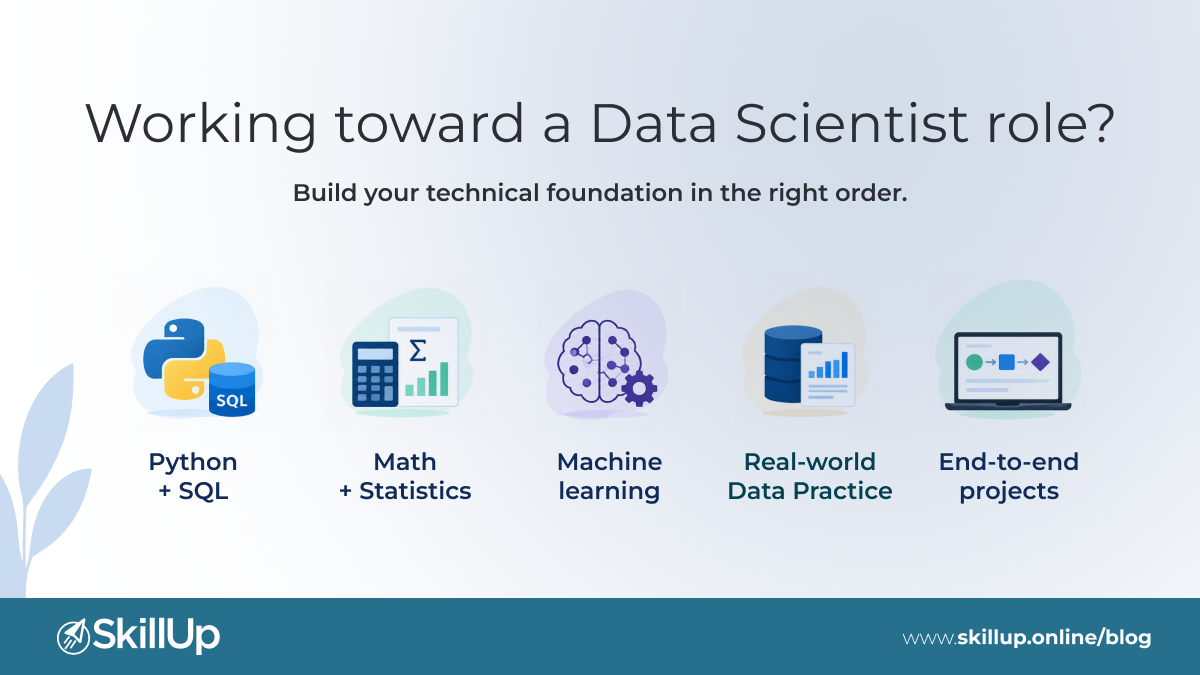
Building a career in data science generally requires a deeper foundation in programming, mathematics, statistics, and machine learning.
1. Strengthen Python and SQL – Develop the programming and database skills needed to work with and analyze data.
2. Build mathematical and statistical foundations – Study probability, statistical inference, linear algebra, and other concepts that support machine learning.
3. Learn machine learning – Develop knowledge of regression, classification, clustering, feature engineering, and model evaluation.
4. Work with real datasets – Practice preparing data, selecting appropriate methods, training models, and evaluating their performance.
5. Build end to end projects – Demonstrate that you can take a data problem from preparation and analysis through modeling and communication of results.
The IBM Data Science Professional Certificate covers areas including Python, SQL, data analysis, visualization, machine learning, and applied project work, making it relevant for learners building toward data science.
FAQs
1. What is the main difference between data science and data analytics?
The difference between data science and data analytics is mainly the scope and depth of the work. Data Analytics generally focuses on examining existing data to identify trends, explain performance, and support decisions. Data science can include these activities but often extends into predictive modeling, machine learning, experimentation, and more complex computational problems.
2. Can a Data Analyst become a Data Scientist?
Yes. A data analyst can transition toward data science by building deeper skills in Python, statistics, mathematics, machine learning, and predictive modeling. The transition usually requires substantial additional technical practice rather than simply adding a few machine learning tools to an existing analytics skill set.
3. Which skills should I learn first to become a Data Analyst?
Start with Excel and SQL, followed by data visualization, descriptive statistics, and data cleaning. Once these foundations are comfortable, add Python and build practical projects that demonstrate your ability to solve business problems with data.
4. Do Data Scientists need to know Data Analytics?
Data Analytics provides useful foundations for data science. Data scientists often need to clean, explore, summarize, and visualize data before building a model. However, data science also requires additional knowledge of programming, statistics, machine learning, and model evaluation.
Read More – How to Become a Data Analyst: A Step-by-Step Guide

SkillUp Online