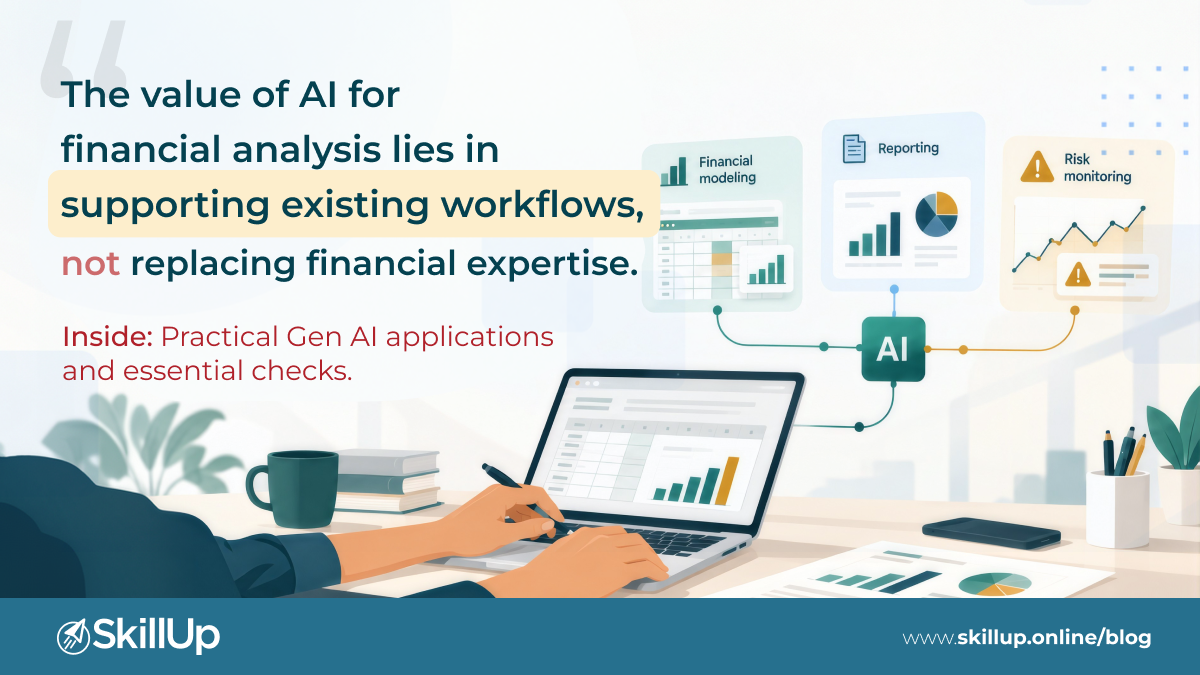
Finance professionals spend much of their time reviewing financial records, preparing reports, tracking expenses, and explaining business performance. AI tools are beginning to change how some of these responsibilities are handled. Accountants, financial analysts, and FP&A professionals are increasingly expected to understand how these tools can support their work without compromising accuracy or financial judgment.
Employers are not necessarily looking for finance professionals who can build AI systems. They are more interested in people who know how to use AI tools, review the information they produce, and apply the results to business requirements. Developing the right AI skills for finance professionals can help employees adapt to these changing expectations and prepare for evolving responsibilities.
This article covers the practical AI capabilities employers value, how they apply to different finance roles, and how professionals can start developing them.
Why AI Skills Matter in Finance
The use of AI in finance is growing across financial reporting, budgeting, forecasting, research, and data analysis. Finance teams can use AI tools to summarize documents, organize information, prepare report drafts, and review large volumes of financial data.
These applications can reduce some of the time spent on routine activities. Instead of manually organizing every document or preparing an initial summary, professionals can use AI to support these tasks and spend more time reviewing results and understanding business performance.
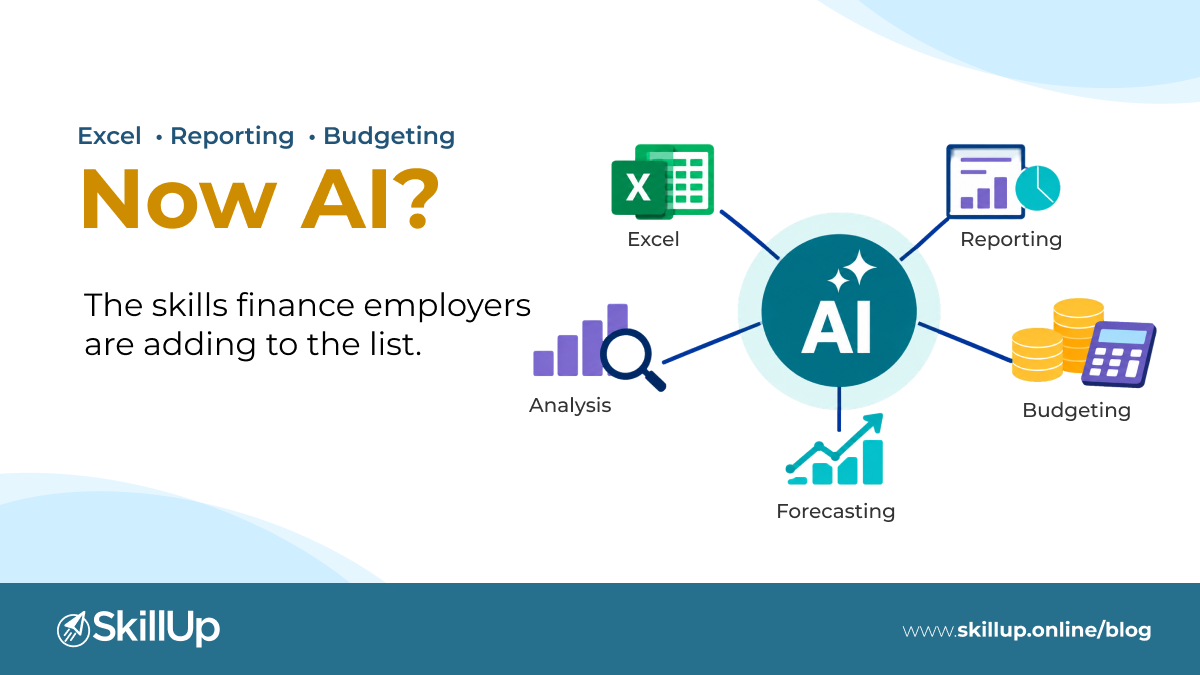
This shift is also changing workplace expectations. Employers increasingly value candidates who can identify suitable AI applications and understand when a task still requires traditional financial tools or specialist expertise. For professionals working in accounting, financial analysis, and FP&A, AI skills for finance professionals are becoming relevant alongside established capabilities such as Excel, financial reporting, and budgeting.
What Employers Expect From Finance Professionals Using AI
Employers generally want practical AI knowledge rather than advanced technical expertise for every finance position. They look for professionals who can use AI tools confidently and understand the responsibilities involved.
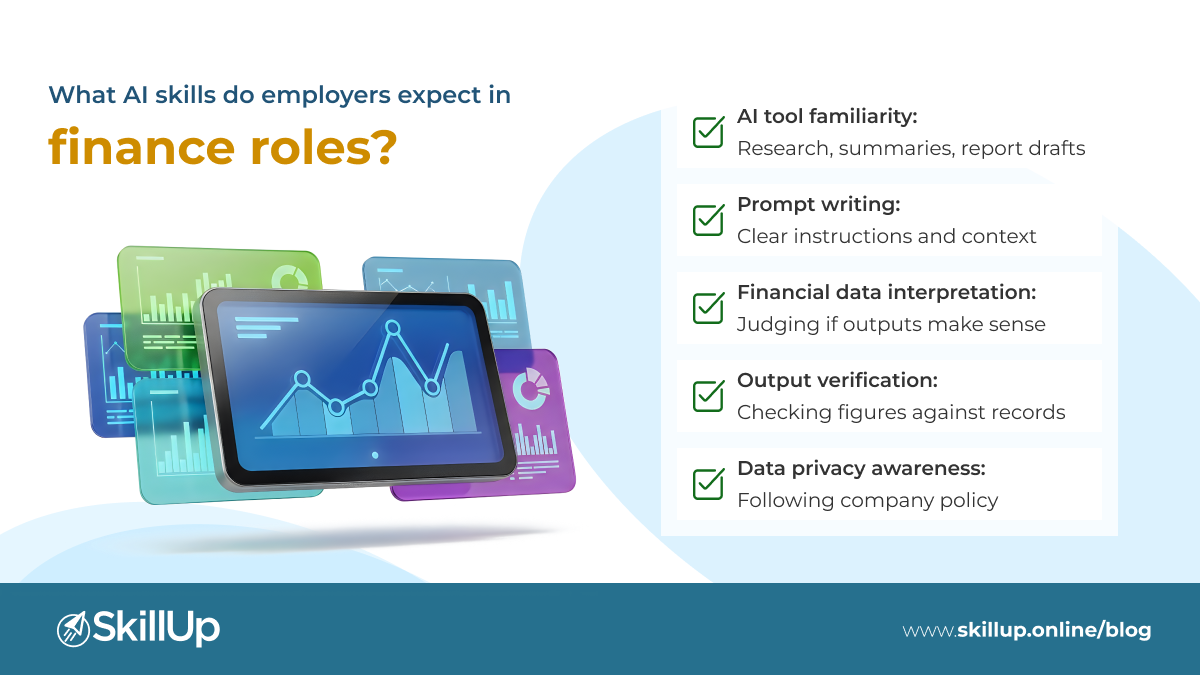
Some of the capabilities that matter include:
- AI tool familiarity: Knowing how to use generative AI platforms for research, document summaries, and report preparation.
- Prompt writing: Providing clear instructions, relevant context, and specific requirements to get useful responses from AI tools.
- Financial data interpretation: Understanding the information being analyzed and identifying whether AI-generated observations make sense.
- Output verification: Checking financial figures, calculations, and summaries against original records before using them.
- Data privacy awareness: Following company policies when working with confidential financial and customer information.
These expectations can vary depending on the role. An accountant may use AI to organize documentation and prepare report drafts, while an FP&A professional may use it to review budget information or structure forecasting assumptions.
Employers want professionals who can select appropriate tools and understand their limitations. This combination of financial knowledge and practical AI skills for finance professionals can be useful across different finance functions.
AI for Financial Analysis
Financial analysis requires professionals to review company performance, compare financial results, identify unusual changes, and communicate findings to management. AI can help with the preparation and organization involved in this work.
AI for financial analysis has several practical applications:
- Summarizing income statements, balance sheets, and financial reports.
- Organizing information collected from multiple documents.
- Identifying possible patterns in historical revenue and expense data.
- Preparing initial summaries of changes in financial performance.
- Reviewing industry reports and organizing research findings.
For instance, a financial analyst reviewing quarterly results could use an approved AI tool to summarize key changes in revenue and expenses. The analyst can then compare the summary with the original financial statements and investigate the reasons behind significant variations.
However, identifying a pattern does not automatically explain why it occurred. An increase in expenses could be related to business expansion, seasonal demand, or an unexpected cost. The analyst needs to investigate the underlying information before presenting an explanation.
Knowing how to use AI for financial analysis while maintaining the quality of financial interpretation is particularly relevant for professionals who regularly work with business data.
AI for Financial Planning
Financial planning involves preparing budgets, developing forecasts, monitoring business performance, and evaluating possible outcomes. AI can help finance teams organize information and prepare initial inputs for these activities.
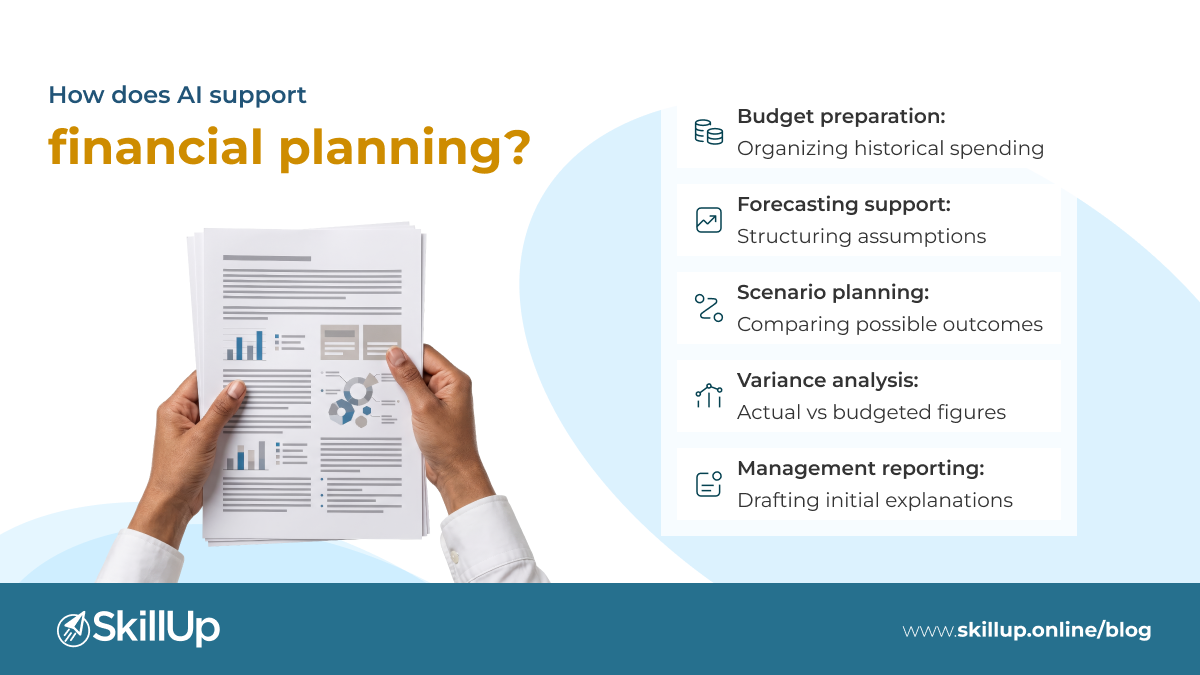
AI for financial planning can support several responsibilities:
- Budget preparation: Organizing historical spending information and summarizing expense categories.
- Forecasting support: Structuring financial assumptions and preparing preliminary forecast inputs.
- Scenario planning: Comparing possible business outcomes using assumptions provided by the finance team.
- Variance analysis: Summarizing differences between actual results and budgeted figures.
- Management reporting: Preparing initial explanations of financial performance for review.
For FP&A professionals, these applications can reduce some of the preparation involved in recurring reporting activities.
Consider a monthly budget review. An FP&A professional could use AI to organize differences between planned and actual spending across departments. The team can then investigate significant variances, check the underlying figures, and decide whether budget adjustments are necessary.
AI-generated forecasts and scenarios also depend on the quality of the information provided. Finance professionals must review assumptions, account for changing business conditions, and determine whether the results are reasonable.
Practical AI Skills That Add Value in Finance Roles
Knowing how to operate an AI platform is useful, but employers also value the ability to apply its outputs to actual business responsibilities. Several complementary capabilities help finance professionals do this effectively.
Understanding business requirements
Before using AI, professionals should understand the purpose of the task. A management report, cash flow review, and budget analysis require different information and levels of detail. Clear business requirements help determine what information an AI tool should process.
Communicating financial information
Finance professionals regularly present findings to managers and other departments. They need to explain financial results in straightforward language, highlight relevant changes, and make reports understandable to people without a finance background.
Reviewing accuracy and assumptions
AI-generated responses may contain incorrect figures, incomplete information, or unsupported explanations. Checking calculations, comparing source documents, and reviewing assumptions should be part of the regular workflow.
Maintaining data security
Financial records can contain confidential company information, employee details, and customer data. Professionals should understand internal data policies and use approved AI platforms when handling sensitive information.
Making informed decisions
AI can provide summaries and possible explanations, but it does not understand every business condition. Finance professionals must assess the available information, consider financial risks, and decide whether further investigation is required.
These capabilities complement the technical side of AI skills for finance professionals and help employees apply AI appropriately in their daily work.
How to Start Building AI-Ready Finance Skills
You do not need to learn every AI platform at once. A better starting point is to identify a few regular responsibilities where AI could help with preparation, organization, or research.
A practical learning approach includes:
- Understand AI fundamentals: Learn what generative AI can do, how it produces responses, and where it can make mistakes.
- Practice prompt writing: Develop clear prompts for financial research, document summaries, and reporting tasks.
- Work with finance-related tasks: Apply AI to suitable activities involving financial analysis, budgeting, and report preparation.
- Develop verification habits: Check outputs against source information and review calculations before using the results.
- Understand responsible AI use: Learn about data privacy, company policies, and appropriate uses of AI in financial workflows.
Building AI skills for finance professionals is an ongoing process. The most useful progress comes from applying new knowledge to familiar tasks and understanding how it fits into your existing financial expertise.
The Generative AI for Financial Professionals Program from SkillUp Online is an option for professionals who want structured learning in this area. The program can help build practical knowledge of generative AI and its applications in financial analysis, planning, reporting, and responsible AI use.

FAQs
How can finance professionals develop AI skills?
Start by identifying routine tasks where approved AI tools can help. Practice writing prompts, summarizing financial documents, organizing information, and checking AI-generated results against original records.
How can finance professionals learn AI for finance?
Follow a structured learning path covering AI fundamentals, prompt engineering, finance-related applications, and responsible AI practices. Hands-on training can help connect these concepts with everyday finance responsibilities.
Do finance professionals need coding to use AI?
No. Most generative AI tools allow users to interact through natural language prompts. Coding is mainly useful for specialized tasks involving programming, advanced automation, or custom AI applications.
Which AI skills are most useful for finance jobs?
Prompt writing, financial data interpretation, report summarization, forecasting support, output verification, and data privacy awareness are among the useful skills for finance roles.
Can AI replace financial analysts?
AI may automate some repetitive analytical and reporting tasks, which could change the responsibilities of financial analysts. However, interpreting business performance, evaluating financial assumptions, investigating unusual results, and advising stakeholders still require professional expertise. The extent of AI’s impact will depend on the organization, role, and tasks involved.
How long does it take to learn AI for finance?
Basic AI skills can be developed through regular practice over a few weeks. More advanced applications, such as workflow automation and specialized financial analysis, may require several months of learning and practical experience.

SkillUp Online