Nurses are at the heart of each shift, each bedside decision, and each interaction with patients that occurs in a hospital. Recent numbers show that nurses spend close to 40% of every shift on documentation alone, but in 2026, AI tools are actively pulling that number down, and hospitals are starting to reflect that in what they hire for.
Nurses who can work with AI systems are no longer differentiators. They are becoming a new benchmark. This guide breaks down the most important AI skills for nurses in 2026, based on what health systems are actually implementing today, to enable you to grow faster, earn more, and remain valuable in a profession that is changing rapidly.
Why AI Skills for Nurses Are Now Essential in 2026
Let’s clear up something first. AI isn’t replacing nurses. But nurses who use AI will replace those who don’t. And this is not a far-off scenario. AI is already being implemented in hospitals in diagnostics, documentation, and patient care. The transition is creating a huge divide between the nursing professionals who have become conversant with AI in these systems and those who have yet to catch up.
The question isn’t if AI is changing nursing careers. It’s whether your skill set is keeping pace with the floor you’re already working on.
Read More – AI in Healthcare: Why AI Certification Matters Now for Modern Clinicians
How AI is Transforming Nursing Careers and Patient Care
The case for building healthcare AI skills for nurses is not abstract. It shows up in concrete ways that directly impact the day-to-day work of nurses.
- Reduced workload: AI helps with clinical documentation and reporting, which, as we have already stated, occupy up to 40% of a nursing shift. With AI handling documentation and reporting, that time can be redirected to direct patient care.
- More accurate patient care decisions: AI-based early warning systems and diagnostic support tools present nurses with more accurate and timely information to take action at the bedside.
- Better-paying jobs: Nursing professionals who have proven AI literacy are now being offered more specialized and senior jobs that have higher compensation.
- Career trajectories: Hospitals developing AI-based care teams require nurses who can mediate clinical understanding and technology, a role that has a tangible organizational impact.
These are not long-term projections. They are outcomes already visible in health systems that have adopted AI in its early days.
Top 5 AI Skills for Nurses in 2026 That Boost Career Growth
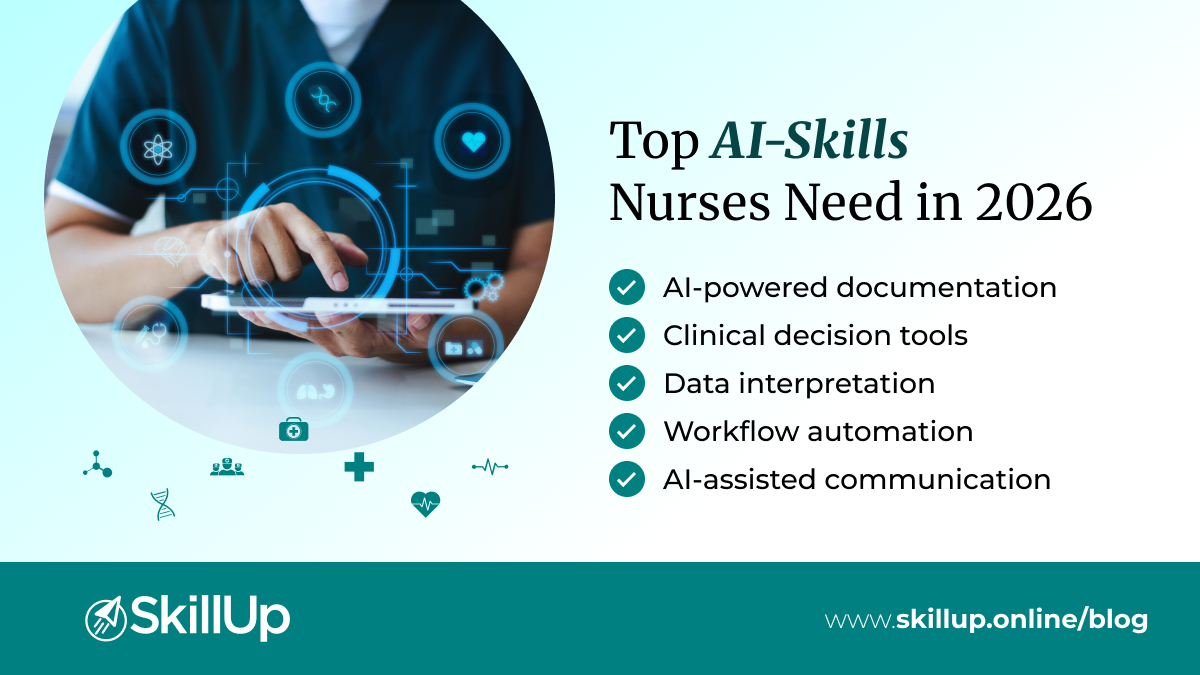
Here are the five AI skills for nurses that are making the clearest difference in clinical environments right now.
1. AI-Powered Documentation and Charting Skills for Nurses
Most nurses did not train for years just to spend half a shift typing. Yet documentation consistently ranks as one of the biggest time drains in clinical settings. AI scribes and ambient voice tools are changing that equation. They listen during patient interactions and generate structured clinical notes automatically.
Research published in JAMA Network Open found that AI scribes reduced EHR documentation time by over 13 minutes per shift. The same study also reported:
- 16.0 fewer minutes of documentation time
- 0.49 additional weekly visits delivered
The actual skill here is knowing how to review, correct, and validate AI-generated notes so nothing clinically significant gets lost in the output.
2. Clinical Decision Support Tools in Modern Nursing
What if a system flagged patient deterioration before the vitals looked obviously wrong? That is exactly what clinical decision support tools are built to do. These tools run continuously in the background, scanning monitoring feeds, history, and lab outcomes to identify threats early.
For nurses, the skill is learning to work with these alerts effectively: relying on the right alerts, doubting those that require it, and making faster and better-supported decisions because of them.
3. Data Interpretation and Healthcare Analytics Skills
AI generates the report. The nurse decides what to do with it, and that distinction matters. AI systems pull continuously from EHRs, monitoring data, and patient history to flag patterns, such as:
- Deterioration signals
- Medication risks
- Population trends across a ward
Reading those outputs accurately, knowing when something looks off, and translating findings into care decisions is a skill that sits entirely with the nurse. It does not require a statistics background. It requires clinical pattern recognition applied to a new kind of information.
4. Workflow Automation Skills for Nursing Professionals
Scheduling, compliance tracking, routine record updates, and shift handover prep are some tasks that pull nursing professionals away from patients consistently.
This is mostly done now by AI, and health systems that have automation tools have experienced reductions in administrative overhead and overtime expenses, which are measurable.
The skill here lies in understanding what tasks to delegate and what to do to ensure that control is maintained when they do. Automation does not remove accountability, it redirects where attention needs to go.
5. AI Communication Tools for Nurses and Patient Care
Communication gaps between clinicians and patients remain one of the leading causes of avoidable clinical errors. AI is reducing that risk on both ends.
- Patient-facing: Customized discharge guidelines, medication guide, and follow-ups created in simple, plain language.
- Team-facing: AI-generated handoff briefings that narrow the gap between shifts and minimize information loss.
For nursing professionals, the skill is using these tools to make every handover more accurate and every patient conversation more effective, not replacing the conversation, but making it sharper.
How Nurses Can Get Started (Simple Roadmap to Learning AI Skills)
Here’s a step-by-step starting approach for building these skills for nurses.
Step 1: Learn AI basics: no coding needed
Start with foundational AI literacy. Courses from SkillUp Online cover how AI works in healthcare without any technical prerequisites.
Step 2: Explore healthcare-specific AI tools
Become familiar with existing platforms already implemented in clinical settings, including:
- Ambient documentation tools
- EHR-connected AI
- Clinical decision support systems
Half the skill is to know what they do.
Step 3: Practice through real scenarios
If you are figuring out what AI skills nurses should learn first, case-based learning is the fastest path. Many nursing informatics programs now include AI modules built around real clinical situations.
Step 4: Apply it in your daily workflow
Start small. Use an AI documentation tool for one shift. Review an AI-generated summary. The learning compounds quickly once it is grounded in actual practice.
Step 5: Position yourself as an “AI-enabled nurse”
Nursing professionals who adopt AI early are moving into supervisory and specialized roles faster than those who wait. That is not a projection, it is already visible in how health systems are structuring their teams for 2026.
Understanding how AI is changing nursing careers makes this shift easier to see and easier to move ahead with.
Career Shift That Comes After Building AI Skills
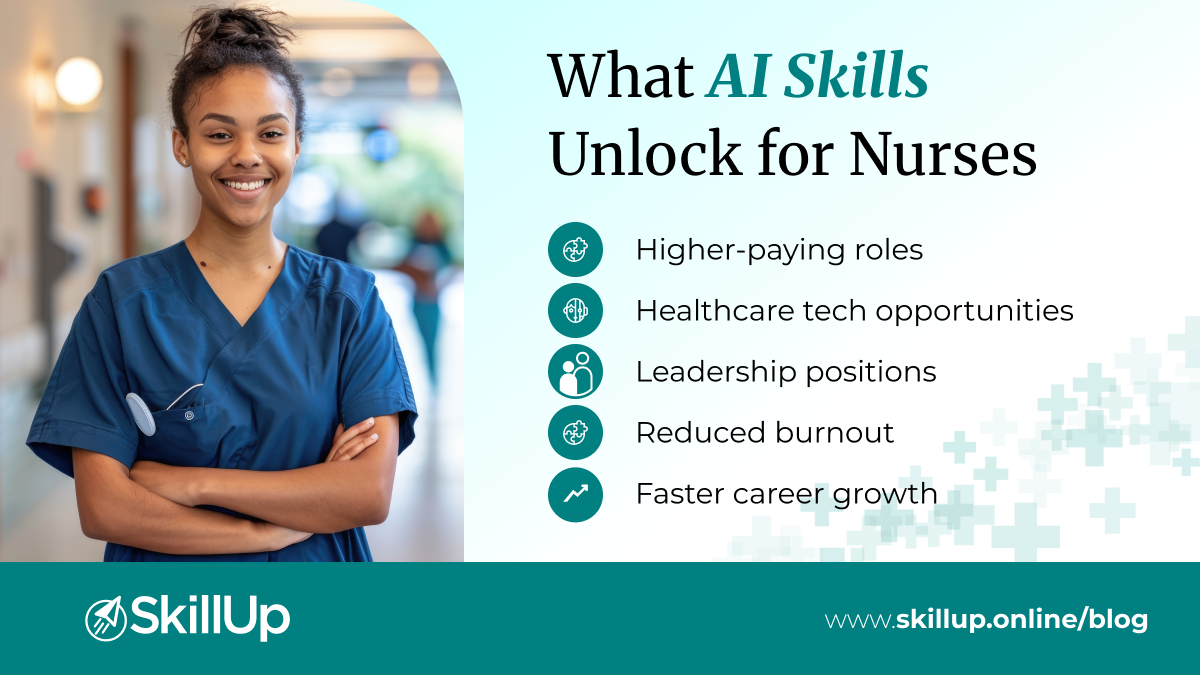
The right skills for nurses in AI-enabled environments do more than keep careers current, they open entirely new ones.
- Transition into healthcare tech roles: Clinical experience and AI fluency help unlock informatics, health tech, and AI implementation jobs that lie far outside of the nursing career path.
- Higher salary brackets: AI jobs for nurses now exist across hospitals, payer organizations, and health tech firms, with higher compensation than the traditional nursing path.
- Less burnout: With AI taking care of documentation and repetitive administration, nurses are finally able to focus on the work that matters.
- Leadership and training opportunities: Nurses who are AI fluent are finding themselves in team lead and training positions previously out of reach.
All of this is a serious career shift, not just a skill upgrade.
How SkillUp Online Prepares Nurses for AI Roles
Learning AI for nursing professionals should be a structured career-oriented journey, and not a one-off course dropped in a broader catalog. At SkillUp Online, we understand that. Our courses include:
Constructive progress monitoring: you always know where you stand and what you need to do next.
Industry expert sessions: real exposure to how AI operates in clinical and corporate healthcare environments.
Real-time feedback: you have qualified instructors who help you throughout the learning process, not at the very end of it.
Don’t Just Work Harder: Work Smarter with AI
The nurses pulling ahead right now are not working longer hours; they are working with better tools and relevant AI skills. Enroll in the Artificial Intelligence for Healthcare Program and learn practical AI skills for nurses, and begin implementing them in documentation, clinical decisions, and patient communication.
The future of nursing isn’t just care, it’s care powered by intelligence. And the nurses who build that foundation today will be the ones leading the profession tomorrow.

SkillUp Online