Surprise billing may feel like a patient problem, but the ripple effects hit everyone working in healthcare. Confusion, denied claims, delayed payments—one disagreement between a provider and a health plan can slow down entire workflows.
That’s exactly why the No Surprises Act (NSA) introduced the Independent Dispute Resolution (IDR) process. If you understand how IDR works, you’re better equipped to protect your organization, reduce friction, and keep revenue moving.
How the IDR Process Works
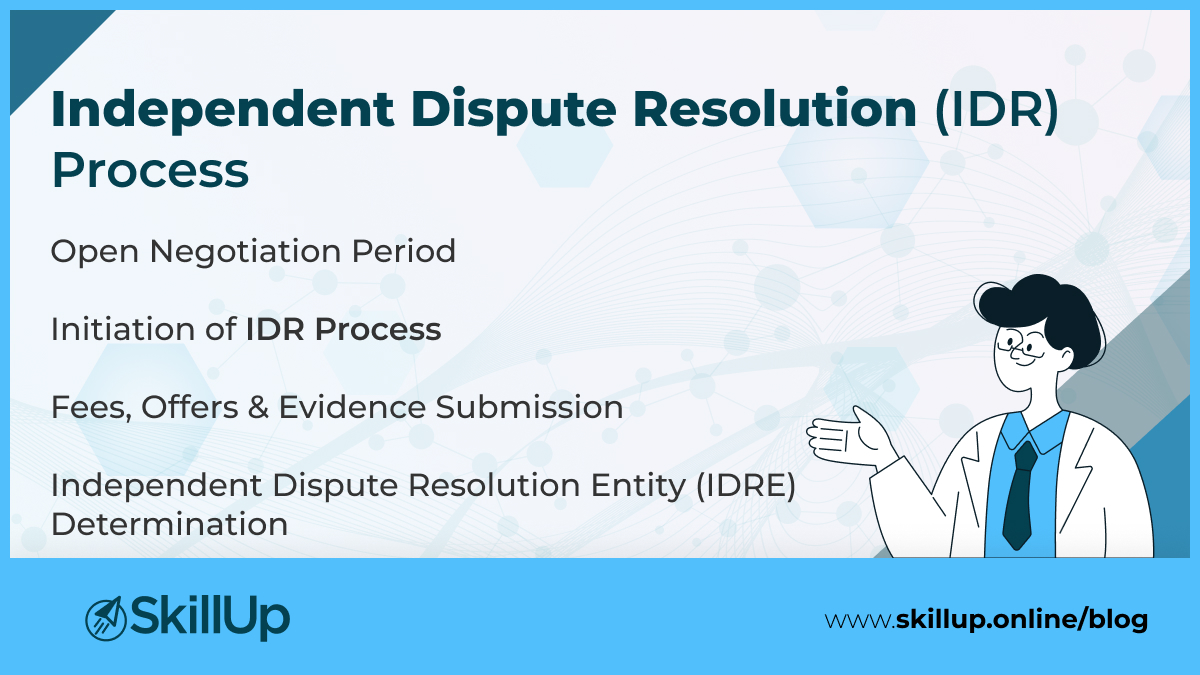
The IDR process follows a clear, step-by-step structure:
- Open Negotiation Period(30business days)
After an out-of-network provider submits a claim for services provided, the health plan reviews and adjudicates the claim. If the provider disagrees with the amount reimbursed or denial of payment for services provided, either the provider or health plan may initiate the Open Negotiation Period. This is a 30-business day period for both sides to attempt to reach an agreement on a payment amount for the services provided. Notice of the Open Negotiation Period must be sent by the initiating party to the non-initiating party within 30 business days of the initial denial or payment of the claim. - Initiation of IDRProcess(within 4 days of negotiation ending)
If the payment negotiations fail, either party may initiate the IDR process, within 4 days of the end of the Open Negotiation Period. The initiating party will provide notice to the non-initiating party and select an Independent Dispute Resolution Entity (IDRE) to review, and determine the payment amount for, the service or item being disputed. If the parties cannot agree on an IDRE, one will be appointed. - Fees, Offers & Evidence Submission (10 business days)
If the IDRE determines the disputed items/services are eligible for the Federal NSA process, each party has 10 business day to pay an administrative fee (currently $115) and IDRE fee (varies per entity). Each party must also submit a Notice of Offer Form within 10 business days of the IDRE’s acceptance of the dispute. The offer form is where each party states what they believe to be fair and accurate payment for the disputed items or services provided. If either party fails to submit payment for the fees and/or offer timely, a default judgment will be issued in favor of the lone party that did. If both parties fail to submit the fees and/or offer timely, the dispute will be dismissed. - IDRE Determination (30 business days)
The IDRE has 30 business days to determine the prevailing party and payment amount. Payment of the adjudicated amount must be made by the unsuccessful party within 30 business days. The prevailing party is refunded their IDRE fee within 30 business days.
Circumstances or Factors for Qualified Items and Services

The circumstances or factors for qualified items and services are sets of facts that are presented by the parties and reviewed by the IDRE. The factors are different for qualified non-air ambulance items and services and qualified air ambulance items and services.
Below are the six factors for qualified non-air ambulance items and services:
- The level of training, experience, and quality and outcomes measurements of the provider or facility that furnished the qualified IDR item or service.
- The market share held by the provider or facility or that of the plan in the geographic region in which the qualified IDR item or service was provided.
- The acuity of the participant, beneficiary, or enrollee receiving the qualified IDR item or service, or the complexity of furnishing the qualified IDR item or service to the participant, beneficiary, or enrollee.
- The teaching status, case mix, and scope of services of the facility that furnished the qualified IDR item or service (only applicable if one of the parties is a facility).
- Demonstration of good faith efforts (or lack thereof) made by the provider or facility or the plan to enter into network agreements with each other, and, if applicable, contracted rates between the provider or facility, as applicable, and the plan during the previous four plan years.
- Additional information relevant to the submitted Qualified Payment Amount QPA.
Keys for Healthcare Providers to Prevail
The Open Negotiation Period and IDR process are often initiated by the non-contract provider, as they are the party that is not in agreement with the denial or amount of reimbursement received, for the items or services provided. To support their requested payment amount, providers must submit documentation that:
- Proves the Open Negotiation Period was initiated timely, and notice sent to the correct health plan. This includes, but is not limited to, a copy of the notice, documentation (i.e.: email) showing the notice was sent to the correct health plan, and a copy of the Explanation of Benefits or Remittance Advice for the disputed items or services.
- Proves the IDR process was initiated and notice sent to the correct health plan. This would be the Notice of IDR Initiation, and any subsequent IDRE selection responses.
- Proves the disputed items or services are eligible for the Federal NSA process. This includes, but is not limited to, a copy of the patient’s health care ID card to confirm the correct health care plan and type (self-funded, fully funded, etc.) was identified.
- Details and supports their Circumstances or Factors for Qualified Items and Services.
Keys for Health Plans to Prevail

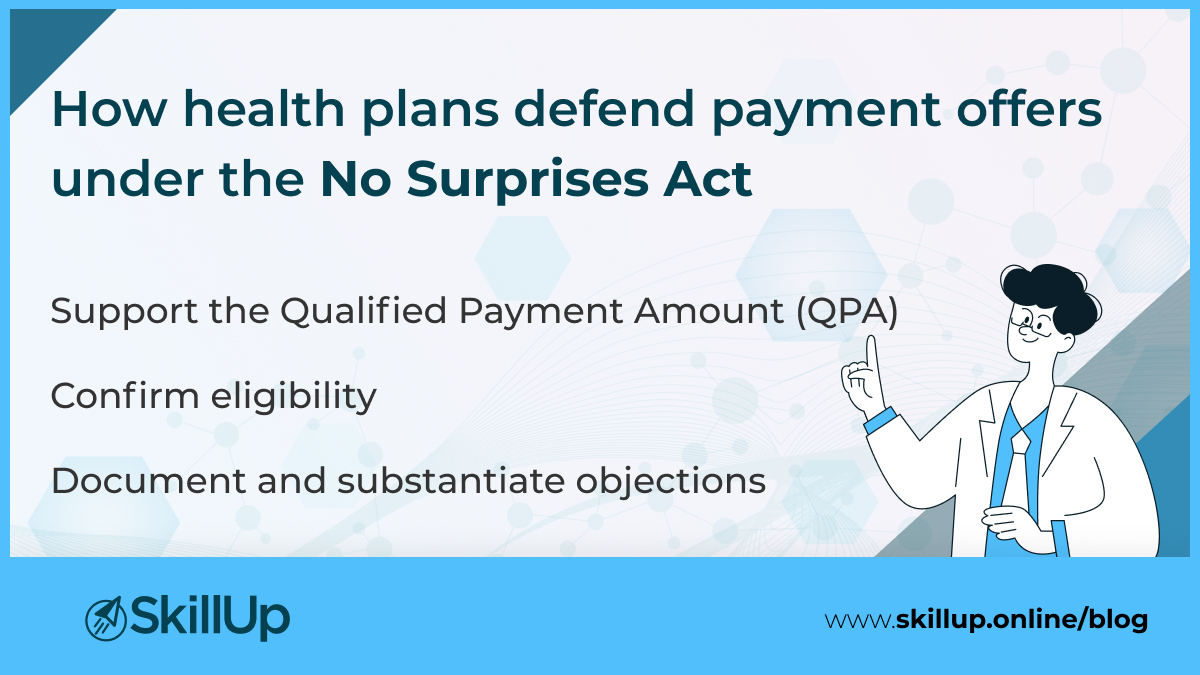
Health plans are often the non-initiating party in the Open Negotiation Period and IDR process and must defend their calculated QPA for the items or services rendered. To support their offered payment amount, health plans must submit documentation that details and supports their Circumstances or Factors for Qualified Items and Services.
Health plans can also file objections to the IDR process, based on:
(1) Receipt of notice or timely initiation of the Open Negotiation Period and IDR process.
(2) The disputed items or services being ineligible for the Federal NSA process. This can be based on the type of item or service provided or the network status of the provider or facility, or if the plan or service is subject to State law.
If the health plan files any objections to the IDR process, it must submit documentation that supports or is evidence of the objections made.
Conclusion
The Federal NSA IDR process is detailed, highly regulated, and documentation-driven.
Success for both providers and health plans depends on:

- Understanding each stage
- Submitting complete and timely documentation
- Following structured procedures with precision
A longstanding compliance truth applies here: “If it isn’t documented, it doesn’t exist.”
In the IDR process, an even stronger rule applies: “If it isn’t submitted, it doesn’t exist.”
For that reason, every provider and health plan must be fully informed and prepared to navigate the complexities of the NSA IDR process.

Compliance Training Expert
SkillUp