Financial analysts spend a significant part of their workday reviewing spreadsheets, preparing reports, comparing forecasts, and organizing information from multiple sources. Generative AI can assist with these tasks by helping finance teams prepare information and examine business questions more efficiently. However, its output still requires careful review.
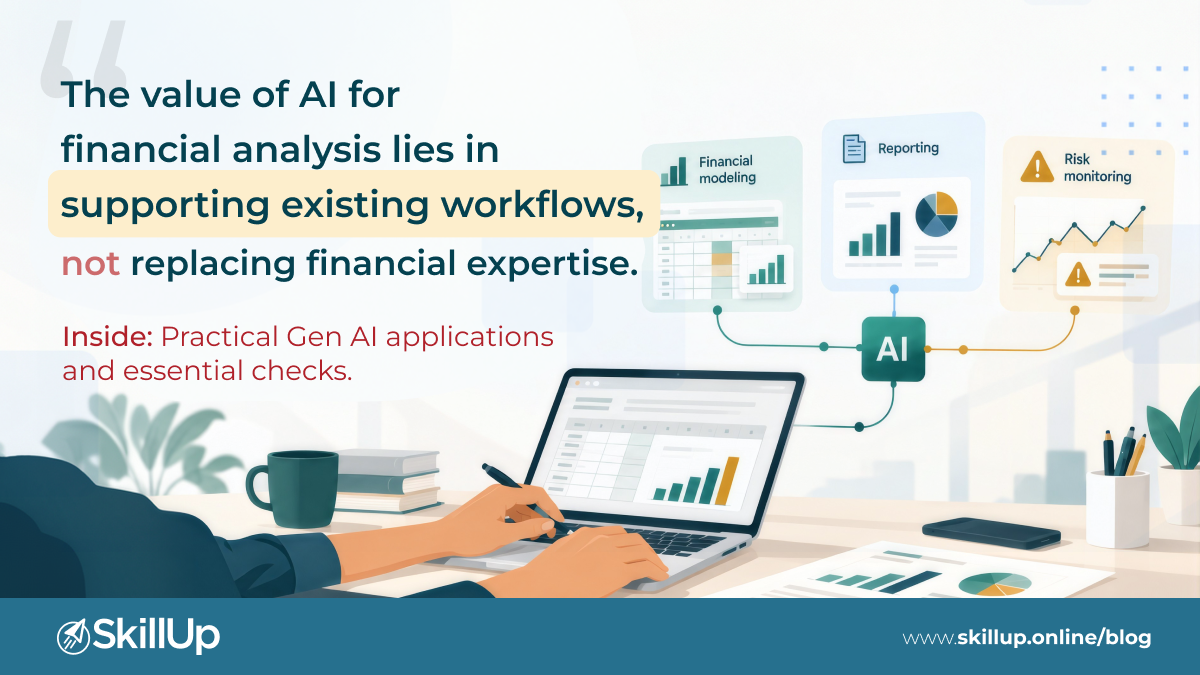
The value of AI for financial analysis lies in supporting existing workflows, not replacing financial expertise. Analysts can use AI tools to summarize lengthy reports, draft spreadsheet formulas, organize financial data, and prepare scenarios for review. Understanding how generative AI is used in financial analysis helps finance professionals identify suitable tasks while recognizing the limitations of AI-generated results.
For finance professionals in the United States, the priority is to use these tools responsibly while protecting confidential information and maintaining sound analytical practices. A practical approach starts with understanding where AI can help, how its output should be checked, and when human judgment remains essential.
Practical Applications of Generative AI in Financial Analysis
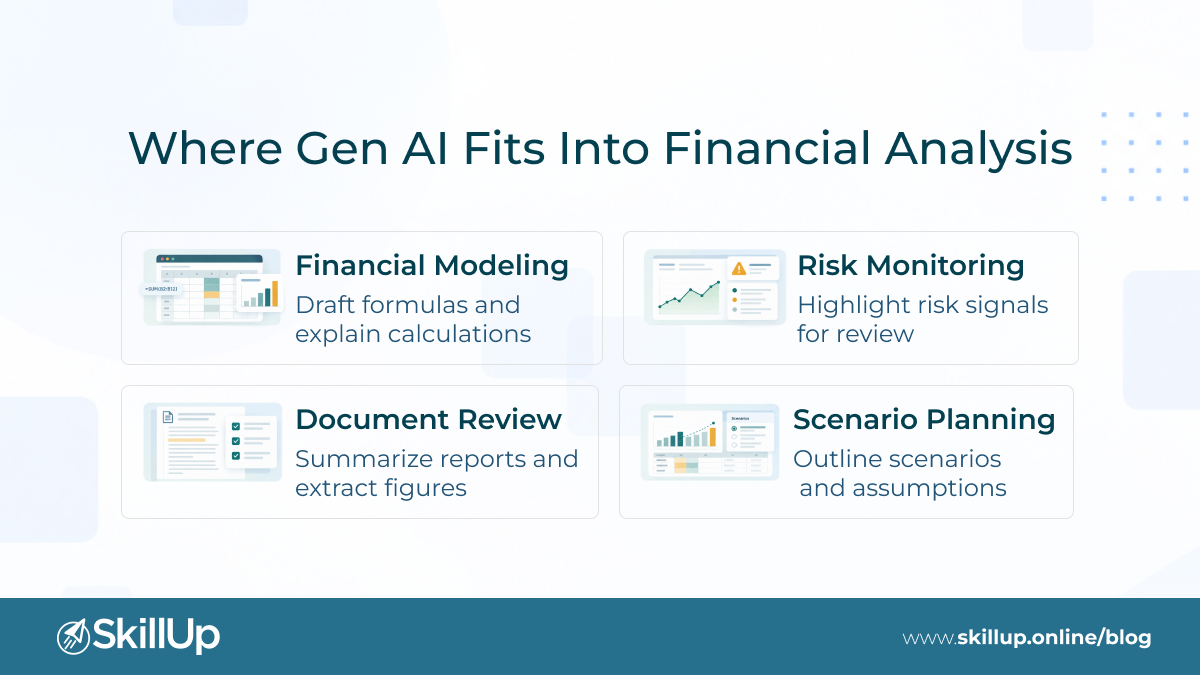
Generative AI can assist with routine tasks across financial planning, reporting, and research. These applications of AI for financial analysis are most useful when the task is clearly defined and the output can be checked against reliable financial information.
1. Supporting Financial Modeling
Financial modeling involves working with historical results, assumptions, and forecasts to estimate possible business outcomes. AI tools can help analysts draft Excel formulas, explain calculations, and organize the structure of a model.
An analyst building a discounted cash flow (DCF) model could ask a GenAI tool to draft a formula for calculating free cash flow or explain how changes in the discount rate affect a valuation. It can also suggest a structure for a three-statement model connecting the income statement, balance sheet, and cash flow statement.
These applications can support parts of the financial modeling process, but analysts must verify formulas, assumptions, cell references, and relationships between financial statements. AI-generated calculations should not be accepted without testing, and any valuation must be based on appropriate data and defensible assumptions.
2. Extracting Information from Financial Documents
Financial analysis often requires reviewing SEC filings, earnings, call transcripts, annual reports, and market research. Finding relevant information across these sources can take considerable time.
GenAI can summarize documents, organize key figures into tables, and identify statements related to revenue growth, operating costs, capital expenditure, or management guidance. An analyst comparing quarterly earnings reports could use AI to prepare an initial summary of changes in revenue, margins, and business outlook.
The analyst should verify extracted figures against the original documents, check reporting periods and units, and distinguish reported results from management estimates. This helps keep AI-assisted analysis grounded in source information rather than relying on an unverified summary.
3. Assisting With Risk Monitoring and Compliance
Risk monitoring requires finance teams to review financial exposures, changing assumptions, unusual transactions, and relevant regulatory developments. GenAI can support this work by summarizing risk reports, organizing findings, and helping teams investigate unusual patterns identified by existing systems.
A corporate finance team could use an AI tool to summarize changes in supplier payment terms or organize information about currency exposure across business units. It could also help prepare compliance documentation or summarize relevant policy updates for further review.
However, GenAI should not be treated as a standalone risk detection system. Effective risk monitoring still depends on reliable data, established controls, and appropriate analytical tools. Finance professionals must verify potential issues before taking action, particularly when handling sensitive information or making compliance decisions.
How AI Can Improve Financial Analysis Workflows
Understanding how AI can improve financial analysis starts with identifying tasks where the technology can provide practical support. The benefits depend on the quality of the inputs, the tools being used, and the safeguards in place. AI should complement existing financial processes rather than replace established controls.
Less Time Spent on Routine Preparation
Analysts often prepare recurring reports, reconcile information from different sources, and draft explanations for financial variances. GenAI can help create first drafts, summarize supporting documents, and organize information before an analyst completes the review.
An FP&A manager preparing a monthly performance report could use AI to draft explanations for differences between actual spending and budgeted amounts. The manager would still need to confirm the figures, investigate the underlying causes, and approve the final commentary.
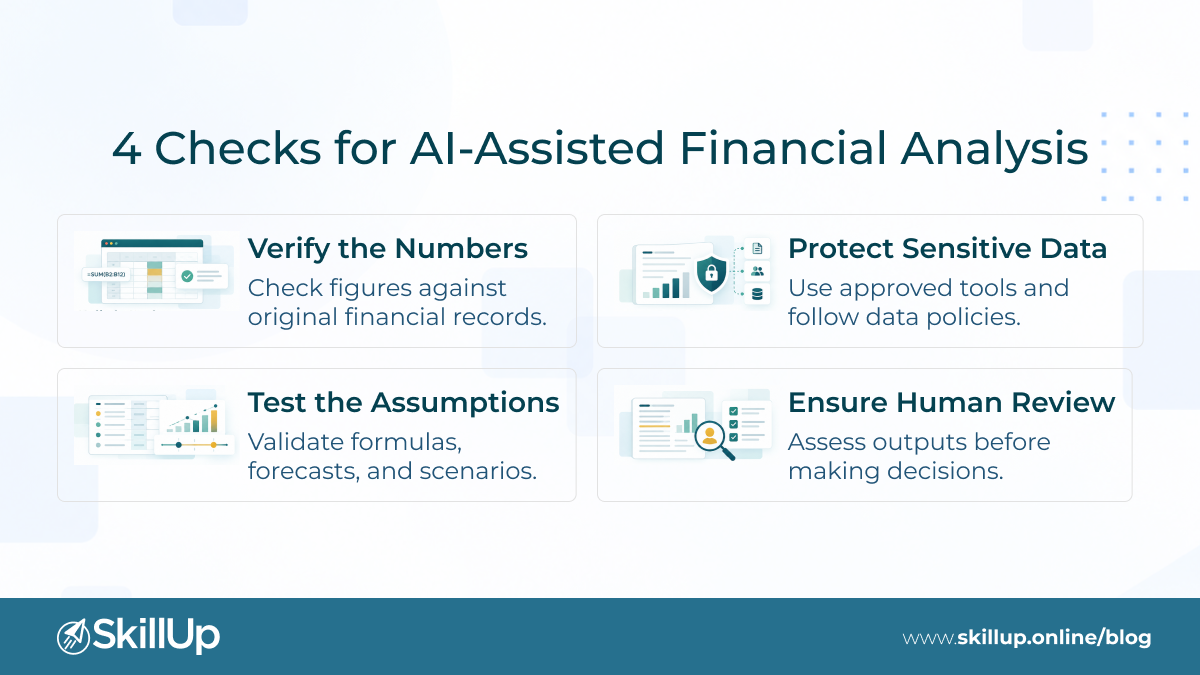
Finance professionals can use AI to prepare reports and organize information, while remaining responsible for verifying the analysis and approving the final report.
More Structured Scenario Planning
Scenario planning helps finance teams understand how changes in business assumptions may affect forecasts. GenAI can suggest relevant variables, outline alternative scenarios, and help analysts document the assumptions behind each case.
A finance professional evaluating a proposed expansion might ask an AI tool to outline scenarios involving different sales growth rates, operating costs, or financing expenses. The analyst can then test these assumptions within a spreadsheet or established financial model.
The calculations should be performed and validated using appropriate analytical tools. AI-generated assumptions are not forecasts by themselves, and scenario outputs should not be interpreted as predictions of what will happen.
Additional Checks During Review
AI-assisted workflows may help analysts identify inconsistencies that deserve further investigation. A tool could compare report summaries, flag missing explanations in a variance report, or help draft checks for unusual general ledger entries.
These checks can complement existing controls, but they do not guarantee that errors will be detected. Finance teams should test the process, verify flagged issues, and retain established reconciliation and audit procedures. This is especially important when using AI for financial analysis in reporting or other workflows where errors could affect business decisions.
Building Practical AI Skills for Finance Professionals
Using AI effectively requires more than knowing how to write a prompt. Finance professionals need to frame tasks clearly, provide appropriate context, evaluate outputs, and recognize when a tool is unsuitable for the work.
Practical AI skills for finance include writing clear prompts, reviewing AI-generated financial summaries, checking calculations, and understanding data privacy requirements. Professionals should also know when to use established spreadsheet functions, financial systems, or specialist tools instead of a generative AI model.
SkillUp Online’s Generative AI for Financial Professionals Program covers prompt engineering for finance, custom AI financial assistants, and case studies related to financial workflows. These topics provide a structured starting point for practicing AI-assisted tasks while considering their limitations.

A Practical Approach to AI for Financial Analysis
The most useful applications of AI for financial analysis are those that address specific workflow needs without weakening financial controls. GenAI can help professionals organize information, draft formulas, summarize documents, and prepare scenarios for review. Its output must still be checked against reliable data and established analytical methods.
Finance teams can start with clearly defined, low-risk tasks, review the results, and assess whether the tools provide meaningful support. Keeping human validation, data protection, and professional judgment at the center allows organizations to evaluate AI adoption without assuming that the technology automatically improves accuracy or decision-making.
Frequently Asked Questions
1. Do financial analysts need coding skills to use Generative AI?
No. Many GenAI tools accept natural-language instructions, allowing analysts to request summaries, draft formulas, and organize information without coding. Advanced automation may require programming skills.
2. How do AI tools protect sensitive corporate financial data?
Protection depends on the provider, product settings, and organizational controls. Finance teams should check data retention, encryption, access permissions, and model-training policies. They should use employer-approved tools and follow internal data security requirements. SOC 2 reports can also help assess a provider’s security controls.

SkillUp Online